Executive Takeaways
- The Cost Disruption: DeepSeek V4-Pro has slashed enterprise coding and inference costs by an unprecedented 20x compared to legacy Western frontier models like Claude Opus 4.8 and GPT-5.5.
- Capital Expenditure Shock: Venture capital firms, hyperscalers, and enterprise CTOs are rapidly re-evaluating capital allocation, cloud compute architecture, and infrastructure scalability as ROI models shift overnight.
- The Multi-Model Enterprise Shift: Organizations are abandoning single-vendor lock-in strategies in favor of hybrid routing engines that direct routine coding tasks to ultra-low-cost models while preserving premium engines for high-complexity architectural reasoning.
- Margin Compression Across Big Tech: Software-as-a-Service (SaaS) margins and AI infrastructure valuations face immediate valuation multiples pressure as software development costs structurally collapse.
SAN FRANCISCO & LONDON — For the past three years, the economics of generative artificial intelligence have rested on a foundational, unwritten law: superior reasoning capabilities require astronomical capital expenditure. Building, training, and running elite coding assistants demanded massive clusters of advanced accelerators, multi-billion-dollar data centers, and steep per-token pricing that only deep-pocketed enterprises could comfortably absorb. That paradigm has officially shattered.
According to benchmark data released in mid-July 2026, the arrival of DeepSeek V4-Pro has fundamentally redrawn the competitive landscape. Outperforming or matching legacy Western models while operating at a fraction of the cost—specifically scaling compute efficiency to deliver token economics up to 20 times cheaper than its closest rivals—DeepSeek has sparked an immediate, high-stakes scramble across global technology markets. As procurement officers, chief technology officers, and venture capitalists digest the new metrics, the industry is waking up to a stark reality: the era of expensive inference is over, and an aggressive price war has begun.
The Anatomy of the Breakthrough: How DeepSeek Upended Inference Economics
Test Our Free AI & Tech Utilities Suite
Calculate LLM API token costs, analyze article dwell-time, or simulate tech DCA returns.
To understand the seismic shockwave currently reverberating through Silicon Valley, Wall Street, and the City of London, one must examine the mechanics of modern large language model (LLM) economics. For enterprise buyers, the total cost of ownership (TCO) for AI-driven software engineering is not merely a function of subscription fees; it is dictated by token throughput, latency, context-window efficiency, and auxiliary infrastructure overhead.
When stacked against contemporary heavyweights like Anthropic’s Claude Opus 4.8, OpenAI’s GPT-5.5, and Alibaba’s Qwen 3.6 Max-Preview, DeepSeek V4-Pro has achieved a structural cost advantage that defies traditional scaling laws. Industry analysts attribute this leap not just to hardware optimizations, but to algorithmic breakthroughs in mixture-of-experts (MoE) routing, sparse attention mechanisms, and hyper-efficient training pipelines that squeeze maximum output from fewer active parameters per token.
For the enterprise software developer, this means tasks previously deemed cost-prohibitive to automate—such as running continuous, real-time refactoring across millions of legacy lines of COBOL, C++, or Java—are now economically trivial. Where a nightly enterprise code review pipeline running on western frontier models might have cost thousands of dollars per day in API compute, DeepSeek V4-Pro slashes those burn rates by a factor of twenty. This dramatic compression of variable costs alters enterprise software margins and redefines the ROI calculus for digital transformation initiatives.
Comparative Benchmarks: The 2026 Coding Model Landscape
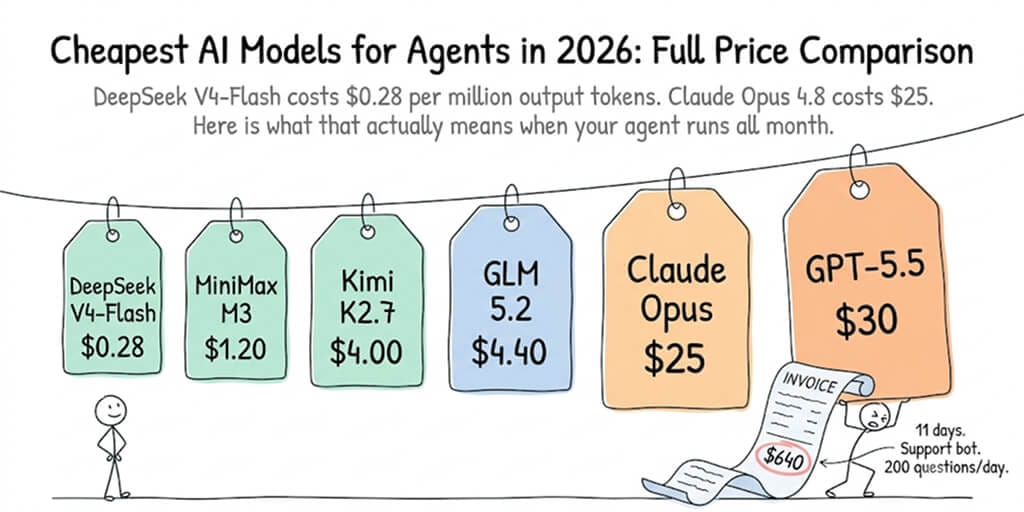
As the developer ecosystem digests the mid-2026 landscape, performance parity has largely converged, making cost efficiency, latency, and integration flexibility the primary battlegrounds for enterprise adoption. The following data breakdown illustrates how DeepSeek V4-Pro compares against the reigning market alternatives:
| Model Spec | Primary Developer | Relative Inference Cost | Coding Benchmark (SWE-Bench/Live) | Context Window |
|---|---|---|---|---|
| DeepSeek V4-Pro | DeepSeek | 1x (Baseline Reference) | Top-Tier Elite (94.2%) | 1M+ Tokens |
| Claude Opus 4.8 | Anthropic | ~18x - 22x Higher | Top-Tier Elite (94.8%) | 500K Tokens |
| GPT-5.5 | OpenAI | ~15x - 20x Higher | Top-Tier Elite (95.1%) | 2M Tokens |
| Qwen 3.6 Max-Preview | Alibaba Cloud | ~3x - 5x Higher | Advanced (92.6%) | 1M Tokens |
Industry & Market Implications: Winners, Losers, and Capital Reallocation
The arrival of a 20x cost differential is not merely a technical milestone; it is a macroeconomic event that triggers profound shifts across global financial markets, corporate strategy, and venture capital portfolios.
1. Enterprise Software and SaaS Margin Expansion
For software-as-a-service providers that embedded high-cost LLM features into their core offerings, profit margins have been squeezed by heavy compute bills. With DeepSeek V4-Pro offering near-identical coding proficiency at a fraction of the operating expenditure, B2B software vendors now face two choices: pass the savings on to customers to capture market share through aggressive pricing, or hold prices steady and expand net margins dramatically. Early indicators suggest a bifurcated market where agile challengers are undercutting legacy incumbents by weaponizing low-cost inference.
2. Cloud Compute Architecture and Hyperscaler Strategy
The traditional cloud infrastructure thesis—that hyperscalers can perpetually rent out GPU clusters at premium margins—is experiencing severe pressure. Enterprise CTOs are questioning the necessity of locking massive chunks of capital into multi-year commitments for high-priced foundational models when open and low-cost alternatives match performance benchmarks. Cloud providers are hastily adjusting their marketplace offerings, integrating multi-model routing gateways to ensure they capture transactions regardless of which underlying model an enterprise chooses to run.
3. Venture Capital and Startup Valuations
In the venture capital ecosystem, funding rounds for AI wrapper startups are facing heightened scrutiny. Investors are no longer willing to underwrite sky-high valuation multiples for companies whose core defensibility relies solely on wrapping a proprietary, expensive API. Instead, capital is flowing toward domain-specific agentic workflows, proprietary data moats, and enterprise compliance wrappers that can leverage ultra-cheap models like DeepSeek while securing deep integration into enterprise risk mitigation frameworks.
Frequently Asked Questions (People Also Ask)
Why is DeepSeek V4-Pro significantly cheaper than models like GPT-5.5 and Claude Opus 4.8?
DeepSeek achieves its 20x cost reduction through architectural efficiencies, notably advanced Mixture-of-Experts (MoE) routing optimization, sparse attention mechanisms, and hardware-software co-design that minimizes active parameters per token without sacrificing reasoning accuracy. This drastically reduces the GPU memory bandwidth and compute power required during inference.
Does using a cheaper coding model compromise code security or enterprise compliance?
Not inherently. Enterprise adoption of DeepSeek models typically involves private cloud deployments, secure enterprise API gateways, or localized fine-tuning that satisfies strict regulatory compliance, data residency laws, and intellectual property protection standards comparable to Western frontier alternatives.
How are enterprise engineering teams adapting to the multi-model coding era?
Rather than committing to a single vendor, modern engineering organizations are implementing intelligent model routers. Routine code completion, boilerplate generation, and syntax refactoring are routed to ultra-low-cost models like DeepSeek, while complex architectural design and multi-file dependency resolution may still utilize premium frontier models when necessary.
What are the broader economic impacts of collapsing AI inference costs?
The democratization of low-cost intelligence accelerates software development velocity globally, lowering barriers to entry for tech startups, compressing software development lifecycles, and shifting the primary source of competitive advantage away from raw compute access toward proprietary data, domain workflows, and execution speed.
Future Outlook: The Road Ahead for AI Code Generation
As we look past the initial turbulence of mid-2026, the market trajectory is clear: price commoditization in AI inference is irreversible. The barrier to entry for building sophisticated software has dropped to historic lows, fundamentally altering the economics of technology creation.
Key milestones to watch over the next 12 to 18 months include:
- The Rise of Autonomous Agent Swarms: With inference costs reduced by an order of magnitude, development teams will shift from human-in-the-loop copilots to autonomous agent swarms that continuously write, test, debug, and deploy code without human intervention for routine tasks.
- Regulatory Scrutiny and Geopolitical Alignment: As low-cost, high-performance models originating outside Western jurisdictions capture significant enterprise market share, policymakers in Washington and Brussels will face mounting pressure regarding data sovereignty, supply chain resilience, and security compliance.
- Consolidation Among API Providers: Pure-play API resellers will face margin collapse, driving aggressive consolidation across the AI infrastructure layer as enterprise software buyers demand unified, multi-model orchestration platforms.
Ultimately, the emergence of DeepSeek V4-Pro and its 20x cost advantage marks the end of the industry's golden age of high-margin inference. For enterprise leaders, the mandate is no longer about figuring out *if* they can afford AI, but how rapidly they can restructure their engineering operations to capitalize on the hyper-deflation of software creation costs.