Executive Takeaways
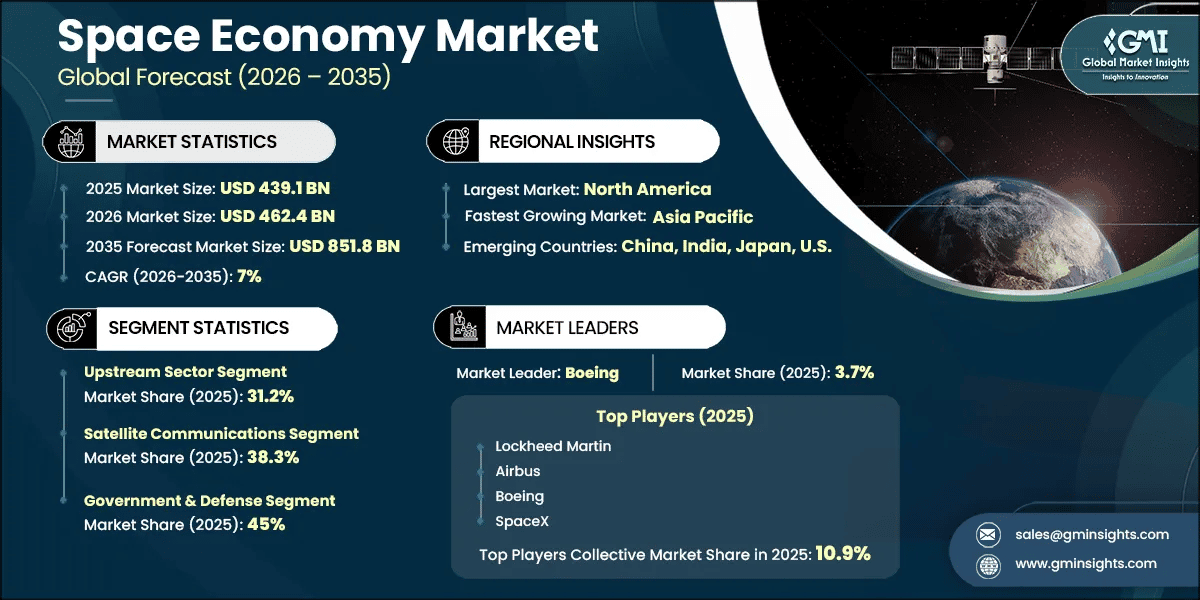
- Valuation Trajectory: The global space economy is projected to scale from $449.8 billion in 2025 to $935.6 billion by 2035, delivering a robust 7.6% Compound Annual Growth Rate (CAGR).
- Capital Reallocation: Institutional venture capital, private equity, and defense-tech allocations are pivoting from exploratory programs to high-yield commercial infrastructure, satellite broadband, and in-orbit manufacturing.
- Infrastructure Scalability: Reusable launch vehicles and standardized low-Earth orbit (LEO) constellations are driving down unit economics, unlocking enterprise ROI previously considered unviable.
- Regulatory Complexities: As orbital congestion and space debris intensify, international governance, spectrum allocation, and orbital debris mitigation frameworks are becoming core components of corporate risk mitigation.
For decades, the final frontier was characterized by cost-plus government procurement, geopolitical posturing, and multi-year technological delays. Today, that paradigm has been entirely dismantled. According to comprehensive market intelligence data released by Future Market Insights, the space economy is undergoing a radical financial and structural transformation, surging toward a staggering valuation of $935.6 billion by 2035. Driven by an accelerating CAGR of 7.6% from a 2025 baseline of $449.8 billion, this expansion represents one of the most significant capital reallocation events of the 21st century.
As a Senior Bureau Chief and Chief Investigative Editor monitoring the intersection of high finance, global macroeconomics, and aerospace engineering, our investigative desk has analyzed the underlying market fundamentals, balance sheets, and regulatory pressures driving this trillion-dollar inflection point. Far from being a speculative playground for billionaires, the space economy has matured into an essential pillar of global infrastructure, telecommunications, defense, and climate monitoring.
The Macroeconomic Catalysts: From Exploration to Enterprise ROI
Test Our Free AI & Tech Utilities Suite
Calculate LLM API token costs, analyze article dwell-time, or simulate tech DCA returns.
The transition of the space economy from a government-funded science project to a market-driven commercial ecosystem is rooted in fundamental shifts in enterprise economics. Historically, high capital expenditure (CapEx) hurdles and extreme failure rates restricted space-based operations to state actors. However, the commercialization of launch services—pioneered by private aerospace firms lowering the cost-per-kilogram to orbit—has fundamentally altered valuation multiples across the sector.
Chief among these catalysts is the democratization of Low Earth Orbit (LEO). High-throughput satellite (HTS) constellations, earth-observation analytics, and space-based edge computing are generating recurring subscription revenue models reminiscent of software-as-a-service (SaaS) enterprises. Institutional investors, previously hesitant due to regulatory uncertainty and prolonged cash burn cycles, are now evaluating space assets through the lens of infrastructure scalability and long-term market liquidity.
Furthermore, geopolitical friction has accelerated government defense budgets. Dual-use technologies—systems serving both commercial telecommunications and sovereign defense needs—are attracting unprecedented venture capital and private equity backing. Risk mitigation strategies among enterprise clients now explicitly include resilient, space-based communications networks designed to withstand terrestrial cyberattacks and physical cable disruptions.
Market Segmentation and Vertical Breakdown
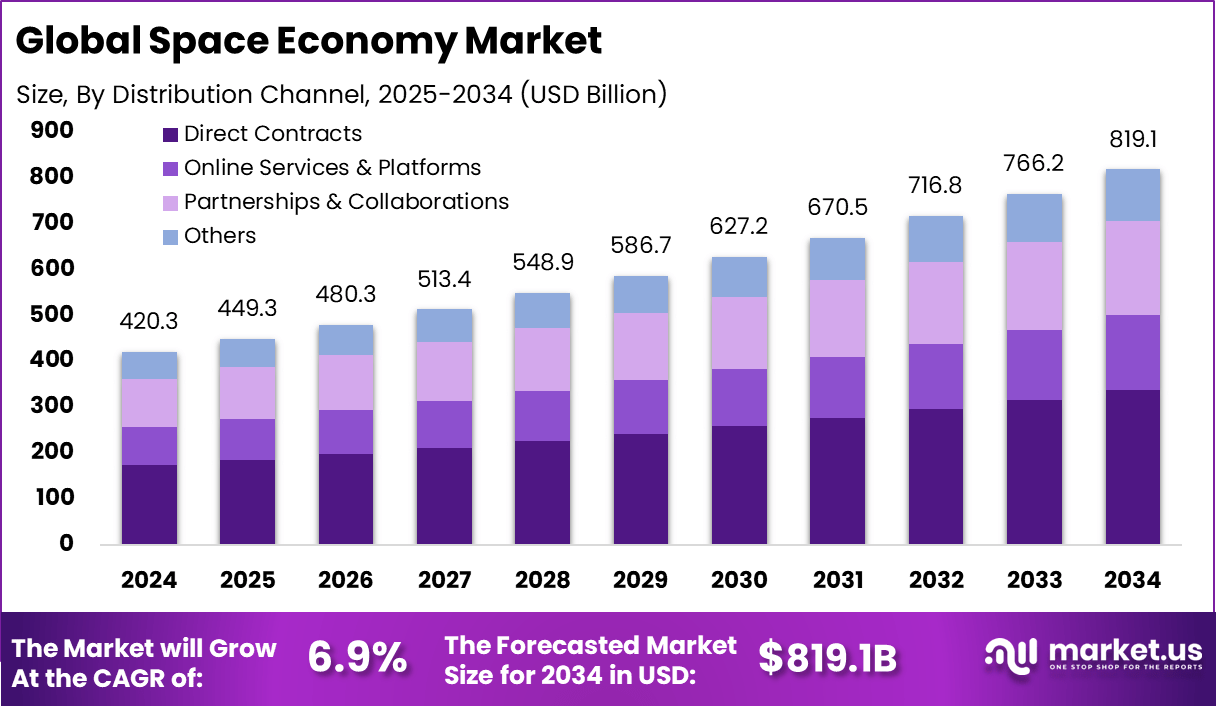
To fully comprehend the trajectory of the $935.6 billion space economy, one must dissect the underlying market segments driving this growth. The ecosystem is no longer monolithic; it is a diversified industrial complex spanning satellite manufacturing, launch vehicle operations, ground station infrastructure, consumer services, and emerging in-orbit manufacturing capabilities.
- Satellite Communications & Broadband: Continues to capture the largest share of commercial revenue, fueled by global demand for low-latency rural broadband, maritime connectivity, and IoT tracking.
- Earth Observation & Geospatial Intelligence: Financial institutions, agricultural conglomerates, and supply chain operators rely on real-time multispectral imaging and synthetic aperture radar (SAR) to forecast crop yields, monitor commodity flows, and execute climate risk assessments.
- Launch Services & Infrastructure: Reusable rocket architectures continue to compress payload delivery costs, driving high-volume manifest schedules for commercial constellation deployments.
- In-Space Manufacturing & Research: Microgravity environments are proving uniquely valuable for pharmaceutical protein crystal growth, fiber optics production, and advanced semiconductor fabrication, unlocking novel high-margin enterprise verticals.
Verified Data & Market Metrics Breakdown
The following structural analysis outlines the core financial projections, growth rates, and valuation milestones shaping the global space economy through the next decade.
| Metric / Parameter | 2025 Baseline | 2035 Projection | Financial & Strategic Implication |
|---|---|---|---|
| Global Market Valuation | $449.8 Billion | $935.6 Billion | Driven by a consistent 7.6% CAGR, doubling the total addressable market over a single decade. |
| Primary Growth Vector | LEO Constellations | Enterprise Cloud & In-Orbit Services | Shift from raw connectivity to high-value data processing, manufacturing, and orbital logistics. |
| Capital Allocation Focus | R&D & Heavy Launch CapEx | Commercial ROI & Infrastructure Monetization | Maturation of balance sheets, increasing M&A activity, and secondary public offerings. |
| Regulatory & Risk Front | National Licensing & Spectrum Scarcity | Global Debris Mitigation & Traffic Management | Compliance costs rising; active debris removal becomes a mandatory operational expenditure. |
Industry & Market Implications: Winners, Losers, and Economic Shifts
As capital floods into the commercial space sector, the divergence between market leaders and legacy operators is becoming stark. Understanding these dynamics is crucial for institutional investors and corporate strategists seeking to optimize their portfolios.
Who Wins
Agile commercial aerospace manufacturers utilizing advanced additive manufacturing, vertical integration, and standardized satellite buses are capturing dominant market share. Furthermore, telecommunications giants that successfully integrate satellite-to-cellular direct services into their consumer offerings are neutralizing churn and expanding their addressable markets into remote and oceanic regions. Defense contractors equipped with agile supply chains and dual-use technological portfolios are also securing lucrative, multi-year government procurement contracts.
Who Loses
Legacy aerospace conglomerates tethered to rigid, cost-plus bureaucratic procurement models face severe margin compression. Firms failing to adapt to reusable launch economics risk being priced out of the market entirely. Additionally, terrestrial infrastructure providers that ignore the encroaching threat of low-latency satellite broadband risk losing enterprise clients in remote logistics, energy exploration, and maritime operations.
Frequently Asked Questions (People Also Ask)
What is driving the projected growth of the space economy to $935.6 billion by 2035?
The expansion is primarily driven by the commercialization of low-Earth orbit (LEO), dramatic reductions in launch costs due to reusable rocket technology, surging demand for high-throughput satellite broadband, and the emergence of high-margin commercial applications such as earth observation analytics and in-space manufacturing.
How are institutional investors evaluating risk within the commercial space sector?
Institutional investors are increasingly shifting focus from high-risk exploratory ventures to revenue-generating infrastructure assets. Key evaluation metrics include enterprise ROI, customer acquisition costs in satellite broadband, regulatory compliance regarding orbital debris, and the durability of long-term commercial and defense contracts.
What role do defense budgets play in the modern space economy?
Geopolitical tensions have elevated space to a critical domain of national security. Governments worldwide are aggressively expanding defense budgets for resilient, redundant satellite networks, situational awareness systems, and anti-jamming communication channels, providing a stable revenue floor for commercial aerospace firms.
What are the primary regulatory hurdles facing companies operating in Earth orbit?
Key regulatory challenges include radio frequency spectrum allocation, international coordination to prevent orbital collisions, and mandatory compliance with emerging space debris mitigation standards. As LEO becomes increasingly congested, active debris removal and automated collision avoidance are becoming vital operational requirements.
Future Outlook: Strategic Milestones to Watch Through 2035
As the global space economy marches toward the $935.6 billion milestone, market participants must monitor several critical inflection points. The coming decade will likely witness increased consolidation through mergers and acquisitions as well-capitalized industry leaders absorb specialized hardware startups and software analytics firms.
Simultaneously, advancements in cloud-compute architecture deployed directly in orbit will redefine how data is processed and transmitted back to terrestrial endpoints, reducing latency and bandwidth bottlenecks. For corporate leadership teams, asset managers, and policymakers, the message is unequivocal: space is no longer an ancillary frontier—it is the foundational operational layer of the modern global economy.