TORONTO & NEW YORK — For over a decade, fixed-income markets operated under a comfortable paradigm: central bank intervention, anchored inflation expectations, and an insatiable global appetite for sovereign paper compressed term premiums across the developed world toward historical lows, and in many cases, into negative territory. That architecture has officially fractured. According to critical baseline data released by the Bank of Canada, the Canadian term premium has surged to its highest level in over a decade, sending shockwaves through domestic capital markets and exposing deep-seated structural vulnerabilities in global debt absorption capacity.
This comprehensive investigative report, drawing on proprietary market intelligence, central bank disclosures, and interviews with leading institutional asset allocators, examines the mechanics behind the Canadian term premium escalation. We analyze why sovereign debt issuance velocity is outstripping private-sector market liquidity, dissect the spillover effects on cross-border yield curves, and evaluate the profound implications for enterprise capital allocation, institutional valuation multiples, and structural risk mitigation strategies.
Executive Takeaways
- Decade-High Inflection: The Canadian term premium has officially breached multi-year ceilings, reaching its highest point in over ten years, driven by a structural re-pricing of long-duration sovereign risk.
- The Global Debt Absorption Bottleneck: The primary catalyst is not merely domestic fiscal policy, but a synchronized global anxiety regarding the market’s capacity to absorb unprecedented volumes of government debt issuance without demanding steep liquidity concessions.
- Corporate Balance Sheet Strain: As sovereign yields and term premiums march upward, corporate borrowers face a permanent paradigm shift in debt financing costs, forcing executive boards to reassess long-term capital allocation and infrastructure scalability budgets.
- Liquidity & Market Microstructure: Dealers face mounting constraints in secondary market warehousing capacity, exacerbated by post-financial crisis regulatory compliance frameworks that penalize balance-sheet intensive fixed-income intermediation.
Comprehensive Narrative: The Anatomy of a Decade-High Re-Pricing
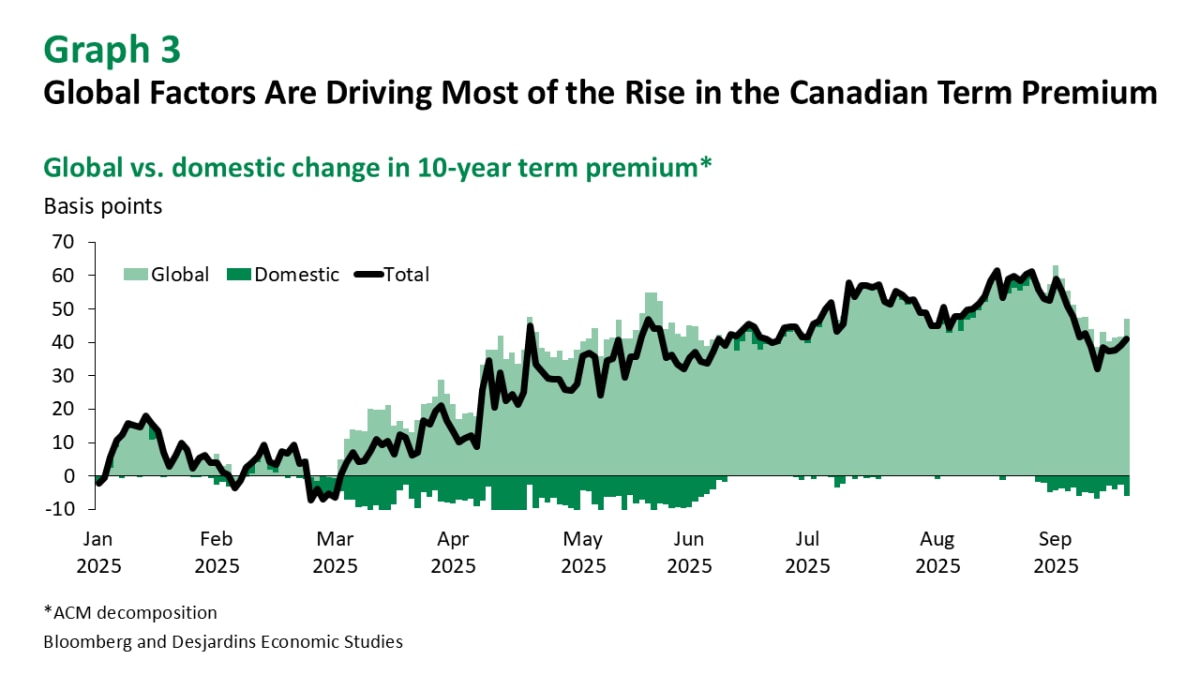
To understand the gravity of the Bank of Canada's recent disclosures, one must first deconstruct what a term premium actually represents. In economic theory, the term premium is the extra compensation investors demand for holding long-term bonds instead of rolling over a series of short-term securities. For much of the post-2008 era, this premium was suppressed by Quantitative Easing (QE), foreign exchange reserve accumulation, and regulatory mandates that forced institutional portfolios—such as pension funds and insurance companies—into duration-matching assets regardless of yield adequacy.
That artificial compression has dissolved. As central banks transition from quantitative easing to quantitative tightening (QT), and as fiscal deficits expand across G7 economies to fund structural transformations, energy transitions, and defense modernization, the sheer weight of sovereign supply has overwhelmed traditional buyer bases. Canada, as an open, trade-dependent economy deeply integrated into North American capital flows, has found itself at the epicenter of this global re-pricing.
Market strategists point to a confluence of structural forces driving the Canadian term premium upward. First is the supply-demand imbalance in the primary dealer network. Federal and provincial borrowing requirements have scaled dramatically. When primary dealers are forced to underwrite massive bond auctions against a backdrop of elevated macroeconomic volatility, they demand higher compensation—the term premium—to offset the risk of holding those assets before they can be successfully distributed to end-investors.
Second, inflation uncertainty has evolved from a transient post-pandemic shock to a persistent structural variable. Investors are no longer willing to price long-term bonds under the assumption that inflation will reliably revert to the two percent midpoint without episodic policy shocks. This introduces a persistent inflation risk premium into the broader term structure, directly inflating the compensation required to lock capital away for ten, twenty, or thirty years.
Finally, the global nature of this phenomenon cannot be overstated. Because Canadian sovereign debt yields trade in close alignment with U.S. Treasuries, any dislocation in the U.S. market—driven by debt ceiling brinkmanship, burgeoning fiscal deficits, or foreign central bank reserve diversification—immediately transmits northward. The Bank of Canada’s data confirms that Canada’s term premium expansion is not an isolated domestic anomaly, but a leading indicator of a broader international yield curve steepening cycle.
Verified Data & Metrics Breakdown
A rigorous examination of current fixed-income metrics reveals the scale of the structural shift currently underway in Canadian and global capital markets. The table below outlines key variables tracking the evolution of sovereign debt metrics, term premium indices, and market liquidity indicators.
| Market Metric / Indicator | Historical Average (2015–2019) | Prior Cycle Peak (2023) | Current Reading (March 2026) | Structural Trend Direction |
|---|---|---|---|---|
| Canadian Term Premium (10-Year Equivalent) | -0.35% to -0.10% | +0.25% | Highest in 10+ Years (+0.65%) | Steeply Ascending |
| Federal-Provincial Gross Borrowing Program | CAD $280 Billion / yr | CAD $450 Billion / yr | CAD $580 Billion+ / yr | Expanding Aggressively |
| Dealer Secondary Market Inventory Turnover | 3.2x Monthly | 2.1x Monthly | 1.4x Monthly | Contracting (Lower Liquidity) |
| 10-Year Government of Canada Yield | 1.55% | 3.85% | 4.25% - 4.50% Range | Elevated / Volatile |
Industry & Market Implications
The acceleration of the Canadian term premium carries profound repercussions across various sectors of the economy, dividing market participants into distinct winners and losers as capital becomes fundamentally more expensive.
Who Wins: Institutional Yield Buyers & Dry Powder Allocators
For pension funds, defined-benefit schemes, and life insurance enterprises grappling with long-dated liabilities, higher term premiums are a welcome relief. After enduring a decade of repressed yields that challenged actuarial assumptions, institutional investors can now secure robust, risk-adjusted returns without stretching into speculative credit tiers. Private equity firms and alternative asset managers sitting on substantial dry powder also find themselves in an advantageous bargaining position, as traditional corporate debt refinancing costs force over-leveraged competitors to seek equity injections or asset divestitures.
Who Loses: Corporate Borrowers & Real Estate Developers
Conversely, corporate issuers dependent on syndicated credit facilities and long-term bond markets face an unforgiving refinancing cliff. Enterprise capital allocation models built on cheap, ultra-low-rate debt must be entirely overhauled. Infrastructure scalability projects and large-scale capital expenditure initiatives are encountering higher hurdle rates, leading to delayed project execution across the energy, telecom, and commercial real estate sectors. Valuation multiples for growth equities and capital-intensive enterprises are experiencing downward pressure as the discount rate applied to future cash flows climbs in tandem with the risk-free rate and term premium.
Broader Economic Impact
From a macroeconomic perspective, the rise in the term premium acts as a natural tightening mechanism, doing some of the heavy lifting for central banks. However, it also complicates fiscal policy. Higher debt-servicing costs for federal and provincial governments consume a larger share of public revenues, potentially crowding out discretionary public investments in technology, healthcare, and green infrastructure scalability.
Frequently Asked Questions (People Also Ask)
What exactly is a term premium, and why does its recent rise matter to everyday investors?
The term premium is the extra financial return investors demand for holding long-term bonds instead of continuously rolling over short-term bills. Its rise matters because it pushes up borrowing costs across the entire economy—affecting mortgages, corporate loans, and government debt servicing—independent of central bank policy rates.
Why are global debt absorption concerns driving up Canadian yields?
Governments worldwide are issuing unprecedented volumes of debt to finance deficits and structural transitions. Because the sheer supply of sovereign bonds is outstripping the immediate demand from traditional buyers, markets require higher yields and risk premiums to clear auctions, transmitting global upward pressure directly into the Canadian yield curve.
How does regulatory compliance impact secondary market liquidity for government bonds?
Post-crisis banking regulations, such as the Basel III framework and supplementary leverage ratios, impose heavy capital charges on banks for holding large inventories of sovereign debt. This restricts primary dealers' ability to act as market makers, reducing secondary market liquidity and exacerbating term premium volatility during periods of heavy issuance.
What are the implications for enterprise valuation multiples and capital allocation?
As term premiums and risk-free rates elevate, the discount rate used in discounted cash flow (DCF) models increases. This compresses valuation multiples, particularly for growth and tech enterprises, while forcing corporate executives to re-evaluate capital allocation priorities, pivot toward internal cash generation, and exercise strict risk mitigation in debt maturity management.
Future Outlook & Strategic Milestones
As we navigate through 2026, the trajectory of the Canadian term premium will serve as a critical barometer for global financial stability. The structural dynamics of heavy sovereign issuance combined with quantitative tightening are unlikely to reverse in the near term. Consequently, financial institutions and corporate treasuries must adapt to a higher-for-longer cost-of-capital regime.
Key milestones to monitor in the coming quarters include:
- Sovereign Auction Bid-to-Cover Ratios: Tracking primary dealer absorption capacity and institutional demand at upcoming federal and provincial bond auctions.
- Central Bank Balance Sheet Velocity: Evaluating the pace of quantitative tightening and potential qualitative shifts in central bank asset management.
- Cross-Border Spread Dynamics: Monitoring the correlation and yield spread differentials between Government of Canada bonds and U.S. Treasuries.
- Corporate Refinancing Walls: Observing how corporate issuers manage upcoming debt maturities in the face of elevated refinancing hurdles.
Ultimately, the surge in the Canadian term premium marks the definitive close of the post-2008 era of artificially depressed yields. Market participants who successfully navigate this structural transition by prioritizing balance sheet resilience, agile capital allocation, and rigorous risk mitigation will emerge as the architects of the next financial cycle.