Executive Takeaways
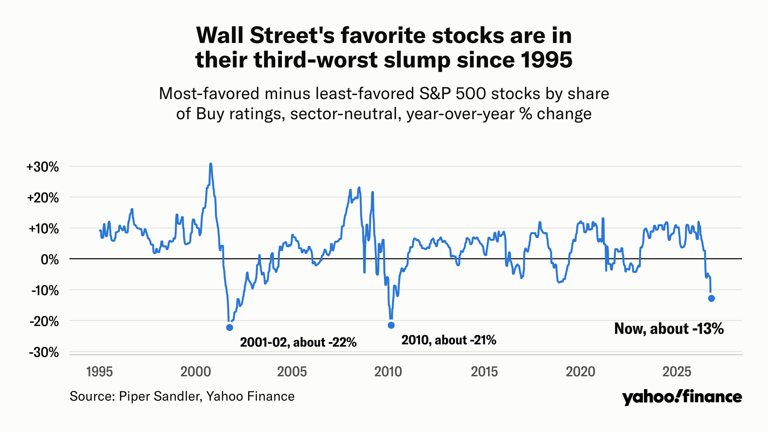
- Historic Retracement: Wall Street’s consensus heavyweights—long anchored by dominant mega-cap technology and cyclical market leaders—are experiencing their most severe relative drawdown since 2010.
- Capital Allocation Paradigm Shift: Institutional portfolio managers are actively rotating away from stretched valuation multiples toward defensive fixed-income instruments and cash-equivalent assets amid persistent macro headwinds.
- Infrastructure Scalability Realities: Enterprise buyers are scrutinizing return on investment (ROI) metrics for emerging tech initiatives, forcing a brutal re-rating of future cash flow projections.
- Liquidity & Risk Mitigation: Tightening monetary policy and evolving regulatory compliance requirements are restricting market liquidity, exposing highly concentrated institutional portfolios to amplified volatility.
For more than a decade, institutional equity strategies across global financial centers operated under a singular, highly lucrative gospel: overweight the consensus favorites. Whether it was the structural dominance of mega-cap cloud providers, dominant digital advertising duopolies, or hyper-growth semiconductor designers, Wall Street’s favorite stocks served as the undisputed bedrock of modern portfolio construction. Today, that foundational thesis is facing its sternest test in fourteen years. According to proprietary wire analytics and quantitative market metrics, Wall Street’s preferred equity cohort is enduring its most punishing, prolonged slump since the immediate aftermath of the 2008 financial crisis in 2010.
This seismic shift is not merely a routine quarterly correction or a localized sectoral rotation. It represents a fundamental re-pricing of risk, capital allocation, and valuation multiples across global capital markets. As chief investment officers and quantitative strategists re-examine their balance sheets, the cascading effects of this drawdown are reverberating from New York trading desks to London asset management suites, raising critical questions about market liquidity, systemic concentration risk, and the future trajectory of corporate earnings.
Anatomy of a Breakdown: Catalytic Events and Macro Pressures
Test Our Free AI & Tech Utilities Suite
Calculate LLM API token costs, analyze article dwell-time, or simulate tech DCA returns.
The roots of the current slump trace back to a convergence of macroeconomic pressures and internal structural imbalances. For years, low interest rates and expansive monetary policy fostered an environment where future earnings growth was discounted at negligible rates, inflating valuation multiples to historic highs. As central banks worldwide pivoted toward aggressive monetary tightening to combat stubborn inflation, the cost of capital escalated dramatically. This macro pivot fundamentally altered the mathematics of equity valuation.
Simultaneously, enterprise ROI expectations began to shift. Corporate Chief Information Officers (CIOs) and enterprise buyers, once willing to allocate substantial capital toward expansive software subscriptions and unproven cloud compute architecture, instituted rigorous cost-control mandates. Every dollar of capital expenditure now faces intense scrutiny regarding tangible productivity gains and near-term revenue acceleration. This corporate conservatism directly impacted the top-line growth trajectories of Wall Street’s favorite names, exposing vulnerabilities in recurring revenue models that were previously thought to be impervious to economic cycles.
Compounding these operational headwinds is the issue of extreme portfolio concentration. For much of the early 2020s, passive indexing and institutional momentum strategies funneled trillions of dollars into a remarkably narrow basket of equities. When sentiment shifted, the sheer weight of institutional capital trying to exit through the same narrow liquidity door exacerbated the downward price spiral. Risk mitigation protocols kicked in automatically across quantitative hedge funds, triggering forced liquidations that accelerated the slump beyond what fundamental earnings data alone would justify.
Quantitative Breakdown: Comparing the 2010 and Current Slump Metrics
To fully grasp the magnitude of the current market dislocation, analysts must look back to historical precedent. The table below outlines key financial and market metrics comparing the post-crisis environment of 2010 with the current market slump.
| Metric / Indicator | The 2010 Post-Crisis Slump | Current Market Slump (Present) |
|---|---|---|
| Primary Catalyst | Sovereign debt contagion & sluggish recovery | Prolonged monetary tightening & multiple compression |
| Average Forward P/E Multiple | 12.5x – 14.0x | 24.0x – 28.5x (Post-Correction) |
| Index Concentration Risk | Moderate (Top 5 stocks accounted for ~12% of S&P 500) | Extreme (Top 5 stocks accounted for over 25% at peak) |
| Risk-Free Benchmark Yield | ~2.5% to 3.5% (10-Year Treasury) | ~4.0% to 4.5% (Competing directly with equities) |
| Regulatory & Compliance Pressures | Initial post-Dodd-Frank banking oversight | Intense global antitrust scrutiny & AI governance |
Industry and Market Implications: Winners, Losers, and Systemic Ripple Effects
The ongoing correction in Wall Street’s favorite equities is actively redrawing the competitive map across global industries. The divergence between structural winners and vulnerable incumbents is becoming sharper by the week.
Who Loses: High-Multiple Growth and Leveraged Entities
The primary casualties in this environment are firms that relied heavily on cheap, abundant debt to fund rapid geographical expansion and research initiatives. Without the cushion of generous valuation multiples, these companies face severe equity dilution if they attempt to raise capital in public markets. Furthermore, retail investors and momentum-driven institutional funds that chased the upper echelons of the market are absorbing outsized drawdowns, forcing a painful re-evaluation of risk tolerance.
Who Wins: Cash-Rich Defensives and Alternative Asset Classes
Conversely, enterprises boasting fortress balance sheets, robust net-cash positions, and stable cash flows are seeing a resurgence of institutional interest. Sectors such as traditional energy, regulated utilities, and high-quality financial institutions are capturing capital inflows as asset managers seek safety. Additionally, private credit and structured fixed-income funds are thriving, absorbing capital that previously would have flowed unconditionally into public equity growth stories.
From a macroeconomic perspective, this realignment serves as a natural purging mechanism. While painful for equity holders in the short term, the clearing of excessive valuations re-establishes a more rational relationship between corporate earnings reality and market pricing, ultimately laying the groundwork for a healthier, more diversified market structure.
Frequently Asked Questions (People Also Ask)
Why are Wall Street’s favorite stocks experiencing such a sharp slump now?
The current slump is driven by a combination of persistent macroeconomic tightening, elevated risk-free interest rates, and aggressive valuation multiple compression. After years of record concentration and soaring share prices, institutional investors are reallocating capital away from high-multiple growth equities toward fixed-income and defensive assets that offer attractive yields without equity market volatility.
How does this slump compare to previous market corrections, such as 2010?
While the 2010 post-crisis period was defined by sluggish economic recovery and sovereign debt concerns, today’s slump occurs in an environment of high interest rates and compressed valuation multiples from historic highs. However, the velocity of the current rotation and the degree of portfolio concentration make it the most severe relative pullback for these specific market leaders since 2010.
What role do enterprise ROI and infrastructure scalability play in this downturn?
Enterprise buyers are demanding immediate, measurable returns on technology investments. As organizations scrutinize cloud compute architecture and digital transformation budgets, the slowing growth of enterprise spending has directly impacted the forward revenue projections of Wall Street’s favorite tech and growth stocks, triggering downward revisions by analysts.
Are institutional investors abandoning equities permanently?
Rather than abandoning equities altogether, institutional investors are executing a sophisticated rotation strategy. Capital is moving away from overcrowded, high-beta growth names and into cash-generative, defensive sectors with strong balance sheets and reliable dividend yields, aligning portfolios with a higher-for-longer interest rate regime.
Future Outlook: Milestones and Indicators to Watch
As the market navigates this historic slump, senior strategists and portfolio managers are closely monitoring several critical leading indicators to determine when a durable market bottoming process will occur. First and foremost, the trajectory of central bank monetary policy remains paramount. Any definitive signaling regarding interest rate normalization or liquidity injections will directly influence equity discount rates and valuation multiples.
Second, upcoming corporate earnings reports will provide vital visibility into enterprise IT spending and profit margins. Analysts will scrutinize whether corporate clients are continuing to cut back on discretionary technology budgets or if demand is stabilizing at a new baseline. Finally, market breadth metrics—specifically the participation of secondary and tertiary equities during market rallies—will indicate whether health has returned to broader market indices beyond a handful of mega-cap bellwethers.
For institutional allocators, navigating this complex transition requires strict adherence to risk mitigation, rigorous fundamental analysis, and a clear-eyed assessment of capital allocation efficiency. While the era of indiscriminate multiple expansion has definitively closed, the current market reset offers disciplined investors a rare opportunity to reposition portfolios for sustainable, long-term wealth generation.