Executive Takeaways
Test Our Free AI & Tech Utilities Suite
Calculate LLM API token costs, analyze article dwell-time, or simulate tech DCA returns.
- Gross Margin Pivot: Institutional investors are positioning for Apple Inc. (NASDAQ: AAPL) to expand consolidated gross margins toward 46.5%–47.0%, anchored by a high-margin Services ecosystem and internal architectural cost efficiencies.
- The Apple Silicon Yield Curve: Vertical integration via TSMC’s advanced 3nm process nodes has insulated Cupertino from third-party semiconductor markups, providing a structural defense against raw material cost inflation.
- Capex Efficiency in the AI Era: Unlike hyperscaler peers incurring massive capital expenditure burdens for centralized LLM infrastructure, Apple’s hybrid edge/private cloud compute architecture limits capital intensity, preserving free cash flow conversion.
- Upstream Pressure on Supply Chain: As Apple aggressively defends its corporate margin profile, contract manufacturers and legacy component vendors face margin compression under tightened procurement terms.
The Financial Mechanics Behind the Morning Bid

As global capital markets navigate persistent interest rate volatility and elevated valuation multiples across mega-cap technology equities, institutional trading desks have recalibrated their focus toward a singular fundamental metric: Apple Inc.’s gross margin expansion trajectory. What was historically viewed as a consumer hardware company susceptible to cyclical replacement waves has morphed into an unprecedented cash-generation platform capable of maintaining extraordinary pricing power despite macroeconomic headwinds.
The "Morning Bid" across Wall Street reflects growing confidence that Apple can deliver gross margin relief, counteracting global consumer softness in selected overseas regions. The driver of this optimism is not merely unit volume growth, but a profound structural shift in product mix and cost architecture. Equity analysts are pricing in a strategic convergence of high-margin recurring digital services revenue, favorable NAND/DRAM memory spot pricing contracts, and the maturity of in-house chip design capabilities.
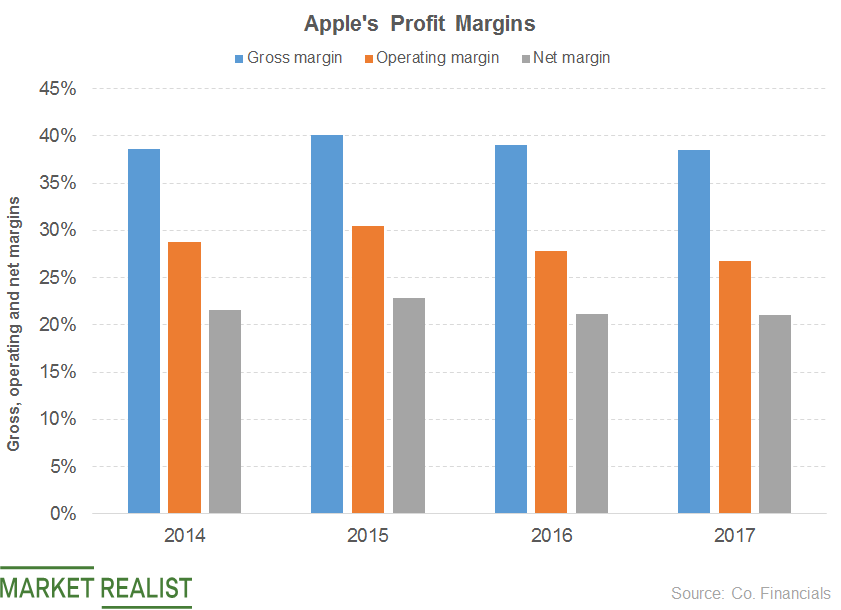
Over the past decade, Apple’s consolidated gross margin has expanded from approximately 38% to historical highs approaching 46.3%. For equity research desks managing capital allocations across S&P 500 benchmarks, every 50-basis-point expansion in Apple’s corporate gross margin equates to roughly $2 billion in incremental gross profit—a cushion that directly underwrites the equity's elevated forward price-to-earnings (P/E) multiple.
Services Mix and Hardware Yield Optimization
To understand Wall Street’s margin hypothesis, one must dissect the operational bifurcations within Apple’s balance sheet. The company operates two distinct margin regimes: Hardware (iPhone, Mac, iPad, Wearables) and Services (App Store, Cloud services, Apple Pay, Apple Music, and licensing arrangements).
1. The Services Multiplier
The Services segment now accounts for over 25% of total corporate revenues while generating gross margins routinely exceeding 70%—nearly double that of the hardware division. As Apple’s installed base of active devices scales past 2.2 billion units, monetization efficiency per user increases. Licensing agreements—most notably search distribution revenues—and high-margin subscription upgrades yield incremental revenue with negligible marginal distribution costs. This dynamic shifts the revenue mix higher, exerting a structural upward pull on the company's consolidated margin profile.
2. Silicon Integration & Assembly Efficiency
On the hardware side, Apple’s transition away from third-party silicon architectures (such as Intel x86 processors) to proprietary Apple Silicon has drastically re-architected its Bill of Materials (BOM). By designing proprietary M-series and A-series system-on-chip (SoC) architectures fabricated via Taiwan Semiconductor Manufacturing Company (TSMC), Apple captures the design margin previously surrendered to external suppliers. Furthermore, as TSMC’s 3-nanometer (N3B and N3E) semiconductor nodes achieve higher manufacturing yields, unit cost curves decrease, offsetting elevated wafer wafer-scale pricing.
3. Mix Shift to Premium Form Factors
Consumer behavior trends indicate a sustained structural migration toward premium tier devices. The iPhone "Pro" and "Pro Max" variants carry significantly higher average selling prices (ASPs) and richer gross margin profiles compared to base models. Through disciplined product stratification—reserving advanced display tech, telephoto camera systems, and top-tier SoCs for high-end SKUs—Apple effectively nudges its customer base up the ASP curve, protecting aggregate hardware gross margins even amid fluctuating global unit shipments.
Capital Allocation and AI Compute Economics
A central debate dominating institutional investor calls is the capital expenditure (Capex) drag associated with Artificial Intelligence infrastructure. Industry hyperscalers—including Microsoft, Alphabet, and Meta—are deploying hundreds of billions of dollars into high-depreciation, GPU-intensive data center builds, weighing heavily on their short-term operating margins and free cash flow yields.
Apple’s strategic approach to AI—branded as Apple Intelligence—presents a starkly different capital intensity profile. By executing small language models (SLMs) directly on-device using the Neural Engine embedded within Apple Silicon, the company offloads the vast majority of compute costs onto the end-user hardware, eliminating recurring cloud inference costs. For complex processing requiring server-