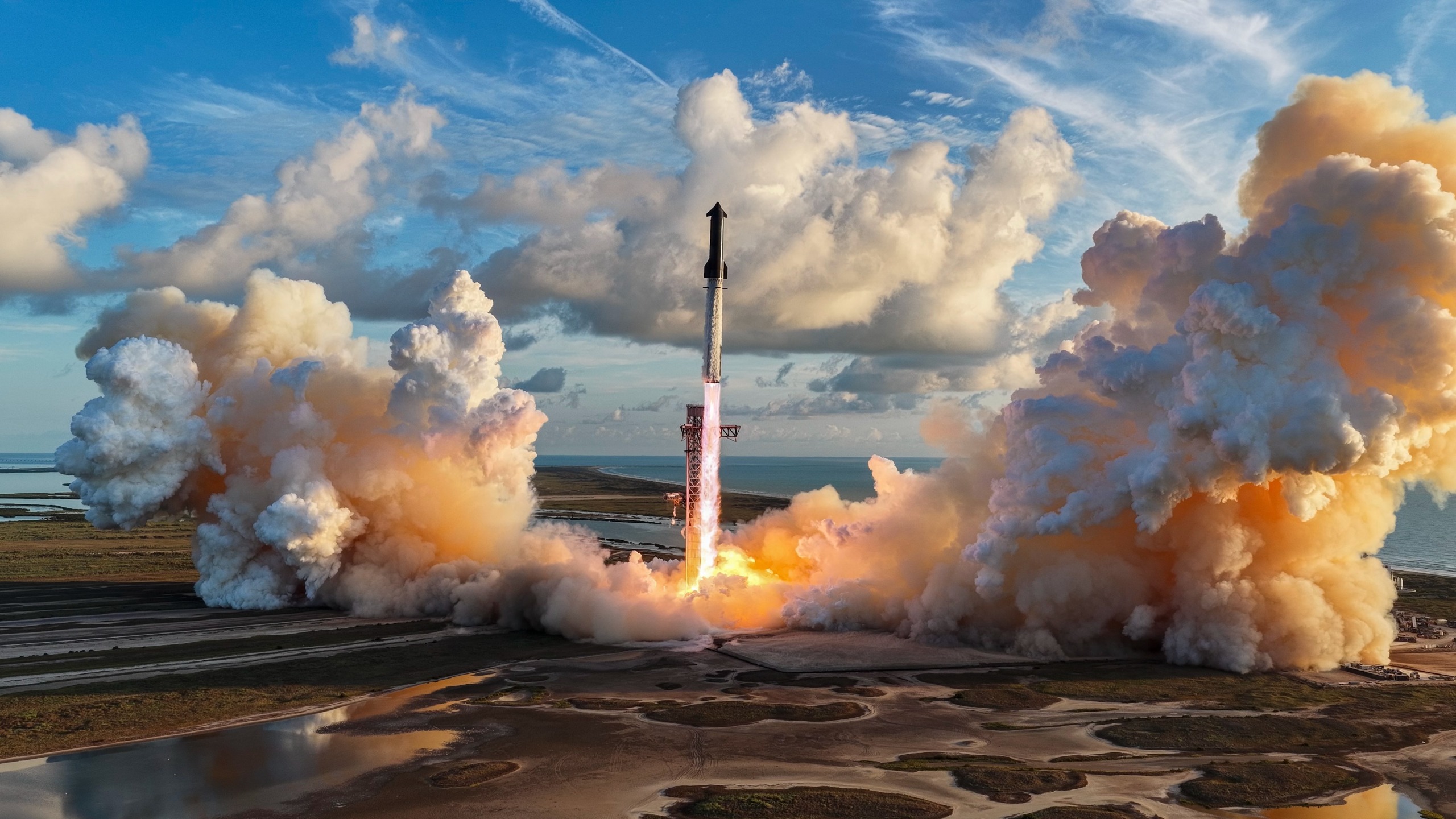
BOCA CHICA, Texas — In a defining moment for modern aerospace and the global space economy, SpaceX has successfully launched its Starship spacecraft into orbit for the very first time. The dramatic Flight 14 test flight of the largest and most powerful rocket ever constructed marks a historic paradigm shift, shattering technological barriers and clearing a direct path for humanity’s return to the Moon and eventual journey to Mars.
As the 397-foot-tall (121 meters) launch vehicle cleared the tower at SpaceX’s Starbase facility in South Texas, the collective sigh of relief and subsequent roar of celebration across the aerospace sector was palpable. For years, skeptics questioned whether a vehicle of this unprecedented scale—utilizing a stainless-steel hull and 33 liquid-methane-burning Raptor engines—could achieve stable orbital insertion. On Flight 14, Elon Musk’s engineering powerhouse silenced the doubters.
Executive Summary: Why Flight 14 Changes Everything
- Historic First: Starship has achieved true orbital insertion, validating the thermal protection system, hot-staging architecture, and orbital velocity propulsion.
- The Cost Revolution: Successful orbital capabilities bring SpaceX closer to its target launch cost of under $90 per kilogram, drastically undercutting traditional aerospace competitors.
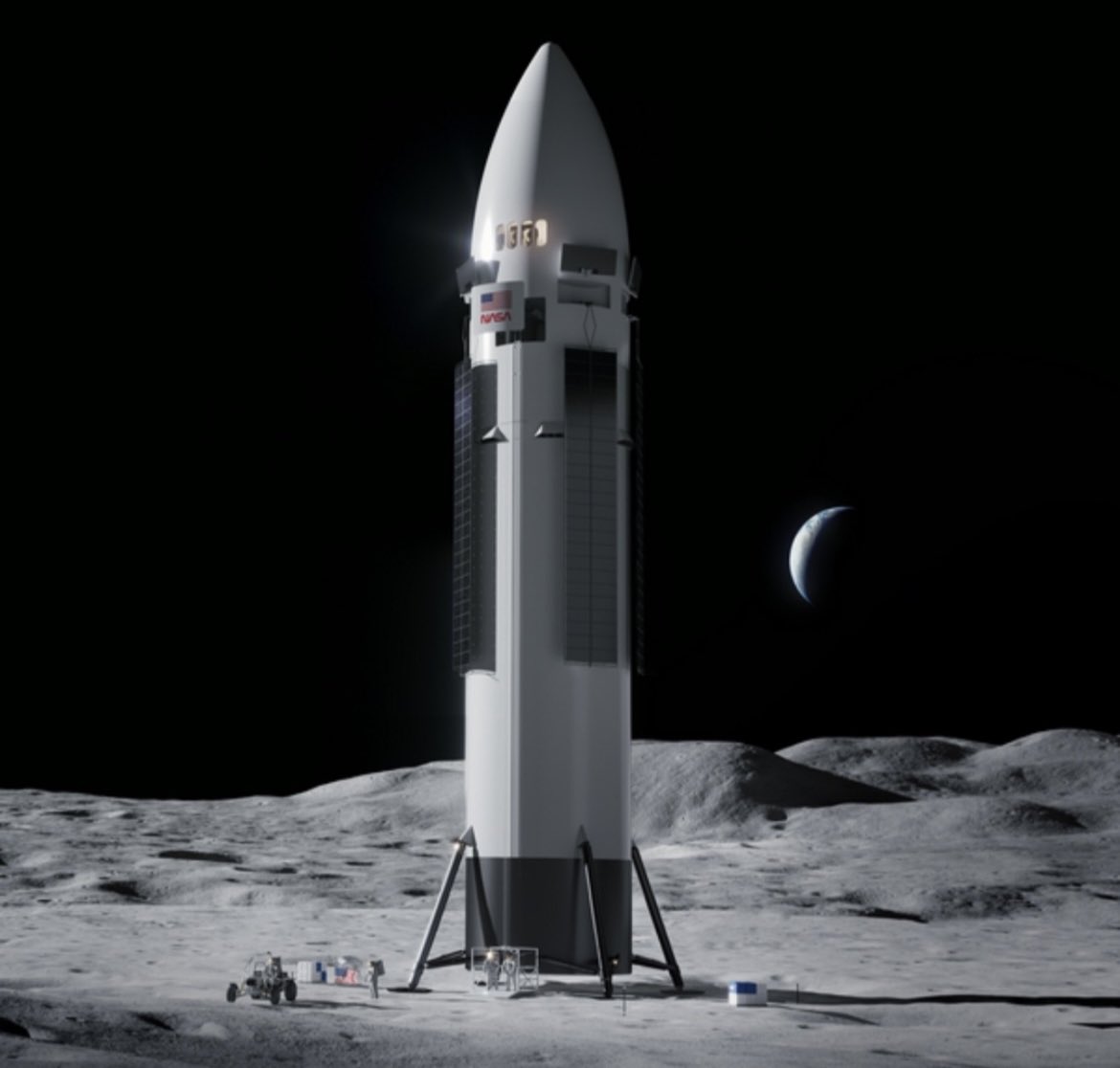
- Artemis and Beyond: NASA’s Artemis III mission, which relies on Starship as its Human Landing System (HLS), now has a validated, orbit-capable transport system.
- Commercial Dominance: With orbital capabilities unlocked, SpaceX can now begin planning the deployment of massive Starlink V3 satellites, multiplying global bandwidth capabilities overnight.
The Flight Profile: Ten Minutes that Redefined Aerospace
The launch sequence commenced under clear morning skies. The Super Heavy booster, producing an unprecedented 16.7 million pounds of thrust—more than double that of NASA's legendary Saturn V—liftoff was flawless. All 33 Raptor engines burned in perfect synchronization, pushing the vehicle through Max-Q (maximum aerodynamic pressure) with remarkable structural stability.
At approximately two minutes and forty seconds into the flight, the critical "hot-staging" maneuver took place. While still attached to the booster, Starship’s upper-stage engines ignited, successfully separating the two vehicles. While the Super Heavy booster executed a controlled deceleration maneuver, the Starship upper stage pushed forward, utilizing its six vacuum-optimized and sea-level Raptor engines to achieve the precise velocity required for orbital insertion.
"This is the holy grail of space exploration," said an ecstatic Elon Musk via social media shortly after telemetry confirmed orbital velocity. "Starship is in orbit. The path to making life multiplanetary is now wide open."
Data Sheet: Starship Flight 14 Technical Achievements
To understand the sheer scale of this milestone, the following table outlines the operational metrics confirmed during the Flight 14 test:
| Metric Parameter | Flight 14 Specifications / Achievements | Industry Impact & Significance |
|---|---|---|
| Maximum Thrust | 16.7 Million lbs (74.3 Meganewtons) | Most powerful rocket to ever successfully reach orbit. |
| Orbital Insertion Velocity | ~26,200 km/h (16,280 mph) | Validated orbital trajectory and engine performance in vacuum. |
| Payload Capacity to LEO | Up to 150 Metric Tons (Fully Reusable) | Over 5x the capacity of any active commercial rocket. |
| Booster Reusability Status | Controlled water landing & recovery path validated | Brings rapid, single-day refurbishment closer to reality. |
The Financial and Geopolitical Impact: A New Monopoly?
The success of Flight 14 reverberates far beyond the launch pad in Boca Chica; it is a seismic event for global financial markets and defense sectors. Traditional aerospace defense contractors, historically reliant on cost-plus government contracts, now face an existential challenge. By proving that a massive, fully reusable rocket can reach orbit, SpaceX has effectively monopolized the heavy-lift market for the foreseeable future.
According to financial analysts on Wall Street, SpaceX’s valuation—already flirting with $200 billion—could surge significantly. "Starship isn't just a rocket; it's an infrastructure platform," notes a senior industrial analyst at a major New York investment firm. "It allows for the rapid deployment of massive satellite constellations, orbital manufacturing, and asteroid mining initiatives that were previously cost-prohibitive."
Furthermore, geopolitical rivals are watching closely. The U.S. Space Force has expressed keen interest in Starship’s "Rocket Cargo" program, which aims to transport 100 tons of military cargo to anywhere on Earth in under an hour. Flight 14 proves to international adversaries that the United States now possesses an unmatched logistical advantage in the upper atmosphere.
What Lies Ahead: The Path to Artemis III and Mars
With orbital insertion achieved, SpaceX’s engineering team will now pivot to solving the next set of monumental challenges: orbital propellant transfer and thermal protection during long-duration orbital flights. To send Starship to the Moon, SpaceX must launch multiple "tanker" Starships to refuel the primary lander in Low Earth Orbit (LEO).
NASA Administrator Bill Nelson congratulated the SpaceX team, stating, "Today's successful orbital insertion is a massive step forward for the Artemis program. Together, we are returning humanity to the Moon, and this milestone brings us closer than ever to the lunar south pole."
SpaceX plans to accelerate its launch cadence, with Flight 15 already in active assembly. The company aims to conduct multiple orbital tests over the next twelve months to perfect the heat shield integrity during high-energy atmospheric re-entry and master the pinpoint landing catch of both the booster and the ship using the "Chopstick" arms of the launch tower.
Frequently Asked Questions (FAQ)
1. Why is Starship reaching orbit such a big deal compared to other rockets?
Unlike other rockets that discard their expensive boosters and spacecraft after a single use, Starship is designed to be 100% fully and rapidly reusable. Reaching orbit proves that a massive vehicle of this scale can survive the extreme environments of spaceflight, paving the way to lower the cost of space access by a factor of 100, making deep-space colonization economically viable.
2. What are the next immediate steps for SpaceX after Flight 14?
The immediate goals for upcoming flights include perfecting the orbital refueling process—which is essential for sending heavy payloads to the Moon and Mars—and reliably catching both the Super Heavy booster and the Starship spacecraft back at the launch site using the giant mechanical arms of the launch tower.