Executive Takeaways
Test Our Free AI & Tech Utilities Suite
Calculate LLM API token costs, analyze article dwell-time, or simulate tech DCA returns.
- 2027 Commercial Target: BYD has formally aligned its next-generation battery roadmap toward a 2027 market introduction for all-solid-state battery technology, signaling a shift from liquid-electrolyte dominance to next-gen solid-state architectures.
- Energy Density Breakthrough: The upcoming solid-state cells aim for energy densities exceeding 400 to 500 Wh/kg—nearly doubling the volumetric efficiency of current Lithium Iron Phosphate (LFP) Blade Batteries.
- Geopolitical & Strategic Escalation: BYD’s timeline directly counters Toyota Motor Corp.’s planned 2027–2028 commercial rollout with Idemitsu Kosan, while placing margin pressure on European OEMs running pilot trials with solid-state developers.
- Capital Allocation & Margin Defense: By leveraging deep vertical integration—from raw lithium refining to in-house cell manufacturing—BYD aims to bypass high supplier premiums, seeking long-term pack-level parity near $100/kWh.
Comprehensive Narrative: The Next Front in Global Battery Supremacy
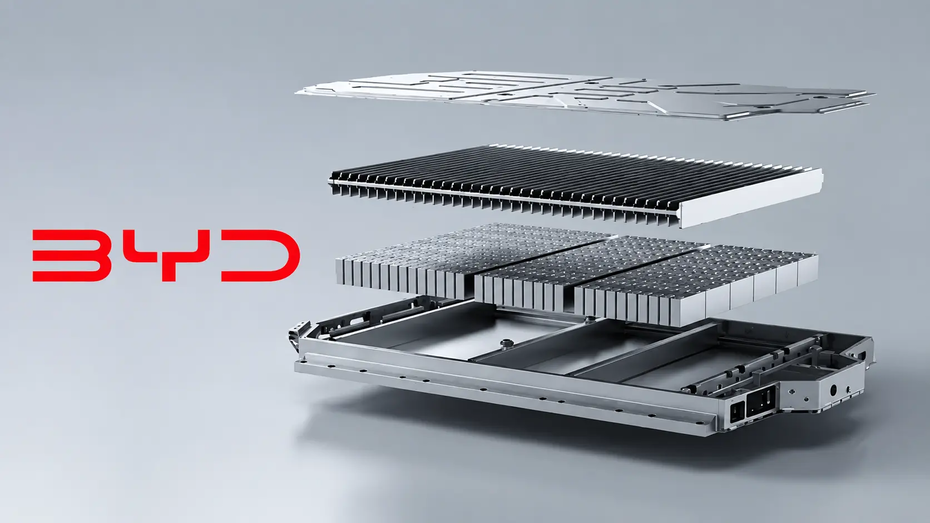
For the past five years, Shenzhen-based automotive and energy giant BYD Co., Ltd. has disrupted the global electric vehicle (EV) sector through industrial scale and chemical optimization. Its proprietary LFP "Blade Battery," integrated via cell-to-body (CTB) engineering, set the benchmark for structural safety, thermal stability, and cost-efficiency. However, with liquid lithium-ion electrochemistry nearing its theoretical limits around 300 Wh/kg, global original equipment manufacturers (OEMs) have engaged in a capital-intensive race for the commercial Holy Grail: all-solid-state battery (ASSB) technology.
Industry confirmations point to 2027 as the pivotal year for BYD's initial commercial deployment of solid-state cells. The move marks a decisive strategic evolution. Rather than viewing solid-state as an isolated, distant R&D exercise, BYD is synchronizing solid electrolyte line engineering with its core vehicle architecture development cycle, preparing to defend its global volume leadership against aggressive technological counter-offensive maneuvers from Japanese and European incumbents.
The Technical Paradigm Shift: Solvents vs. Solid Matrices
Traditional lithium-ion batteries rely on liquid organic electrolytes to shuttle lithium ions between the cathode and anode. While highly conductive, these liquid chemistry formulations suffer from narrow operating temperature windows, volatility under physical puncture, and catastrophic thermal runaway risks. Furthermore, liquid systems require physical separators and heavy cooling apparatuses, which add parasitic weight and reduce volumetric efficiency at the pack level.
BYD's solid-state development pipeline shifts away from flammable liquid solvents toward dense solid electrolytes—primarily focusing on sulfide-based and hybrid oxide solid chemistries. Sulfide-based solid electrolytes exhibit exceptional ionic conductivity at room temperature, approaching that of traditional liquid electrolytes. By pairing a solid electrolyte matrix with a high-capacity lithium-metal or silicon-composite anode, BYD engineers aim to reach energy densities of 400 to 500 Wh/kg.
This leap in energy density alters vehicle design parameters. At 500 Wh/kg, an EV battery pack can yield double the driving range for the exact same physical footprint, or slash total battery weight by 45% while preserving a 600-kilometer (372-mile) baseline range. Lower pack mass directly translates into reduced curb weight, enhanced vehicle driving dynamics, and optimized powertrain efficiency.
The Rivalry: BYD, Toyota, and European Pilot Fleets
BYD’s strategic timeline is far from a vacuum; it lands directly inside a high-stakes competitive field. Toyota Motor Corp. has spent decades amassing solid-state patents. In partnership with Japanese energy group Idemitsu Kosan, Toyota is constructing a commercial-scale solid electrolyte production facility, targeting market launch between 2027 and 2028. Toyota promises charging times of 10 minutes or less and ranges exceeding 1,000 kilometers.
Concurrently, European manufacturers are moving past initial benchtop trials. Mercedes-Benz, in collaboration with U.S.-based developer Factorial Energy, has initiated road-testing of solid-state battery technology in prototype EQS sedans, while Volkswagen Group continues its multi-hundred-million-dollar investment into QuantumScape. Meanwhile, battery behemoth CATL has accelerated its own solid-state timelines, targeting low-volume pilot integration by 2027.
Where BYD asserts a potential competitive advantage is in its full-stack vertical manufacturing model. Unlike traditional OEMs that rely on tier-1 supplier spot pricing, BYD controls upstream raw material processing, cell equipment manufacturing, microelectronics, and final vehicle assembly. This internal ecosystem allows BYD to absorb high early-stage material costs, amortizing R&D expenditures across its high-volume luxury sub-brands like Yangwang and Denza before driving the technology down into mass-market series.
Verified Data & Metrics Breakdown
The table below outlines technical specifications, financial thresholds, and estimated rollout timelines across key automotive battery architectures.
| Battery Chemistry / Architecture | Gravimetric Energy Density (Wh/kg) | Electrolyte Medium | Safety & Thermal Stability Profile | Projected Pack Cost ($/kWh) | Commercial Timeline Target |
|---|---|---|---|---|---|
| BYD LFP Blade Battery (Current) | 140 – 160 Wh/kg | Liquid Organic Solvent | Exceptional; passes nail penetration testing | $60 – $75 / kWh | Active Mass Production |
| High-Nickel NCM (Industry Standard) | 240 – 280 Wh/kg | Liquid / Gel Matrix | Moderate; requires active cooling & thermal propagation barriers | $90 – $110 / kWh | Active Mass Production |
| BYD All-Solid-State (2027 Target) | 400 – 500 Wh/kg | Sulfide / Oxide Solid Matrix | High; non-flammable solid structure, zero liquid leakage risk | $120 – $150 / kWh (Initial) | 2027 Pilot Commercial Scale |
| Toyota Solid-State (Idemitsu Joint) | 450 – 500 Wh/kg | Sulfide Solid Electrolyte | High; resistant to thermal breakdown up to elevated temperatures | $140 – $180 / kWh (Initial) | 2027 – 2028 Targeted Rollout |
Industry & Market Implications
Capital Allocation & Enterprise Valuation Multiples
The industrial pivot toward solid-state chemistry presents significant capital allocation implications across the automotive landscape. For global auto manufacturers, building multi-gigawatt-hour liquid battery factories requires multi-billion-dollar CapEx commitments with 10-to-15-year amortization horizons. A rapid shift toward solid-state technology creates stranded asset risks for legacy gigafactories that cannot be easily re-tooled for solid-state cell deposition.
Financial markets are watching these dynamics closely. Institutional investors are shifting valuation multiples away from legacy auto brands heavily burdened by legacy internal combustion engine (ICE) write-downs and unoptimized liquid EV supply chains. Pure-play EV makers and vertically integrated players capable of transitioning cleanly to solid-state chemistry without incurring massive write-offs are positioned to capture structural equity valuation premiums.
Upstream Supply Chain and Raw Material Dynamics
Solid-state technology reshapes upstream raw material demand profiles:
- Lithium Metal Anodes: Transitioning from graphite to lithium metal anodes increases raw lithium demand per cell unit, prioritizing high-purity battery-grade lithium production.
- Precursor Inputs: Sulfide electrolytes rely on high-purity phosphorus pentasulfide ($P_2S_5$), while oxide formats require elements such as germanium, lanthanum, and zirconium. Supply chain security for these refined chemical precursors will become a key determinant of competitive advantage.
- Elimination of Anode Graphite: Anode-free or lithium-metal designs reduce reliance on traditional synthetic and natural graphite processing, disrupting established graphite supply chains.
Infrastructure Scalability and Utility Payback Models
The broader adoption of 500 Wh/kg batteries will alter EV charging infrastructure economics. Vehicles with double the energy density can support 1,000-kilometer operational ranges between charges, fundamentally changing consumer charging behavior. Ultra-fast charging enabled by solid-state stability (10-to-80% state of charge in 10–12 minutes) reduces the physical footprint required for highway charging plazas, maximizing throughput and asset utilization for station operators while reducing peak strain on local distribution grids.
Frequently Asked Questions (People Also Ask)
Why is BYD accelerating its commercial rollout of solid-state batteries for 2027?
BYD is advancing its solid-state timeline to preserve its technological advantage as liquid LFP chemistry approaches its physical energy density limit (around 180–200 Wh/kg at the cell level). While LFP remains dominant for entry-to-mid-tier vehicles, high-end segments require higher gravimetric energy density to deliver longer ranges and lighter vehicle profiles. Aligning a commercial launch with 2027 counters concurrent initiatives by Toyota, CATL, and European automakers, ensuring BYD protects its pricing power and global EV market share.
What are the primary engineering hurdles to solid-state battery commercialization?
The main technical obstacles center on interfacial resistance, mechanical expansion, and high manufacturing cost. Over repeated charge-discharge cycles, solid materials expand and contract, causing delamination between the solid electrolyte and electrodes, leading to rapid capacity loss. Furthermore, lithium dendrite growth—microscopic metallic filaments that short-circuit cells—can still occur through grain boundaries in solid electrolytes. Overcoming these issues requires precise roll-to-roll manufacturing under dry environments and optimized interlayers to maintain continuous physical pressure on the cell stack.
How will solid-state batteries impact the Total Cost of Ownership (TCO) for consumers?
Initial solid-state options will carry a premium price tag, restricting deployment to high-end halo models. However, over a 7-to-10-year period, solid-state batteries are expected to significantly reduce overall Total Cost of Ownership. Solid-state packs exhibit substantially slower capacity degradation over time, extending vehicle operating lifespans beyond 300,000 miles. Additionally, the elimination of complex liquid thermal management loops lowers vehicle maintenance overhead, while superior cold-weather range retention reduces winter energy loss.
How does BYD's strategy differ from Western developers like QuantumScape or Factorial?
Western developers largely operate as specialized pure-play R&D firms or tier-1 suppliers, relying on joint ventures or supply contracts with established auto manufacturers to commercialize their intellectual property. BYD operates as a fully integrated original equipment manufacturer and battery maker. It develops cell chemistry, designs custom manufacturing machinery, produces its own microelectronics, and builds the end-vehicle platforms. This internal integration allows BYD to execute pilot scale-ups faster and iterate designs directly within its vehicle production lines.
Future Outlook & Strategic Milestones to Watch
The timeline leading to BYD's 2027 commercial target will feature several technical, operational, and regulatory milestones:
- 2025–2026 B-Sample Validation: Watch for BYD to transition solid-state cells from pilot lines into automotive B-sample validation testing, placing working modules in real-world test fleets across extreme temperature environments.
- Precursor Supply Commitments: Securing long-term supply agreements for high-purity chemical inputs—specifically sulfide precursor materials and battery-grade lithium foil—will indicate readiness for full commercial scaling.
- Initial Halo Model Integration: Rollouts will likely begin with low-volume, ultra-luxury halo vehicles, such as the Yangwang U8/U9 platforms, where buyers can absorb initial technology premiums before high-volume cost parity is achieved.
- Regulatory & Safety Standard Approvals: Solid-state cells will need to clear rigorous international transport and crash safety certifications (such as UN 38.3 and China’s updated GB/T traction battery safety standard) to validate non-flammability claims under real-world impact scenarios.
If BYD hits its 2027 milestone, the global automotive balance of power will shift further toward vertically integrated battery manufacturers, accelerating the technological obsolescence of conventional liquid-ion platforms and setting a new benchmark for energy storage design.