Executive Takeaways
- Sovereign Architecture Over Walled Gardens: India’s Unified Payments Interface (UPI) and Brazil’s Pix have permanently broken the proprietary chokehold of multinational card networks, demonstrating that Digital Public Infrastructure (DPI) delivers unprecedented enterprise transactional velocity at near-zero marginal cost.
- Divergent Operational Models, Identical Disruption: While Brazil deployed a state-directed, central bank-operated mandate (Banco Central do Brasil), India leveraged a public-private federated model via the National Payments Corporation of India (NPCI); both succeeded in compressing private interchange margins by over 80%.
- The Enterprise Capital Shift: Traditional merchant acquirers and payment processors face structural valuation compressions, forcing venture capital and global commercial banks to pivot from transaction-fee rent collection toward high-yield credit underwriting, embedded finance, and enterprise software integration.
- Cross-Border Geopolitics: The expansion of Pix across Latin America and UPI across Southeast Asia and the Middle East establishes an alternative cross-border liquidity and settlement corridor, accelerating multilateral bypass of SWIFT and Western correspondent banking clearinghouses.
The Death of the Tollbooth: Inside the DPI Revolution
For more than half a century, global commerce operated on an uncontested premise: the movement of capital across consumer and enterprise balance sheets required private tollbooths. Visa, Mastercard, legacy merchant acquirers, and correspondent banks extracted high-margin interchange rents—often ranging between 1.5% and 3.5% per swipe—justified by the structural costs of clearing, settlement risk, and physical point-of-sale infrastructure.
That paradigm has been decisively dismantled. A comprehensive investigative treatise published by the Observer Research Foundation (ORF), authored by global governance and public finance researchers Caroline Arkalji and Anit Mukherjee, reveals how Brazil’s Pix and India’s UPI transformed payments from a fragmented, privatized monopoly into foundational public infrastructure. The transition has not merely democratized financial inclusion for hundreds of millions of unbanked citizens; it has fundamentally reorganized the macroeconomic velocity of money, reduced cash-handling fiscal drags, and re-engineered the corporate balance sheet.
By treating payment rails as digital public goods—akin to interstate highways, public power grids, or telecommunication spectrum—state architects in Brasília and New Delhi decoupled the underlying rails of financial transit from commercial end-user applications. The downstream consequence is an existential liquidity and margin crisis for traditional fintech toll collectors, accompanied by an explosive expansion of enterprise productivity.
Architectural Divergence: Centralized Mandate vs. Federated Consortium
While global observers frequently conflate Pix and UPI as interchangeable blueprints, Arkalji and Mukherjee’s comparative framework demonstrates that their developmental mechanics, governance structures, and software topologies diverge sharply. Understanding these operational differences is crucial for enterprise Chief Information Officers, sovereign treasury departments, and institutional investors evaluating emerging markets.
1. Brazil’s Pix: The Sovereign Central Bank Directive
Launched in November 2020 by the Banco Central do Brasil (BCB), Pix was designed as a top-down regulatory fiat. The BCB did not wait for voluntary commercial adoption; it mandated that all financial institutions with more than 500,000 active customer accounts connect to the Pix infrastructure and provide free person-to-person (P2P) transfers. The central bank acts simultaneously as regulator, rulebook author, database manager, and the single clearing and settlement operator via the System for Instant Payments (SPI).
This centralized governance eliminated intermediate orchestration friction. By leveraging Brazil's centralized Direct Participant Directory (DICT), Pix matches unique identifiers (tax IDs, mobile numbers, email addresses, or random cryptographic keys) directly to International Bank Account Numbers (IBAN). Transaction finality occurs within two to three seconds on central bank ledger lines, backed by mandatory liquid reserves deposited at the central bank. The result was instantaneous market liquidity and the fastest sovereign adoption curve in modern financial history.
2. India’s UPI: The Public-Private Federated Protocol
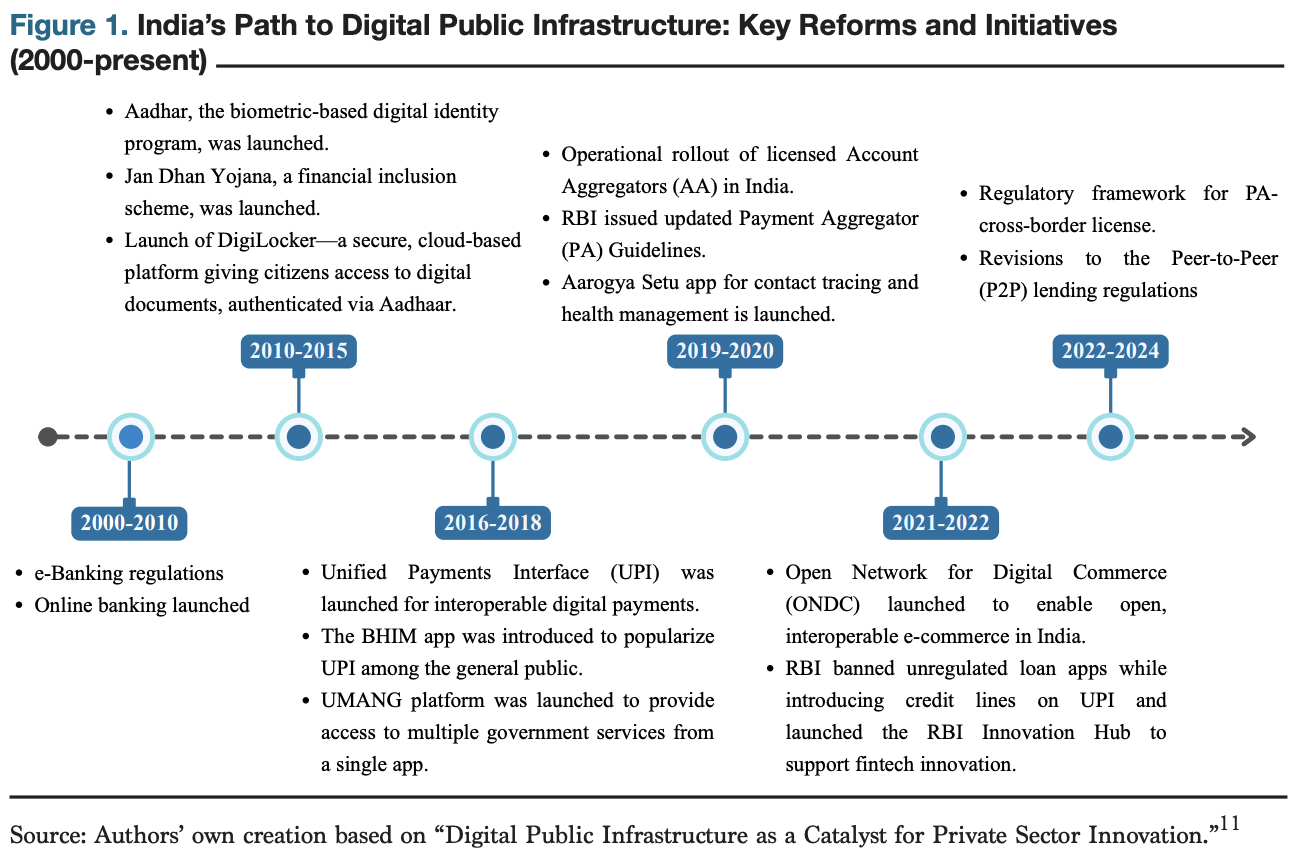
In contrast, India’s Unified Payments Interface, introduced in 2016 by the National Payments Corporation of India (NPCI)—an umbrella non-profit institution backed by a consortium of major commercial banks and regulated by the Reserve Bank of India (RBI)—operates as an open, modular protocol. Rather than a singular, state-run app or closed loop, UPI sits on top of the "India Stack," integrated with the Aadhaar national biometric digital identity layer and the Immediate Payment Service (IMPS) core banking engine.
UPI is architected around a federated, interoperable model. It abstracts bank account details behind a virtual payment address (VPA) through public application programming interfaces (APIs). Crucially, the Indian regime allowed third-party private application providers—most notably Walmart’s PhonePe and Alphabet’s Google Pay—to build consumer-facing interfaces directly on the public rail. This spurred multi-billion-dollar private capital investments into customer acquisition and merchant QR deployment, while the sovereign rail managed the low-latency interbank settlement across more than 600 connected commercial and regional rural banks.
Comparative Operational Matrix: Pix vs. UPI
| Key Metric / Dimension | Brazil (Pix) | India (UPI) |
|---|---|---|
| Governing Authority | Banco Central do Brasil (BCB) — Direct State Operator | NPCI (Public-Private Utility) & Reserve Bank of India |
| Launch Date | November 2020 | April 2016 (Commercial rollout post-demonetization) |
| Monthly Transaction Volume (2025/2026 Run Rate) | ~5.5 Billion to 6.2 Billion transactions/month | ~16.5 Billion to 18+ Billion transactions/month |
| Annualized Total Payment Volume (TPV) | Exceeding $3.8 Trillion USD equivalent | Exceeding $2.7 Trillion USD equivalent |
| Merchant Discount Rate (MDR) Economics | Capped for P2B (Avg 0.22% to 0.33%); strictly zero for P2P | Zero-MDR Mandate on P2P and standard P2B UPI transfers |
| Settlement Layer Engine | Sistema de Pagamentos Instantâneos (SPI) hosted by BCB | Immediate Payment Service (IMPS) distributed core switch |
| Primary User Identifier | Pix Keys (CPF/CNPJ, Email, Phone, EVP Random Key) | Virtual Payment Address (VPA / UPI ID) tied to Mobile |
| Third-Party Front-End Market Dynamics | Embedded natively in incumbent bank & neobank apps (Nubank, Itaú) | Dominated by Third-Party App Providers (TPAPs: PhonePe, Google Pay) |
The Disruption of Global Rail Monopolies: Wall Street’s Reckoning
The macroeconomic ramifications of the Arkalji-Mukherjee findings point to an unprecedented margin collapse for legacy financial intermediaries. Historically, emerging market banking systems subsidized low-balance retail accounts through extortionate interchange and merchant acquiring fees. In Brazil, merchant acquirers like Cielo, Rede, and StoneCo historically commanded merchant discount rates of 2% to 5% on credit and debit transactions, while credit card interest rates regularly breached triple digits.
Pix permanently upended that unit economics structure. By compressing the merchant payment fee from 2.5% on traditional debit down to an average of 0.22% on Pix, enterprise merchants reclaimed billions of dollars in operating margins. Brazil’s dominant e-commerce retailers and physical conglomerates—ranging from Mercado Libre to local fuel stations—incentivized Pix payments via immediate 5% to 10% cash discounts, effectively starving legacy card networks of settlement volume.
In India, the structural intervention was even more radical. The Ministry of Finance enforced a "Zero-MDR" policy on RuPay debit cards and UPI transactions, legally prohibiting banks and payment service providers from charging merchants any processing fees. While this sparked fierce resistance from global payment cartels and private fintechs claiming infrastructure maintenance was unsustainable, the Indian state resolved the capital shortfall via direct fiscal budget subsidies to banks to maintain uptime and security infrastructure.
As a direct consequence, legacy card penetration in India has hit a functional ceiling for domestic consumer transactions. Visa and Mastercard have seen their high-margin transaction growth decoupled from the country’s GDP expansion, forcing these global institutions to pivot their South Asian strategies toward affluent cross-border travel cards, enterprise procurement, and B2B invoice financing.
Geopolitics of Cross-Border DPI: The End of Correspondent Banking Friction
The domestic success of Pix and UPI has elevated both frameworks from local financial instruments to strategic instruments of foreign economic policy. As the ORF study emphasizes, the next geopolitical battlefield is not domestic retail payments, but the cross-border integration of bilateral instant payment systems.
Under traditional correspondent banking, cross-border remittances and trade settlements are plagued by multi-day delays, high compliance costs, and foreign exchange spreads exceeding 5% for low-value corridors. India and Brazil are aggressively pursuing bilateral and multilateral linkages to bypass the SWIFT messaging protocol and the US-dollar-centric clearing ecosystem:
- The UPI-PayNow Corridor: India’s direct linkage with Singapore’s PayNow system established real-time, low-cost P2P cross-border transfers via standardized API messaging, bypassing intermediary correspondent clearing banks entirely.
- Middle East & GCC Expansion: NPCI International Payments Limited (NIPL) has executed state-level agreements with the United Arab Emirates (linking UPI with the UAE’s Jaywan platform) and Saudi Arabia, enabling millions of Indian migrant workers to remit capital instantly with minimal foreign exchange leakage.
- Project Nexus: Both frameworks serve as primary reference architectures for the Bank for International Settlements (BIS) Project Nexus, which aims to standardize instant payment platform interconnectivity across ASEAN, Europe, and Latin America.
By standardizing real-time gross settlement architectures via open ISO 20022 messaging standards, Brazil and India are proving that sovereign clearing can operate without reliance on the Western commercial banking nexus. This trend carries structural ramifications for global market liquidity, sovereign reserve diversification, and the geopolitical leverage of economic sanctions.
Frequently Asked Questions (People Also Ask)
What is the core difference between Digital Public Infrastructure (DPI) and private fintech apps?
DPI treats foundational digital components—such as digital identity (Aadhaar), sovereign instant settlement rails (Pix, UPI), and data consent architectures—as open, interoperable, non-excludable public goods. Private fintech apps (such as PayPal, Venmo, or Apple Pay) operate closed-loop, proprietary networks that charge toll fees and lock users within walled ecosystems. DPI provides an open base layer upon which private companies can innovate and compete purely on user experience and ancillary services.
How do banks and payment providers make money under a Zero-MDR or Low-MDR model?
While basic transaction processing is demonetized under DPI models, financial institutions and fintechs pivot their business models toward secondary, high-value financial products. By processing billions of real-time transactions, providers acquire rich, real-time behavioral data on cash flows. This enables them to underwrite low-risk micro-loans, deploy short-term working capital credit, sell wealth management and insurance products, and charge enterprises for specialized integration software, reconciliation APIs, and fraud monitoring systems.
Can the Pix or UPI model be replicated in the United States or Western Europe?
While the underlying technology (ISO 20022 messaging, microservices cloud architecture) is universally deployable, replication faces regulatory and political economy resistance in the US and Europe. Systems like the Federal Reserve’s FedNow or Europe’s SEPA Instant Credit Transfer possess similar technical capabilities. However, unlike Brazil’s central bank, Western regulators have historically avoided mandating participation, eliminating merchant interchange fees, or deploying sovereign consumer apps, due to heavy lobbying and reliance on established credit card networks.
What are the primary systemic risks associated with DPI-driven payment rails?
The primary vulnerabilities include concentrated systemic operational risk—where an outage at the central switch or national clearinghouse halts domestic commerce entirely—and sophisticated social engineering scams. Because transactions are instantaneous and irreversible, unauthorized push payment (APP) fraud has increased. In response, regulators in Brazil and India are retrofitting systems with dynamic transaction limits, central fraud directories, biometric verification, and automated blocking mechanisms for suspicious liquidity flows.
Future Outlook (2026–2030): Credit Rails, Sovereign Compute, and the CBDC Convergence
As detailed by Caroline Arkalji and Anit Mukherjee, the maturation of Pix and UPI marks only the first phase of the DPI evolution. The next frontier, rapidly crystallizing between 2026 and 2030, is the convergence of instant payment rails with formal credit markets and central bank digital currencies (CBDCs).
In Brazil, the BCB is rolling out Pix Automático—enabling frictionless recurring subscription payments that directly challenge corporate direct debit monopolies—while simultaneously developing Drex, Brazil’s wholesale CBDC designed to introduce smart contracts and asset tokenization over the existing Pix architecture.
In India, the frontier is "Credit on UPI." By permitting pre-sanctioned credit lines from commercial banks to be transacted over UPI QR codes, the RBI is directly attacking the credit card industry’s final bastion: unsecured revolving consumer credit. The systemic integration of real-time cash flow verification with automated credit origination will permanently compress risk premiums, expanding capital availability to millions of small and micro-enterprises previously excluded from the formal banking sector.
The definitive lesson emerging from Brasília and New Delhi is unambiguous: modern economic sovereignty requires sovereign rails. The future of enterprise payments belongs not to proprietary networks extracting economic rent, but to hyper-efficient, state-orchestrated digital public platforms engineered for global interoperability, absolute transactional velocity, and institutional scale.