
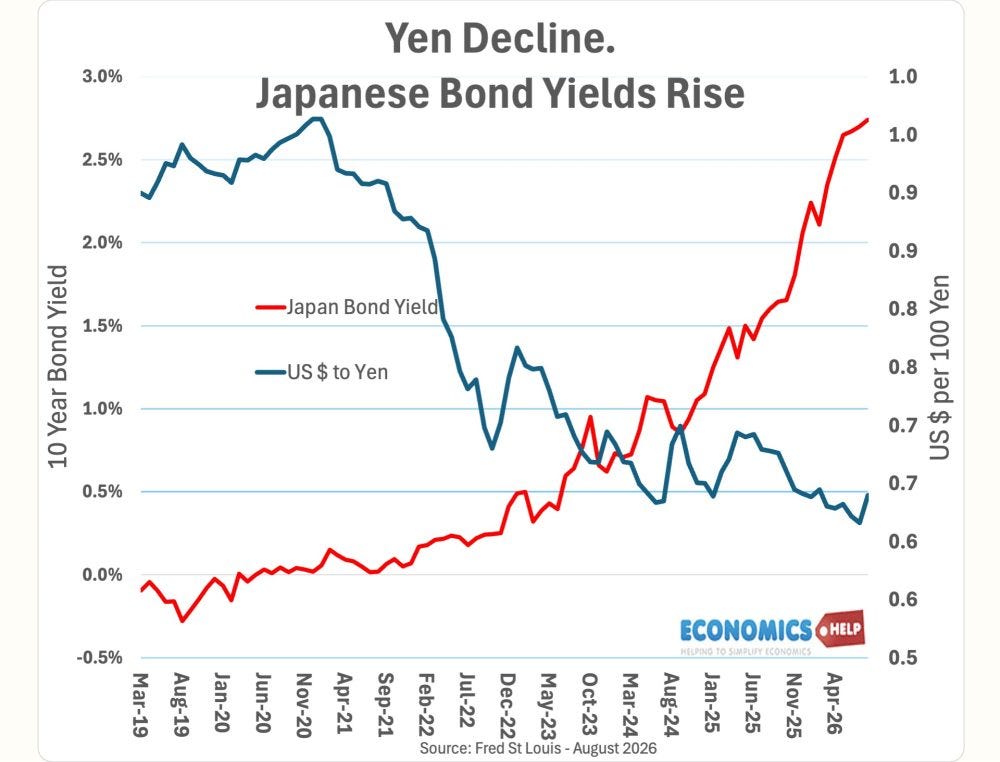
Executive Takeaways
- The Ultimate Creditor: Japan remains the largest foreign holder of U.S. Treasuries, making the Bank of Japan's domestic monetary pivots a direct risk factor for American borrowing costs.
- Capital Repatriation Pressure: As Japanese Government Bond (JGB) yields rise out of decades-long negative and near-zero territory, domestic institutional capital is increasingly staying home, threatening U.S. market liquidity.
- Valuation Multiples at Risk: The unwind of the historic yen carry trade directly impacts global risk asset pricing, threatening tech and industrial valuation multiples across Wall Street.
- Strategic Risk Mitigation: Institutional asset allocators must reassess their portfolio duration and currency hedging strategies as the global macro correlation matrix shifts.
For decades, institutional investors on Wall Street have treated the macroeconomic weather in Tokyo as a localized phenomenon—a fascinating, albeit quarantined, experiment in ultra-loose monetary policy, quantitative easing, and demographic stagnation. Yet, as global capital markets navigate an era of persistent inflation and quantitative tightening, this detachment has become dangerously obsolete. According to recent macroeconomic analyses from the American Enterprise Institute (AEI), if there is one foreign jurisdiction that holds systemic leverage over U.S. financial markets, it is Japan. Boasting an astronomical sovereign debt market exceeding $8 trillion, Japan’s domestic yield curve movements are not merely an Asian story; they are the invisible gears driving American capital allocation, corporate borrowing rates, and equity valuation multiples.
To understand the vulnerabilities embedded within the modern U.S. financial architecture, one must examine the umbilical cord connecting Tokyo’s Ministry of Finance to Wall Street’s primary dealers. For generations, Japanese institutional investors—pension funds, mega-banks, and life insurers—scoured a zero-yield domestic landscape for alpha, funneling trillions of dollars into higher-yielding U.S. Treasury securities and foreign corporate debt. Today, that dynamic is undergoing a violent structural reversal. As the Bank of Japan (BOJ) abandons negative interest rate policies and permits sovereign yields to find natural market levels, the gravitational pull keeping Japanese capital anchored in U.S. assets is weakening. The resulting capital reallocation threatens to drain vital liquidity from American debt and equity markets just as the U.S. federal government faces unprecedented domestic debt issuance.
The Anatomy of the Trans-Pacific Financial Feedback Loop
Test Our Free AI & Tech Utilities Suite
Calculate LLM API token costs, analyze article dwell-time, or simulate tech DCA returns.
The interconnectivity between the Japanese Government Bond (JGB) market and U.S. Treasury yields is rooted in portfolio theory and global liquidity arbitrage. For years, Japanese institutional capital acted as a reliable anchor of demand for U.S. sovereign debt. When the U.S. Treasury needed to finance massive fiscal expansions, Tokyo's massive institutional savings pools stood ready to absorb the supply. This symbiotic relationship kept American mortgage rates lower, reduced corporate cost of capital, and fueled broad-based infrastructure scalability across corporate America.
However, this cross-border capital flow was heavily dependent on the interest rate differential—or spread—between U.S. Treasuries and JGBs, adjusted for currency hedging costs. As the Federal Reserve aggressively hiked interest rates through 2022 and 2023 to combat domestic inflation, and as the BOJ maintained its yield curve control (YCC) framework, hedging costs surged, briefly making unhedged U.S. assets less attractive. Now, with the BOJ engineering a gradual normalization of monetary policy, domestic JGB yields are creeping upward. Japanese financial institutions no longer need to assume the foreign exchange risk of investing in U.S. dollar-denominated assets to achieve their fiduciary return targets. They can secure attractive, risk-adjusted yields at home.
This structural repatriation of capital places immense pressure on U.S. market liquidity. When Japanese buyers step back from Treasury auctions, domestic primary dealers are forced to absorb a larger share of U.S. sovereign debt. This dynamic pushes U.S. yields higher independently of Federal Reserve policy actions, directly impacting enterprise ROI calculations, real estate capitalization rates, and consumer credit availability across the United States.
The Yen Carry Trade Unwind and Global Risk Asset Volatility

Beyond sovereign debt holdings, Japan’s monetary stance underpins the global "carry trade"—a foundational mechanism of modern financial leverage. For decades, hedge funds, global macro traders, and corporate treasurers borrowed Japanese yen at near-zero interest rates to fund purchases of higher-yielding global assets, including U.S. equities, high-yield corporate bonds, and technology sector growth stocks.
When the BOJ adjusts its policy rate, the foundational math of the carry trade shifts. A strengthening yen combined with rising domestic funding costs forces leveraged market participants to rapidly liquidate their foreign asset holdings to cover margin calls and repay yen-denominated loans. We caught a glimpse of this systemic fragility during sudden market shocks, where abrupt yen appreciation triggered violent, cross-asset liquidations on Wall Street.
For U.S. equity markets—particularly growth and technology sectors characterized by lofty valuation multiples—an abrupt unwind of Japanese-funded liquidity acts as an immediate de-rating catalyst. As capital becomes scarcer and more expensive, market participants are forced into aggressive risk mitigation, trimming positions in high-beta tech equities and reallocating toward defensive, cash-flow-positive sectors.
| Metric / Indicator | Historical Baseline (Pre-Normalization) | Current Market Reality (2026) | Direct Impact on U.S. Economy |
|---|---|---|---|
| Japan Sovereign Debt Size | ~$7.5 Trillion | Exceeding $8 Trillion | Heightened systemic risk from sovereign debt servicing costs globally. |
| Foreign U.S. Treasury Holdings (Japan) | Peak ~ $1.3 Trillion | Gradually contracting / plateauing | Reduced foreign demand at Treasury auctions, pushing baseline U.S. yields higher. |
| 10-Year JGB Yield Benchmark | Near 0% (capped via YCC) | Significantly higher, testing multi-decade peaks | Eliminates yield differential incentive, encouraging capital repatriation to Tokyo. |
| USD/JPY Exchange Rate Volatility | Stable, highly managed | Elevated intraday swings and structural pressure | Complicates corporate earnings reporting for multinationals and triggers carry trade unwinds. |
Industry & Market Implications: Who Wins, Who Loses
The structural shift in Japan’s bond market creates clear lines of divergence across global financial ecosystems. Identifying these winners and losers is vital for institutional capital allocation and regulatory compliance frameworks.
- The Winners: Japanese domestic financial institutions, mega-banks, and domestic insurers emerge as primary beneficiaries. For years compressed by negative interest rate margins, Japanese lenders can now generate robust net interest income from domestic sovereign and corporate lending. Furthermore, global macro hedge funds specializing in fixed-income arbitrage and volatility trading find fertile ground amid the heightened cross-border rate dispersion.
- The Losers: Highly leveraged U.S. corporations, commercial real estate developers, and speculative growth equities face severe headwinds. As Japanese liquidity retreats and pushes global borrowing costs higher, companies reliant on continuous debt refinancing will experience compressed operating margins. Additionally, U.S. federal deficit financing becomes increasingly expensive as the Treasury competes for a shrinking pool of international buyers.
Frequently Asked Questions (People Also Ask)
Why does Japan's bond market directly impact U.S. mortgage and borrowing rates?
Japan is the largest foreign holder of U.S. Treasuries. When Japanese investors shift their capital back to domestic Japanese Government Bonds (JGBs) due to rising yields in Tokyo, demand for U.S. debt drops. To attract alternative buyers, U.S. Treasury yields must rise. Because U.S. benchmark rates, corporate loans, and mortgages are priced relative to Treasury yields, higher yields in Tokyo translate directly into more expensive borrowing costs for American consumers and businesses.
What is the "yen carry trade" and why is its unwind dangerous for Wall Street?
The yen carry trade involves investors borrowing low-yielding Japanese yen to invest in higher-yielding global assets, such as U.S. tech stocks and corporate bonds. When the Bank of Japan raises interest rates and the yen strengthens, borrowing in yen becomes more expensive and riskier. Investors are forced to sell their U.S. and global assets to repay their yen loans, which can trigger sharp, synchronized downturns across Western equity markets.
How are Japanese institutional investors altering their portfolio allocations?
For decades, Japanese pension funds and life insurers had to purchase foreign assets (like U.S. Treasuries and European corporate bonds) to meet their liabilities because domestic Japanese yields were near zero. With domestic JGB yields rising, these institutions are increasingly reallocating capital back into domestic fixed-income products, reducing their exposure to foreign exchange risk and overseas sovereign debt.
What milestones should institutional investors monitor next regarding BOJ policy?
Key indicators include announcements regarding the Bank of Japan’s quantitative tightening (QT) schedule, adjustments to its target JGB purchase amounts, core inflation prints in Tokyo, and the movement of the USD/JPY exchange rate. Any acceleration in BOJ policy normalization will instantly ripple through global bond and currency markets.
Future Outlook: Navigating the New Macro Regime
The era of synchronized global central bank easing and artificially suppressed bond yields is definitively over. As Japan navigates its historic transition away from monetary exceptionalism, the reverberations will continue to test the resilience of the U.S. financial system. For institutional asset allocators, corporate CFOs, and risk managers, treating Tokyo as a secondary market is no longer a viable strategy.
Moving forward, vigilance is required across several key operational fronts. Portfolio managers must stress-test their asset models against sudden spikes in cross-border capital repatriation and heightened foreign exchange volatility. Enterprise risk mitigation frameworks must account for the reality that U.S. borrowing costs are no longer solely dictated by the Federal Reserve in Washington, but are increasingly co-determined by the policy calculus unfolding in Tokyo. In the interconnected machinery of global finance, an adjustment in the world's eighth-largest bond market remains the silent trigger that can shake the foundations of Wall Street.


