Executive Takeaways
- The $8 Trillion Anchor: Japan holds an immense volume of global sovereign debt and cross-border assets, making its domestic yield curves a vital component of global market liquidity and capital allocation.
- The Repatriation Risk: As Japanese Government Bond (JGB) yields rise under shifting Bank of Japan monetary policies, institutional capital is rapidly repatriating, starving Wall Street of vital foreign buyers for US Treasuries.
- Valuation Multiples Under Pressure: Higher risk-free rates originating in Tokyo directly compress equity valuation multiples, elevate corporate borrowing costs, and complicate macroeconomic risk mitigation strategies in the United States.
- Systemic Interconnectedness: Far from being a localized liquidity issue, a disorderly JGB unwind threatens to destabilize global carry trades and trigger sudden liquidity crunches across US enterprise credit markets.
For decades, Wall Street traders, institutional portfolio managers, and Federal Reserve officials have treated Tokyo’s bond market as a quiet backwater—a sterile environment defined by decades of yield curve control, negative interest rates, and slumbering volatility. But as global macroeconomic pressures mount in early 2026, financial heavyweights are waking up to an uncomfortable reality: Japan’s bond market is the hidden engine room of US financial stability. When the machinery in Tokyo stutters, the shockwaves reverberate immediately across New York trading desks, corporate balance sheets, and Main Street mortgage rates.
Drawing on critical insights from recent analyses by the American Enterprise Institute (AEI), financial markets are being forced to re-evaluate the systemic exposure tied up in Japanese sovereign debt. With an astonishing $8 trillion economy deeply integrated into international capital flows, Japan’s domestic monetary policy pivot is no longer just an Asian regional story. It is a premier-tier global risk event that directly threatens the cost of capital, infrastructure scalability, and equity valuation multiples across the United States.
The Anatomy of the Link: How Tokyo Funds Washington
Test Our Free AI & Tech Utilities Suite
Calculate LLM API token costs, analyze article dwell-time, or simulate tech DCA returns.
To understand why the Japanese Government Bond (JGB) market matters so profoundly to the US economy, one must examine the plumbing of international capital allocation. For over twenty years, Japan’s ultra-loose monetary policy forced domestic institutional investors—including massive pension funds, life insurers, and mega-banks—to look abroad in a desperate search for positive real yields. This dynamic made Japan the single largest foreign holder of US Treasury securities.
Japanese institutional capital served as a reliable, institutional buyer for American sovereign debt, helping to anchor US long-term interest rates at artificially compressed levels. This steady inflow of foreign capital lowered borrowing costs for American corporations, supported robust corporate investment in enterprise technology and cloud compute architecture, and kept residential mortgage rates accessible for millions of US homeowners.
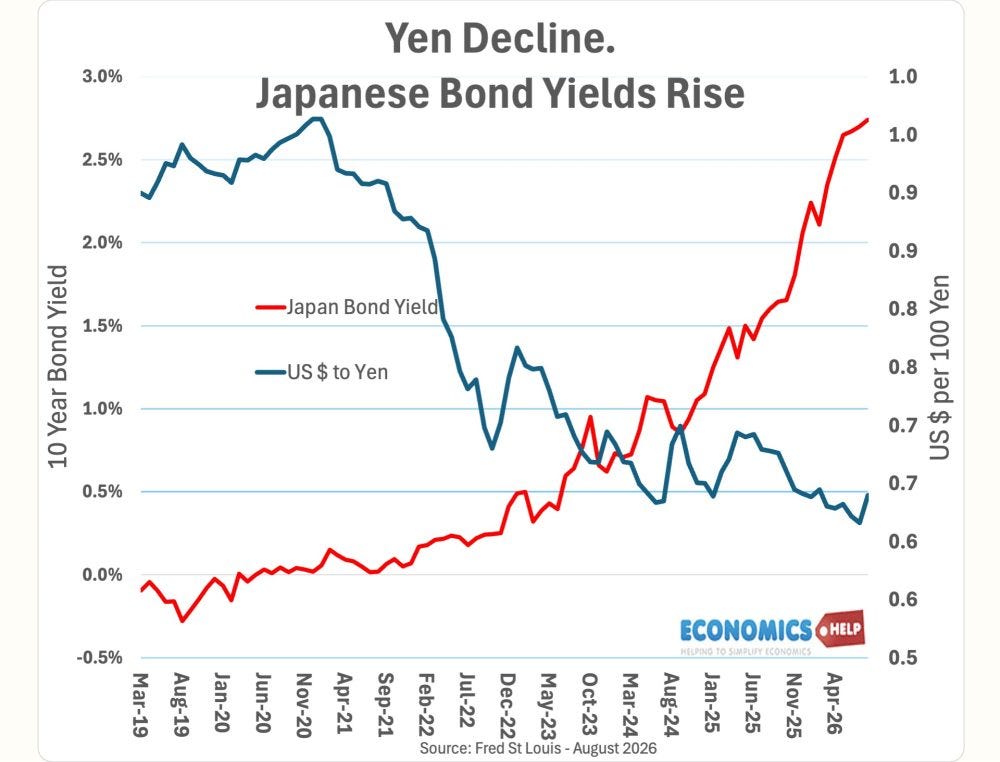
However, this structural arrangement relied entirely on a massive yield differential between Japanese and US sovereign debt. As the Bank of Japan (BOJ) moves away from its historic easing stance to combat domestic wage pressures and currency depreciation, that yield differential is rapidly compressing. The foundational premise of the cross-border carry trade is fracturing in real time.
As JGB yields climb to levels not seen in a generation, Japanese institutional investors face a powerful fiduciary incentive to repatriate their capital. Why assume foreign exchange risk and absorb higher hedging costs to buy US Treasuries yielding 4.5% when domestic government bonds are finally offering attractive, risk-free returns at home? The withdrawal of this critical buyer base from US Treasury auctions threatens to steepen the US yield curve from the outside in, pushing up borrowing costs just as the Federal Reserve attempts to navigate a delicate economic landing.
The Repatriation Feedback Loop and US Market Liquidity

The mechanics of capital repatriation act as a double-edged sword for global financial stability. When Japanese institutions sell foreign assets to bring capital back home, they exert immediate upward pressure on US bond yields. In an era where the US federal deficit continues to expand at a historic pace, the Department of the Treasury relies heavily on uninterrupted market liquidity and robust primary dealer demand to absorb continuous debt issuances.
If Japanese demand for US Treasuries evaporates, the marginal buyer of US debt will demand higher risk premiums. This dynamic cascades directly across the broader financial ecosystem:
- Corporate Borrowing Costs: As sovereign yields rise, corporate debt issuance becomes more expensive, forcing CFOs to downgrade capital expenditure budgets and delay vital strategic initiatives.
- Valuation Compression: Higher risk-free benchmark rates directly challenge equity valuation multiples, particularly in high-growth sectors where future cash flows are heavily discounted against rising benchmark rates.
- Real Estate Pressures: Mortgage rates, which track closely with long-term Treasury benchmarks, face renewed upward pressure, further constricting housing market mobility and residential construction.
Furthermore, the unwinding of the yen-funded carry trade poses acute volatility risks. For years, global hedge funds borrowed low-yielding Japanese yen to invest in higher-yielding US equities, emerging market debt, and commodities. Any sudden spike in Japanese interest rates or sharp appreciation of the yen forces immediate deleveraging, triggering forced liquidations across US risk assets.
| Economic Metric / Indicator | Historical Norm (Pre-Pivot) | Current Environment (2026) | Direct Impact on US Markets |
|---|---|---|---|
| Japan Sovereign Debt Size | ~$10 Trillion equivalent | ~$8–$9 Trillion equivalent | Systemic baseline for global sovereign debt pricing. |
| Japanese Holdings of US Treasuries | Peak > $1.3 Trillion | Declining / Constrained | Reduced foreign absorption at US Treasury auctions. |
| JGB 10-Year Benchmark Yield | Near 0.0% (Capped) | Significantly Higher | Eliminates yield incentive for cross-border capital flight. |
| US Corporate Credit Spreads | Historically Tight | Facing Widening Pressures | Elevated refinancing risks for high-yield borrowers. |
Industry & Market Implications: Winners and Losers
The structural transformation of Japan’s bond market creates a bifurcated landscape across global industries. Asset managers, corporate treasurers, and institutional investors must execute precise risk mitigation strategies to navigate the fallout.
Who Wins
- Japanese Domestic Financial Institutions: Mega-banks, domestic life insurers, and pension funds finally earn positive nominal returns on domestic sovereign debt, improving long-term solvency ratios without taking on risky foreign currency exposure.
- Active Macro Hedge Funds: Sophisticated trading operations positioned to capture currency volatility, yield curve dislocations, and cross-border arbitrage opportunities thrive amid shifting central bank policies.
- US Savers & Fixed-Income Investors: Individuals and conservative institutional portfolios benefit from higher baseline yields on cash equivalents and high-grade fixed-income instruments.
Who Loses
- US Corporate Borrowers & Private Equity: Companies reliant on cheap, abundant leverage face escalating interest expenses, forcing a re-evaluation of M&A activity and debt-funded buybacks.
- The US Department of the Treasury: The federal government faces higher debt-servicing costs as primary dealers demand higher yields to clear auctions in the absence of traditional anchor buyers like Japan.
- High-Growth Equities: Technology firms and venture-backed enterprises experience multiple contraction as discount rates rise, putting a premium on near-term cash flow generation over speculative expansion.
Frequently Asked Questions (People Also Ask)
Why does Japan’s bond market directly impact the US economy?
Japan is the largest foreign holder of US Treasury securities and a major exporter of global capital. When Japanese bond yields rise, institutional investors have less incentive to invest abroad. This repatriation of capital reduces foreign demand for US government debt, driving up American borrowing costs and tightening financial conditions across US markets.
What is the yen carry trade and how does it affect Wall Street?
The yen carry trade involves investors borrowing low-interest Japanese yen to fund purchases of higher-yielding foreign assets, including US stocks and bonds. When Japanese interest rates rise or the yen strengthens rapidly, traders are forced to unwind these positions quickly, which can trigger sudden liquidity crunches and sharp pullbacks in US equity markets.
How are US corporate earnings affected by changes in Japanese monetary policy?
As Japanese capital withdraws from US debt markets, benchmark US interest rates rise. This increases debt-servicing costs for American corporations, compresses equity valuation multiples, and restricts capital allocation for enterprise expansion, technology upgrades, and infrastructure investments.
What role does the Bank of Japan play in global macroeconomic stability?
For decades, the Bank of Japan acted as a provider of ultra-cheap global liquidity. Its recent shifts toward policy normalization mean that global financial markets must adjust to a world with less artificial yield suppression, increasing the importance of rigorous risk mitigation for institutional investors worldwide.
Future Outlook: Milestones and Strategic Imperatives
As the global economy moves deeper through 2026, the financial nexus between Tokyo and Washington will remain a focal point for institutional risk management. Policymakers and market strategists are closely monitoring several critical milestones:
- BOJ Policy Rate Trajectory: The pace and scale of future Bank of Japan rate hikes will dictate the speed of capital repatriation and the ultimate peak of JGB yields.
- US Treasury Auction Metrics: Bid-to-cover ratios and foreign participation levels at upcoming US debt auctions will reveal whether domestic buyers can successfully offset declining foreign demand without destabilizing yield curves.
- Corporate Credit Performance: Monitoring corporate default rates and debt refinancing walls in the US will provide clear signals regarding how effectively businesses are absorbing higher structural interest rates.
Ultimately, the notion that regional monetary policies operate in isolation has been thoroughly dismantled. As AEI research underscores, financial stability in the United States is inextricably linked to the health, liquidity, and pricing dynamics of Japan’s bond market. For institutional leaders, Chief Investment Officers, and corporate executives alike, ignoring the Tokyo transmission channel is a luxury the modern global economy can no longer afford.