Executive Takeaways
- Structural Capital Reallocation: The "Magnificent Seven" (Alphabet, Amazon, Apple, Meta, Microsoft, Nvidia, and Tesla) now represent an unprecedented ~31% weighting of the S&P 500 and over 40% of the Nasdaq 100, forcing institutional desks to migrate from standard cap-weighted vehicles to bespoke, thematic ETF structures.
- Vehicle Segmentation Matters: Investors face a profound tactical choice between pure-play thematic wrappers (such as Roundhill’s MAGS), leveraged/single-stock synthetic notes, modified equal-weight baskets (such as FNGS), and traditional core tech allocations (QQQ, XLK)—each bearing radically divergent rebalancing rules and tracking-error profiles.
- The Capex Paradox and Hyperscaler ROI: With aggregate annual capital expenditure across these tech behemoths surpassing $200 billion—driven by generative and agentic AI infrastructure builds—ETF selection directly dictates investor exposure to GPU depreciation cycles, datacenter power constraints, and cloud revenue conversion multiples.
- Regulatory and Concentration Hazards: The SEC’s diversification guidelines under the Investment Company Act of 1940 (the "25/50 rule") have created systemic friction for legacy sector funds like XLK, creating sudden, multi-billion-dollar rebalancing shocks that agile pure-play ETFs are engineered to bypass.
The Mega-Cap Hegemony: How Seven Equities Hijacked Global Passive Beta
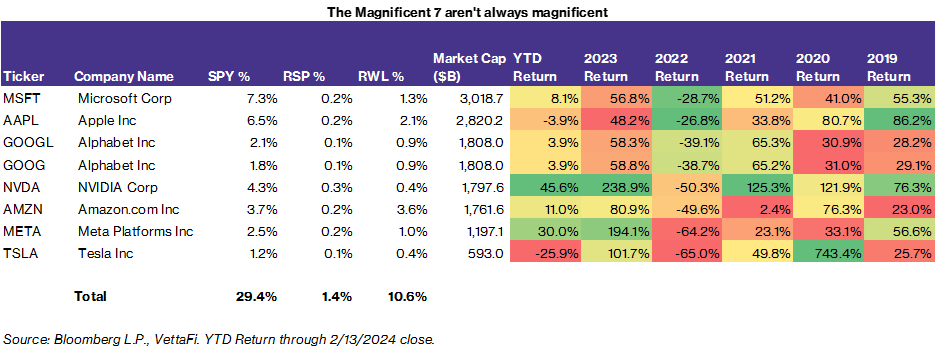
The global equity landscape has reached an unprecedented point of capitalization concentration. What began as a narrative moniker coined to describe Wall Street's primary performance drivers has solidified into a structural liquidity vortex. The Magnificent Seven—Nvidia, Microsoft, Apple, Alphabet, Amazon, Meta Platforms, and Tesla—wield aggregate market capitalizations eclipsing the sovereign equity markets of Japan, the United Kingdom, and France combined. For family offices, sovereign wealth funds, and retail allocators alike, broad market passive indexing is no longer a diversified bet on the American economy; it is an active bet on seven high-beta hyperscalers executing an AI-driven technological super-cycle.
This reality has upended traditional portfolio theory. Standard market-cap-weighted indices, most notably through SPDR S&P 500 ETF Trust (SPY) and Invesco QQQ Trust (QQQ), have delivered superior risk-adjusted alpha over the past three years precisely because of their passive overweighting of these seven names. However, this dynamic introduces asymmetric vulnerability. A failure of enterprise AI to generate tangible, top-line ROI to offset hyperscaler infrastructure spending threatens to trigger correlated downward revisions across the entire index architecture. Consequently, capital allocators are aggressively deploying purpose-built Magnificent Seven ETF vehicles to either isolate, amplify, hedge, or equalize this concentrated mega-cap exposure.
Deconstructing the ETF Architecture: Pure-Play, Thematic, and Synthetic Wrappers
Navigating the ecosystem of mega-cap tech wrappers requires understanding index construction, structural tracking variance, and statutory tax treatments. Investors cannot treat all mega-cap tech exposure as fungible; vehicle mechanics profoundly dictate net real returns.
1. Pure-Play Direct Portfolios: The MAGS Blueprint
The Roundhill Magnificent Seven ETF (Ticker: MAGS) represents the industry’s first direct, physically backed equity wrapper targeting exclusively this cohort. Unlike legacy technology funds governed by broad sector definitions, MAGS utilizes an equal-weight or rules-based quarterly rebalancing across precisely these seven equities. This eliminates peripheral legacy tech drag (such as mature enterprise hardware or telecom providers) while maintaining balanced exposure across semiconductor hardware (Nvidia), enterprise software and cloud infrastructure (Microsoft, Alphabet, Amazon), consumer ecosystem hardware (Apple), digital ad monopolies (Meta, Alphabet), and autonomous/EV systems (Tesla).
2. The Concentrated Growth Proxies: QQQ, QQM, and XLK
The Invesco QQQ Trust (and its lower-cost sibling QQM) tracking the Nasdaq-100 remains the default liquidity hub for high-growth tech exposure. However, QQQ contains 93 other constituents that introduce non-hyperscaler drag, including consumer discretionary, biotech, and transport companies. More problematic is the Technology Select Sector SPDR Fund (XLK). XLK is legally classified as a diversified fund under the Investment Company Act of 1940, subjecting it to the statutory "25/50 rule": no single stock can exceed 25% of the fund’s value, and the sum of all holdings with weights greater than 4.8% cannot exceed 50%. In mid-2024, this mechanic forced XLK to drastically purge its Apple weighting to hold an oversized position in Nvidia, causing severe divergence from market reality. Investors seeking pure Magnificent Seven performance must recognize that sector SPDR funds are encumbered by legacy structural caps.
3. MicroSectors and Thematic Baskets: FNGS and Leveraged Tranches
The MicroSectors FANG+ ETN (Ticker: FNGS) offers an equal-weighted exposure to 10 highly liquid tech titans. While it captures the Magnificent Seven, it also injects idiosyncratic exposure via additional holdings like Broadcom, Netflix, or Snowflake. While ETNs carry structural credit risk tied to the issuing financial institution (such as Bank of Montreal), their strict equal-weight rebalancing provides quarterly profit-taking dynamics—mechanically trimming peak-cycle winners and accumulating names undergoing valuation compression.
Comparative Architecture: Leading Mega-Cap Investment Vehicles
To institutional investors, expense ratios, portfolio concentration, and underlying mechanics are paramount. The following matrix delineates the core operational metrics separating primary mega-cap ETF implementations:
| Ticker | Fund Name | AUM (Est. $B) | Expense Ratio | Mag-7 Weighting (%) | Weighting Methodology | Key Risk Factor |
|---|---|---|---|---|---|---|
| MAGS | Roundhill Magnificent Seven ETF | $1.8B | 0.29% | ~99.5% | Equal-Weighted (Quarterly) | Absolute single-theme concentration; zero diversification |
| FNGS | MicroSectors FANG+ ETN | $2.4B | 0.58% | ~70.0% | Equal-Weighted (Quarterly) | Credit risk of unsecured debt issuer; tracking constraints |
| QQQ | Invesco QQQ Trust | $290B | 0.20% | ~41.5% | Modified Market-Cap | Dilution from non-tech and mature industrial Nasdaq components |
| XLK | Technology Select Sector SPDR | $72B | 0.09% | ~38.0% | Regulated S&P Sector Cap | SEC 25/50 rule distortions; forced abrupt asset dumping |
| RSP | Invesco S&P 500 Equal Weight ETF | $65B | 0.20% | ~1.4% | Equal-Weighted across 500 | Severe structural tracking lag during mega-cap momentum rallies |
The Valuation Dilemma: Free Cash Flow Arbitrage vs. Downstream Capex Depletion
Deploying capital into Magnificent Seven ETFs requires auditing the financial mechanics underlying their aggregate ~$15 trillion enterprise footprint. The critical debate across Wall Street research desks centers on capital expenditure vs. enterprise return on invested capital (ROIC).
Currently, the cohort trades at a blended forward price-to-earnings (P/E) multiple of approximately 29x to 34x—a rich premium relative to the broader S&P 500 equal-weighted index (~17x forward P/E), but notably below historical dot-com bubble extremes where leaders routinely cleared 70x earnings. This valuation premium is defended by fortress balance sheets: the Mag-7 firms possess an aggregate cash and short-term liquid treasury reserve exceeding $500 billion, generating substantial net interest income alongside operational cash flows.
Yet, the operational terrain is shifting from pure software-as-a-service (SaaS) and high-margin ad platforms to heavy industrial computing infrastructure. Between Nvidia's Rubin/Blackwell architecture roadmaps and massive datacenter builds led by Microsoft Azure, Amazon AWS, Google Cloud, and Meta, these firms are undergoing a capital-deepening cycle reminiscent of the early transcontinental telecom buildouts. If agentic AI deployment fails to generate sustained enterprise-tier software recurring revenue within a 12-to-24-month horizon, gross margins will inevitably compress under aggressive server depreciation and escalating power utility costs. Concentrated ETFs (like MAGS) will absorb the full brunt of such downward multiple re-ratings, whereas broader proxies (like QQQ or core market-cap indexes) retain non-correlated shock absorbers.
Industry & Market Implications: The Macro Stratification
The ubiquity of Magnificent Seven ETF vehicles carries profound structural externalities across the broader financial ecosystem:
Market Liquidity and Fragility Mechanics
Because passive capital automatically routes capital based on market-cap weighting or equal-weight basket rules, secondary market flows disproportionately bid the underlying securities of these specific seven firms. This creates a reflexive feedback loop: as institutional, 401(k), and retail money enters index and thematic wrappers, it creates price-insensitive buying pressure that compresses volatility for the largest names while dampening price discovery for small- and mid-cap equities (Russell 2000). A concentrated unwinding in an ETF like MAGS or QQQ has the capacity to destabilize broad market liquidity overnight.
The Winners: Hyperscalers and Specialized Fund Houses
The unequivocal beneficiaries are the hyperscale platforms themselves and tactical ETF issuers. Fund houses capable of launching niche, high-fee-margin derivative overlays (e.g., covered-call variants, leveraged 2x products) capture substantial institutional management fees. Concurrently, the Mag-7 leverage their sky-high equity valuations as transaction currency, consolidating downstream artificial intelligence startups and securing prime power grid allocations ahead of capitalized enterprise competitors.
The Losers: Fundamental Long/Short Equity Hedge Funds
Traditional fundamental active managers have faced generational headwinds. Long/short hedge funds that systematically short mega-caps on historic valuation metrics while going long cheap, cash-generative small/mid-caps have endured severe factor drawdowns. The relentless algorithmic and ETF-driven bid behind the Magnificent Seven has effectively converted passive beta into an aggressive, momentum-skewed active strategy that fundamental stock pickers struggle to beat.
People Also Ask (Frequently Asked Questions)
What is the primary advantage of buying a Magnificent Seven ETF versus purchasing the individual stocks?
A dedicated ETF (such as MAGS) automates systematic rebalancing, dividend reinvestment, and capital allocation without triggering taxable events within the portfolio. For taxable accounts, rebalancing seven individual mega-caps manually to maintain a targeted weighting triggers short- or long-term capital gains taxes on each transaction. The ETF structure utilizes the institutional in-kind creation/redemption process, allowing portfolio adjustments to occur with high tax efficiency while dramatically reducing trading commissions, bid-ask friction, and maintenance overhead.
How does the SEC's 25/50 diversification rule impact technology sector ETFs like XLK?
Under the Investment Company Act of 1940 and the Internal Revenue Code, a registered regulated investment company (RIC) cannot have more than 25% of its total assets invested in a single issuer, and issuers representing more than 5% must not aggregate to more than 50% of the portfolio. In standard market-cap tech ETFs like XLK, when three companies (Apple, Microsoft, Nvidia) concurrently balloon to dominate the index, the fund must mechanically cap exposure to the third-largest holding down to ~4-5%, while allocating heavily to the top two. This leads to profound tracking errors relative to actual market capitalization dynamics.
Is investing in Magnificent Seven ETFs an indirect play on the AI infrastructure boom?
Yes. The Magnificent Seven comprise the primary spenders and hardware architects of the modern artificial intelligence stack. Nvidia designs the leading parallel processing accelerators; Microsoft, Amazon, and Alphabet are the dominant cloud hyperscalers underwriting multi-billion-dollar datacenter builds; Meta is deploying massive open-source AI infrastructure to enhance user engagement; and Apple and Tesla are the targeted consumer-edge execution endpoints (via on-device Apple Intelligence and Autonomous FSD/robotics, respectively). Concentrated Mag-7 exposure functions as a fully integrated proxy on the entire AI value chain.
What are the downsides of equal-weighted Magnificent Seven exposure compared to market-cap-weighted exposure?
An equal-weight Mag-7 structure allocates roughly 14.3% to each constituent at rebalance dates. The downside is structural drag if a single hyper-performer (e.g., Nvidia throughout 2023-2024) significantly outperforms the rest of the group, as its gains are systematically trimmed at each rebalancing cycle to buy lagging constituents (e.g., Tesla during periods of operational drawdown). In a market-cap-weighted approach, winners are allowed to run unbounded, which maximizes upside during momentum-driven bull markets but elevates downside concentration risk when mega-cap leaders finally peak.
Future Outlook: Catalysts, Regulatory Flashpoints, and the Next Cycle
As the market transitions into the next structural epoch of artificial intelligence and high-cost capital allocation, the viability of Magnificent Seven ETF investing will hinge on three critical catalysts:
- Sovereign and Antitrust Scrutiny: The European Commission’s Digital Markets Act (DMA) alongside ongoing US Department of Justice (DOJ) and FTC antitrust actions against Alphabet, Apple, and Amazon present persistent structural headwinds. Any court-ordered breakup, forced unbundling of services, or prohibition of exclusive distribution contracts could destroy ecosystem synergies and fundamentally re-rate multiple valuations lower.
- Transition from CapEx Buildout to Operational Free Cash Flow: The 2025–2027 enterprise software upgrade cycle will serve as the moment of truth for the hyperscalers. Investors deploying capital into mega-cap tech vehicles must monitor enterprise cloud consumption metrics and marginal software revenue. If enterprises fail to transition pilot AI architectures into commercial production workloads, hyperscalers will scale back capital spending, severely punishing semiconductor and hardware components.
- Power and Energy Constraints: The primary bottleneck for Mag-7 expansion is no longer simply capital or algorithmic advancement—it is baseload electric power availability. Long-term corporate agreements between these tech giants and nuclear, geothermal, and utility operators will define which hyperscalers maintain scalable cloud capacity, permanently stratifying long-term equity returns within the Magnificent Seven construct.
For modern capital allocators, Magnificent Seven ETFs represent the definitive institutional instrument for navigating this landscape: a potent, highly liquid, yet structurally concentrated vehicle that sits at the literal center of global financial markets.