Executive Takeaways
- An Absolute Monolith: In an unprecedented alignment of sell-side sentiment, all 21 premier investment bank equity strategists surveyed by Bloomberg News predict positive gains for the S&P 500 in 2026, with zero forecasting a market contraction.
- Underlying Catalysts: The aggregate bullish thesis hinges on the transition of Artificial Intelligence from infrastructure capex to measurable enterprise ROI, synchronized central bank monetary easing, and resilient corporate earnings growth.
- Valuation Multiples Under Pressure: With forward price-to-earnings (P/E) ratios hovering above long-term historical averages, analysts are wagering that operating margin expansion will outrun compressed equity risk premia.
- The Contrarian Threat: Market historians note that total unanimity among Wall Street prognosticators often signals acute systemic vulnerability, where even nominal macro shocks can trigger rapid liquidity reassessments.
The Anatomy of an Unprecedented Consensus
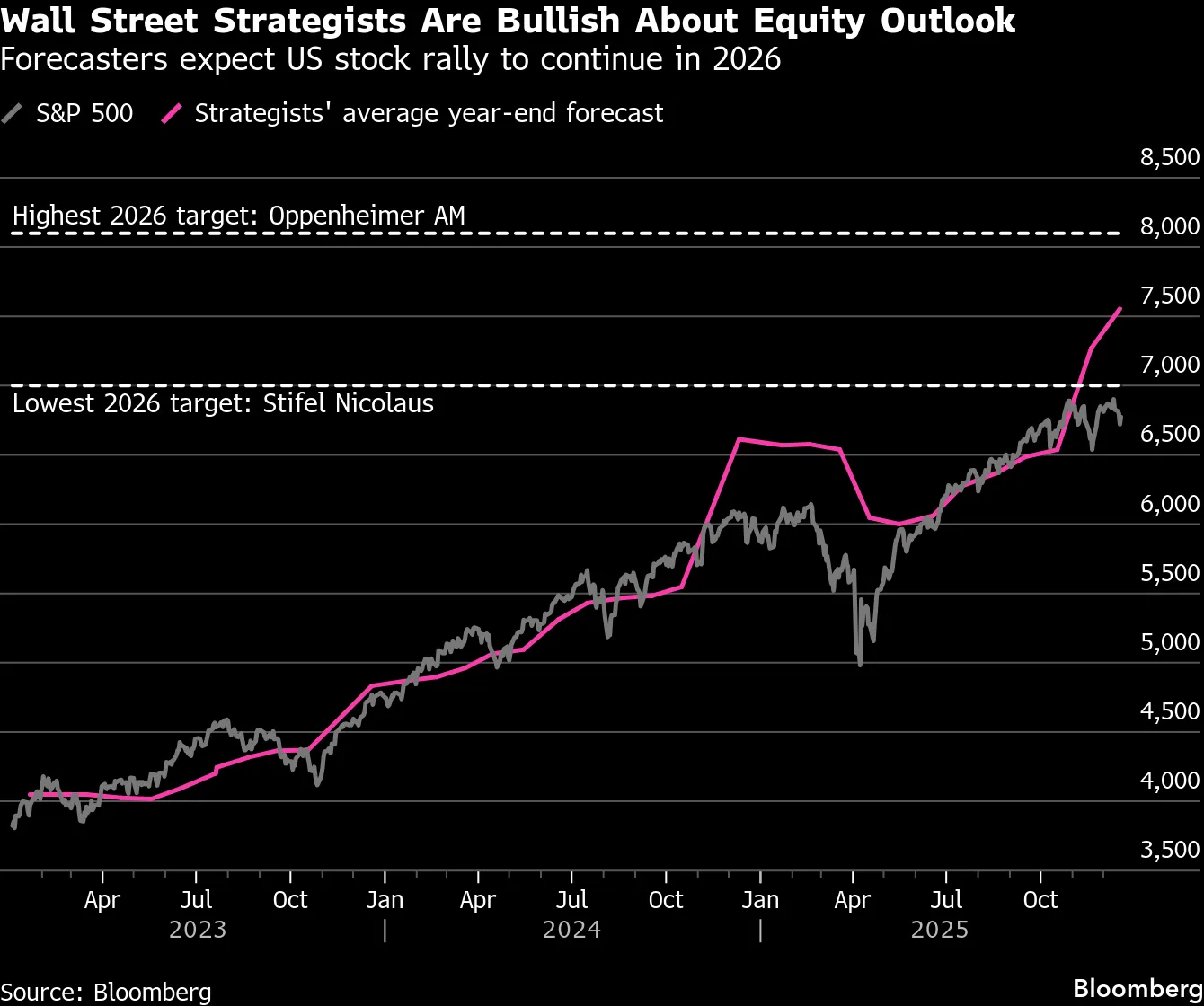
As trading desks close their ledgers on 2025, Wall Street has engineered a phenomenon rarely seen in modern capital markets: complete, unwavering unanimity. According to year-end survey data compiled by Bloomberg News across 21 top-tier financial institutions—including Goldman Sachs, Morgan Stanley, JPMorgan Chase, and Citigroup—not a single chief equity strategist is forecasting a retreat for U.S. equities in 2026. Price targets for the S&P 500 range from modest single-digit appreciations to aggressive double-digit bull cases, but the directional consensus is absolute.
Sell-side uniformity of this scale is historically anomalous. Even during the post-pandemic recovery cycles or the mid-1990s tech expansion, market sentiment typically maintained a vocal contrarian cadre warning of macroeconomic overheating, debt sustainability issues, or valuation excess. Today, that skepticism has systematically evaporated from published headline targets. The prevailing Wall Street consensus models an uninterrupted economic landing, an accommodating Federal Reserve, and historic cash flows cascading from corporate balance sheets into equity buybacks and tech-driven efficiency gains.
However, beneath the veneer of collective optimism lies a complex web of structural assumptions. To understand how every premier bank arrived at identical bullish conclusions requires dissecting the twin engines of Wall Street's 2026 modeling: structural monetary easing and the financial monetization of enterprise AI architectures.
The Fundamental Engines: Enterprise ROI, Monetary Policy, and Capital Allocation
The institutional rationale underpinning the 2026 rally rests primarily on corporate earnings resilience. Equity research divisions project that aggregate S&P 500 earnings per share (EPS) will expand by 11% to 14% year-over-year. What differentiates this cycle from earlier speculative phases is the composition of that expected growth. Analysts argue that the trillions deployed into cloud compute architecture, data centers, and advanced semiconductor clusters across 2023–2025 are finally shifting into an operational monetization phase.
Over the past 24 months, tech behemoths sustained unprecedented capital allocation programs, prompting equity markets to demand verifiable proofs of enterprise ROI. Heading into 2026, enterprise software integrations, automated corporate workflows, and custom large language models are projected to widen net profit margins across non-tech sectors—including healthcare, logistics, and regional financial services. This broader operational leverage provides Wall Street with the quantitative justification to keep terminal growth rates elevated.
Simultaneously, the global interest rate architecture is functioning as a broad tailwind. With inflation metrics stabilizing within institutional tolerance bands, the Federal Reserve and the European Central Bank have recalibrated their policy rates downward toward neutral territory. This easing has substantially lowered borrowing costs for high-yield corporate issuers, unfrozen mid-market syndicated debt, and reduced the hurdle rate for capital investment. Consequently, portfolio managers who spent years parked in short-duration Treasury bills and money market funds yielding over 5% are faced with dwindling cash returns, prompting an ongoing reallocation toward risk assets.
Valuation Realities: Street Estimates for 2026
The table below synthesizes the consolidated sell-side projections, median baseline estimates, and core economic indicators that formulate Wall Street’s unanimous outlook for the 2026 trading year.
| Metric / Strategic Parameter | Median Consensus (21 Analysts) | Bull Case Distribution (Upper Decile) | Bear Case Floor (Lowest Target) |
|---|---|---|---|
| S&P 500 Year-End 2026 Target | 6,850 | 7,300 | 6,100 (+1.2% from current) |
| Projected EPS Growth (YoY) | +12.4% | +15.8% | +7.5% |
| Forward P/E Multiple Assumed | 21.8x | 23.5x | 19.5x |
| Federal Reserve Terminal Rate Baseline | 3.25% - 3.50% | 2.75% - 3.00% | 3.75% - 4.00% |
| Corporate Share Repurchases (Est.) | $1.18 Trillion | $1.35 Trillion | $980 Billion |
| Directional Outlook for Equities | 100% Positive (21 of 21) | N/A | 0% Negative |
The Peril of Institutional Groupthink: Contrarian Warning Signals
While the quantitative inputs behind these projections appear cohesive on an individual spreadsheet, market historians view total sell-side alignment as a flashing yellow light for broader market liquidity. The fundamental flaw of unanimous institutional optimism is structural: when every major market participant is positioned for an upside scenario, the capacity for positive surprises diminishes, while the sensitivity to negative anomalies increases exponentially.
The concept of "groupthink" on Wall Street is rarely born out of negligence; it is heavily influenced by business model incentives. Independent forecasters and investment banking desks navigate severe reputational risk asymmetry. Under-projecting equity gains in a rising market risks alienation from institutional asset managers and corporate finance clients seeking optimistic underwriting conditions. Conversely, missing a market downturn alongside every other major peer carries minimal individual reputational cost.
This dynamic poses genuine structural risks when examining the equity risk premium (ERP)—the additional return an investor demands for choosing equities over risk-free government paper. The ERP remains at multi-decade lows. If S&P 500 forward price-to-earnings multiples contract from their current high-20s marks due to unforeseen inflationary re-acceleration, geopolitical trade escalations, or fiscal policy deadlocks, the absence of an analytical safety buffer could spark sudden equity drawdowns. In a market where not one desk anticipates a loss, even a modest liquidity shock can transform into an aggressive cascade of automated de-risking.
Industry & Market Implications: Who Capitalizes, Who Is Vulnerable?
The universal expectation of higher equity prices creates distinct winners and losers across institutional sectors, changing how corporate balance sheets, asset managers, and private market vehicles will operate in 2026.
Market Winners
- Hyperscale Cloud & Semiconductor Ecosystems: Continued capital allocation into custom silicon, server deployment, and accelerated compute guarantees sustained order backlogs for foundries and systems integrators.
- Tier-1 Investment Banks & Private Equity: A benign macroeconomic environment and predictable cost of capital create the foundation for an acceleration in mergers and acquisitions (M&A), initial public offerings (IPOs), and debt restructuring.
- Cyclical and Industrial Leaders: Lower benchmark interest rates and sustained infrastructure spending provide relief to heavily capitalized manufacturing, utility, and heavy transport firms that struggled under peak rate environments.
Market Losers & Vulnerabilities
- Defensive and Fixed-Income Proxies: Traditional utilities, consumer staples, and low-yield long-duration sovereign paper will face consistent capital flight as institutional investors rotate toward growth assets.
- Cash-Consumptive Mid-Cap Tech: Despite broader enthusiasm, companies lacking a path to operational margin expansion and positive free cash flow will find that public markets remain unforgiving of high cash burns.
- Short-Biased Funds & Volatility Arbitrageurs: Systematic long-only momentum and retail ETF flows will continue to suppress baseline equity market volatility, pressuring the business models of classical hedging specialists.
Frequently Asked Questions (People Also Ask)
Why is it so rare for every Wall Street analyst to predict a stock market rally?
Wall Street typically features divergent perspectives between bullish desks and risk-averse or value-oriented shops. At any given point, varying models on macroeconomic conditions, corporate leverage, and policy intervention produce mixed outcomes. A scenario where all 21 premier analysts surveyed project positive returns indicates an extraordinary degree of confidence in the underlying fundamentals—specifically sustained earnings expansion, monetary easing, and macro stabilization—effectively eliminating dissent from baseline financial projections.
What are the primary macro risks that could disrupt Wall Street's 2026 forecast?
The most immediate systemic risks to this unanimous outlook include unexpected inflationary persistence (which would halt central bank rate-reduction cycles), escalating trade barriers or tariffs that compress multinational corporate margins, geopolitical disruptions affecting critical energy supply chains, and sovereign debt refinancing friction. Furthermore, any material shortfall in enterprise AI monetization relative to massive hyperscale capital expenditures could trigger deep valuation multiple compression.
How does current stock market valuation affect the likelihood of a 2026 rally?
With forward price-to-earnings multiples trading significantly above historical averages, the S&P 500 has limited room for multiple expansion. This means any equity rally in 2026 must be driven almost entirely by genuine, unvarnished corporate earnings growth rather than investors paying higher prices for each dollar of earnings. If corporate earnings fail to hit double-digit growth targets, current valuation multiples will likely contract, suppressing the projected rally.
Has unanimous Wall Street bullishness occurred before, and what happened?
Historically, broad consensus bullishness has preceded both strong extended rallies and severe market corrections. Monolithic optimism was widely prevalent heading into the late-1990s and prior to previous inflection points like 2007 and 2022. While consensus optimism accurately reflected underlying momentum in the mid-1990s, unanimous alignment often limits the market's resilience against unforeseen shocks, transforming unexpected negative catalysts into outsized market corrections.
Future Outlook: Strategic Milestones to Watch in 2026
The validation or unraveling of Wall Street’s 2026 thesis will happen early in the calendar year. Institutional allocators must track three crucial operational milestones to measure whether this unanimous optimism holds structural weight or collapses into narrative fatigue.
First, corporate earnings announcements across Q1 and Q2 2026 will serve as the litmus test for non-tech margin expansion. Analysts will scrutinize whether general software, healthcare, financial, and industrial corporations report lower operational expenditure ratios derived from AI and automation investments. If enterprise ROI remains ambiguous, the primary fundamental pillar supporting broad-based multiples will crack.
Second, the pace of corporate capital returns—specifically equity repurchases—will reveal management confidence. Wall Street expects buyback authorizations to cross the $1 trillion mark annually. Any pullback in share repurchase execution in favor of corporate debt retirement or defensive liquidity preservation will signal executive caution that directly contradicts sell-side optimism.
Third, liquidity metrics managed by global central banks, including the wind-down of quantitative tightening (QT) operations and sovereign debt absorption rates, will dictate whether baseline multiples can remain elevated. If real borrowing costs stabilize as projected, the path of least resistance remains upward. But in a market where every major player has already bet on a rally, even a minor miscalculation in macroeconomic mechanics could deliver a reality check to the most optimistic consensus Wall Street has ever produced.