Executive Takeaways
- NVIDIA’s Moat: Beyond hardware raw performance, NVIDIA’s CUDA software ecosystem creates an almost insurmountable switching cost for enterprise buyers, insulating its valuation multiples.
- The Hyperscaler Counteroffensive: Major cloud service providers (AWS, Microsoft Azure, Google Cloud) are accelerating proprietary ASIC capital allocation to reduce margin erosion and mitigate single-vendor supply chain risk.
- The Fragmentation of Silicon: The AI chip market has splintered beyond GPUs into specialized neuromorphic, edge-inferencing, and optical interconnect architectures, giving rise to over 30 viable competitors.
For decades, the semiconductor industry operated on a predictable, albeit capital-intensive, cyclical cadence tied to personal computing, mobile adoption, and enterprise data center refreshes. That paradigm evaporated the moment generative models crossed the threshold from academic curiosities to enterprise imperatives. Today, silicon is the new crude oil, and NVIDIA Corp. sits atop a geostrategic throne, commanding market capitalizations that rival the GDPs of G7 nations. Yet, beneath the veneer of Jensen Huang’s leather jacket-clad keynotes lies a ferocious, multi-front war for infrastructure scalability, architectural dominance, and enterprise wallet share.
According to recent market intelligence reports from AIMultiple and proprietary Wall Street supply-chain tracking, the ecosystem of artificial intelligence hardware developers has expanded rapidly. While NVIDIA captures the lion’s share of high-margin data center deployments, an unprecedented wave of over 30 alternative chipmakers—spanning hyper-scaler custom ASICs, venture-backed silicon startups, and legacy enterprise giants—are aggressively positioning themselves to disrupt the status quo. For institutional investors, chief technology officers, and risk-mitigation strategists, understanding this shifting topography is no longer optional; it is a fiduciary requirement.
The Anatomy of NVIDIA’s Supremacy: Hardware Meets Software Lock-In
To comprehend why NVIDIA commands gross margins exceeding 70%, one must look past raw floating-point operations per second (FLOPS). The company’s true economic moat is CUDA (Compute Unified Device Architecture), a proprietary parallel computing platform launched in 2006. By giving developers direct access to the GPU's instruction set long before the deep learning boom, NVIDIA fostered a developer diaspora that now spans virtually every major machine learning framework, from PyTorch to TensorFlow.
This software lock-in has profound implications for enterprise ROI. When Chief Information Officers approve multi-million-dollar capital allocations for server racks populated by H100, H200, or Blackwell-generation chips, they are not merely purchasing silicon; they are buying guaranteed software compatibility, reduced compilation times, and verified cloud compute architecture. NVIDIA’s vertically integrated approach—spanning switches, networking cables (via its Mellanox acquisition), and full-stack orchestration software—creates a turnkey infrastructure solution that legacy competitors struggle to replicate.
However, this market concentration introduces systemic vulnerabilities. Global enterprises and sovereign states alike are urgently seeking supply chain diversification to hedge against geopolitical friction in the Taiwan Strait, export control tightening by the U.S. Bureau of Industry and Security (BIS), and pricing power abuses. This market vulnerability has catalyzed a golden age of semiconductor competition.
The Challengers: Hyperscaler ASICs and Venture-Backed Silicon
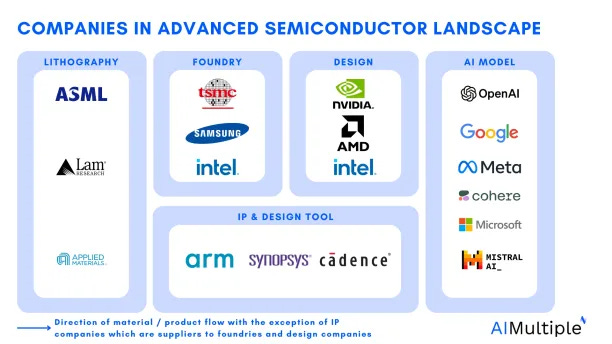
The competitive landscape outside of NVIDIA can be segmented into three distinct tiers: Hyperscale Cloud Service Providers (CSPs) building application-specific integrated circuits (ASICs), established merchant silicon heavyweights pivoting their portfolios, and venture-backed fabless startups targeting hyper-specific performance niches.
1. The Hyperscale In-House Assault
The world’s largest buyers of AI compute—Amazon Web Services (AWS), Microsoft, and Google—are systematically reducing their dependency on NVIDIA through aggressive capital allocation toward proprietary silicon. Google’s Tensor Processing Unit (TPU), now in its v5p and truncheon iterations, powers the foundational training of Gemini models internally while being monetized via Google Cloud Platform (GCP). Similarly, AWS has doubled down on its Trainium and Inferentia chips, offering cost-optimized inference alternatives to budget-conscious enterprise clients. Microsoft’s recent unveiling of the Maia 100 AI accelerator signals a parallel intent to optimize internal workloads, particularly for its OpenAI partnership, thereby safeguarding margins against rising component costs.
2. The Merchant Silicon Counter-Offensive
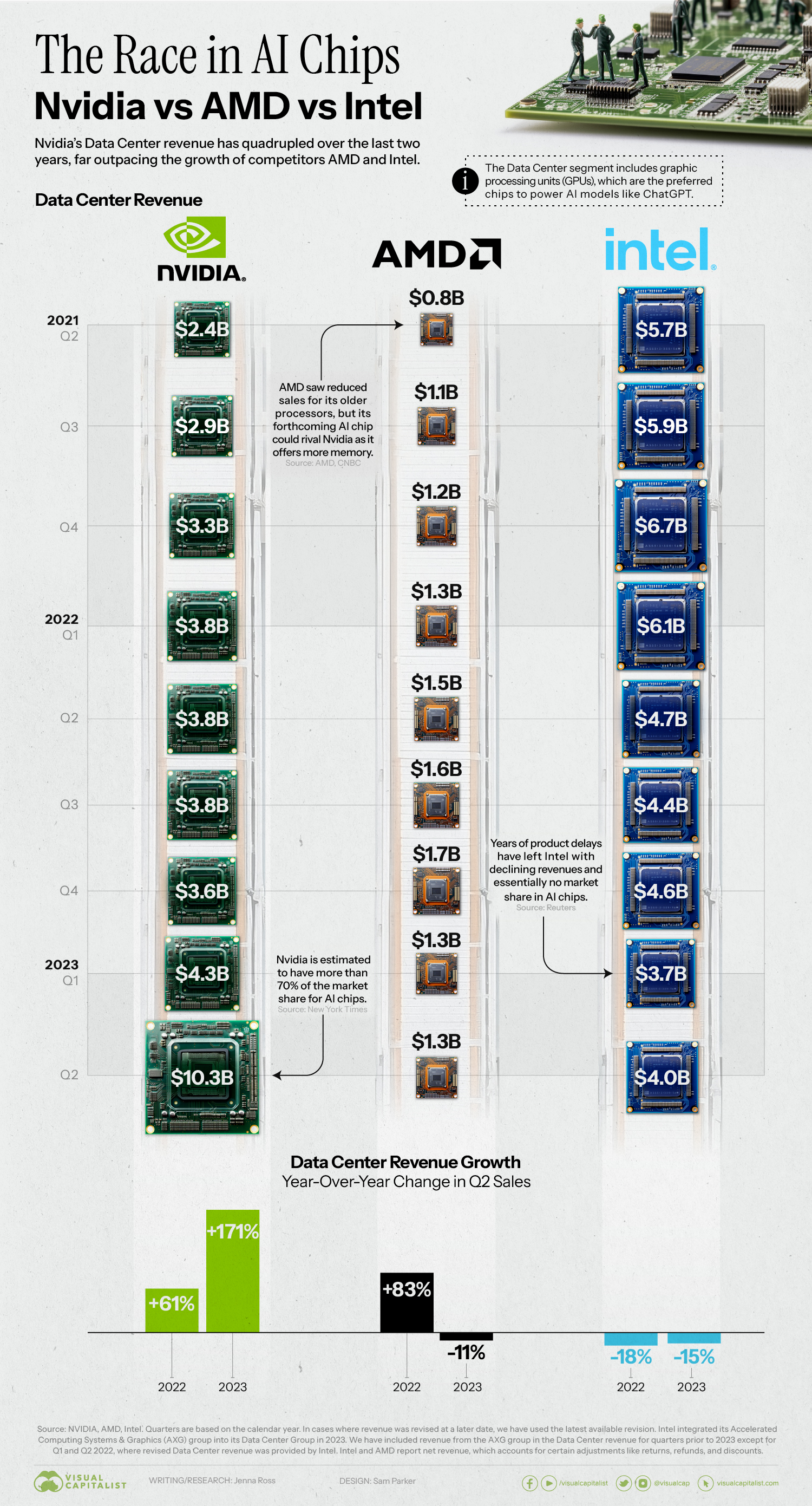
Advanced Micro Devices (AMD) and Intel remain NVIDIA's most formidable traditional merchant competitors. AMD’s MI300 series has successfully courted major tier-1 cloud buyers looking for multi-source optionality, boasting impressive memory bandwidth figures that rival competing architectures. Meanwhile, Intel, under the leadership of its foundry transformation strategy, is attempting a dual-pronged attack: producing chips for external fabless designers while pushing its Gaudi accelerator line as an open, cost-effective alternative for enterprise deployments.
3. The Specialized Startup Vanguard
Beyond the Fortune 500 giants, a diverse cohort of venture-backed startups is carving out defensible niches. Companies like Cerebras Systems have bypassed standard GPU limitations entirely by engineering wafer-scale engines—massive single-chip silicon monoliths designed to house entire neural networks on a single die. Other innovators, such as Groq, leverage deterministic instruction set architectures (LPU technology) to decimate latency barriers in real-time language model inferencing. Meanwhile, Graphcore (acquired by SoftBank) pioneered Graph Processing Units designed specifically to exploit sparse graph structures inherent in advanced AI workloads.
Verified Data & Metrics Breakdown
Evaluating the macroeconomic weight of these players requires a granular look at performance metrics, target workloads, and market positioning across the top-tier semiconductor landscape:
| Company / Architecture | Primary Chip Family | Target Workload | Strategic Advantage | Primary Market Risk |
|---|---|---|---|---|
| NVIDIA | Blackwell (B200), H200 | Training & Large-Scale Inference | Unmatched CUDA ecosystem, full-stack networking | Geopolitical exposure, extreme valuation multiples |
| Google (Alphabet) | TPU v5p / Trillium | LLM Training & Cloud Inference | Massive internal deployment, cost efficiency | Limited merchant availability outside GCP |
| AMD | Instinct MI300X | Generative AI Training & Serving | High memory bandwidth, competitive pricing | Software maturity lag relative to CUDA |
| Amazon Web Services | Trainium2 / Inferentia2 | Cost-Optimized Cloud Inference | Deep integration into AWS cloud infrastructure | Developer adoption restricted to AWS ecosystem |
| Intel | Gaudi 3 / Xeon Scalable | Enterprise Hybrid Workloads | Established enterprise footprint, foundry optionality | Execution risk in manufacturing turnaround |
Industry & Market Implications: Winners, Losers, and Economic Shifts
The structural transition toward specialized AI hardware is reshaping global capital allocation, corporate balance sheets, and geopolitical alliances. As organizations evaluate their technology budgets, the financial ramifications are stark.
Who Wins
Advanced Foundries: Taiwan Semiconductor Manufacturing Company (TSMC) remains the primary bottleneck and beneficiary of the AI boom, manufacturing the vast majority of advanced accelerators for both NVIDIA and its fabless competitors.
Enterprise End-Users with Proprietary Data: Corporations that successfully deploy localized, cost-effective inference chips will realize operational efficiencies and productivity gains that outpace infrastructure expenditure amortization.
Energy Infrastructure Providers: The extreme power density requirements of dense AI clusters have triggered unprecedented demand for grid modernization, nuclear power integration, and advanced liquid-cooling engineering firms.
Who Loses
Legacy CPU-Centric Enterprises: Data centers built exclusively around traditional central processing units face obsolescence as parallel processing workloads become the baseline enterprise requirement.
Under-Capitalized Startups: Fabless semiconductor ventures that fail to secure tier-1 foundry capacity or run out of runway before achieving software parity with CUDA face immediate liquidation or distressed acquisition.
Frequently Asked Questions (People Also Ask)
1. Why is NVIDIA dominant in AI chips compared to traditional semiconductor giants?
NVIDIA’s dominance is not solely a function of raw hardware performance, but rather its early and aggressive investment in software ecosystems. The creation of CUDA in 2006 established a standard programming model that machine learning researchers and developers adopted universally. Consequently, switching to competing hardware incurs massive engineering overhead, effectively locking enterprises into NVIDIA’s vertically integrated stack.
2. How do hyperscale custom ASICs (like Google TPU or AWS Trainium) impact NVIDIA’s pricing power?
Hyperscale custom ASICs act as a vital price ceiling and volume buffer. While they rarely unseat NVIDIA for bleeding-edge frontier model training, they successfully internalize a significant portion of predictable, high-volume inference workloads. This limits NVIDIA’s ability to extract infinite margin expansion from cloud providers who possess the engineering talent to design their own silicon.
3. What are the primary bottlenecks facing new AI chip manufacturers entering the market?
New entrants face three primary barriers: advanced packaging capacity (such as Chip-on-Wafer-on-Substrate or CoWoS) which is tightly controlled by TSMC; software maturity (emulating or bridging the CUDA software moat); and astronomical non-recurring engineering (NRE) costs associated with sub-3nm chip tape-outs.
4. Are traditional GPUs expected to remain the standard for AI compute, or will alternative architectures take over?
While GPUs will remain foundational for large-scale model training due to their massive parallel throughput, the industry is fragmenting. For real-time inferencing and edge computing, domain-specific architectures—including LPUs, neuromorphic chips, and optical interconnect processors—are gaining market share by optimizing latency and power efficiency over raw floating-point versatility.
Future Outlook: Milestones and Strategic Horizons
As the AI hardware market matures past its initial hyper-growth phase, several structural milestones will dictate the next decade of semiconductor economics. First, the commercial viability of 2nm and 1.4nm process nodes will test the financial limits of capital expenditure, separating well-capitalized tech titans from secondary players. Second, the maturation of open-source compilation frameworks (such as MLIR and Triton) aims to systematically dismantle the CUDA software moat, potentially democratizing merchant silicon adoption.
For executive leadership teams and institutional portfolio managers, risk mitigation will require a balanced portfolio strategy: hedging core NVIDIA infrastructure dependencies with agile, multi-source ASIC and merchant silicon deployments. In the high-stakes theater of artificial intelligence, silicon is no longer merely a component; it is the ultimate determinant of corporate survival and national sovereignty.