NEW YORK, LONDON, FRANKFURT — In the high-stakes theater of global commerce, the traditional supply chain has ceased to be a mere logistics backwater. Driven by geopolitical friction, labor shortages, and margin compression, the architecture of global trade is undergoing its most radical structural pivot since the invention of containerization. According to comprehensive market intelligence compiled by AIMultiple, enterprise capital allocation is shifting decisively toward autonomous, machine-learning-driven supply chain orchestration. For CFOs, chief supply chain officers (CSCOs), and institutional investors, deploying top-tier supply chain AI tools is no longer a speculative technology experiment; it is a primary determinant of valuation multiples, working capital optimization, and enterprise risk mitigation.
This investigative report breaks down the top 20 supply chain AI tools reshaping the global economy, examining how advanced neural networks, predictive analytics, and cloud compute architecture are rewriting the rules of inventory management, demand forecasting, and tier-one risk mitigation.
Executive Takeaways
- Capital Allocation Shift: Global enterprises are redirecting IT budgets toward AI-native supply chain platforms to combat inflation, labor deficits, and volatile consumer demand patterns.
- Precision Over Guesswork: Modern AI tools move beyond legacy ERP reporting, leveraging real-time telemetry, maritime tracking, and macro-economic indicators to predict disruptions weeks before they materialize.
- Valuation Multiples: Publicly traded firms demonstrating high inventory velocity and automated resilience through AI consistently command premium valuation multiples from institutional equity analysts.
- Risk Mitigation: Multi-tier supplier visibility tools have transformed from compliance checklists into essential national security and operational continuity assets.
The Macro Catalyst: Why Supply Chain AI is the Defining Enterprise Investment of the Decade
For decades, global supply chains operated on a fundamentally flawed premise: that historical data was a reliable proxy for future outcomes. The systemic shocks of the 2020s—spanning pandemically induced factory closures, geopolitical blockades in critical shipping lanes, and wild fluctuations in raw material pricing—shattered that assumption. Legacy enterprise resource planning (ERP) systems built by SAP and Oracle in the late 20th century were simply not engineered to process millions of real-time variables across multi-tier supplier networks.
Enter the era of AI-driven supply chain orchestration. By leveraging advanced natural language processing (NLP), computer vision, and deep reinforcement learning, contemporary software platforms ingest everything from satellite imagery of port congestion to macroeconomic currency fluctuations. The goal is absolute operational visibility. Enterprise ROI on these deployments has proven staggering, with early adopters reporting reductions in carrying costs of up to 25% and forecast accuracy improvements exceeding 40%.
Categorizing the Top 20 Supply Chain AI Tools

To understand the current competitive landscape, industry analysts generally segment supply chain AI tools into functional categories: Demand Sensing & Forecasting, Inventory & Warehouse Optimization, Transportation & Fleet Management, and Multi-Tier Risk Mitigation. Below is the definitive breakdown of the top 20 tools dominating the enterprise market.
1. Demand Sensing & Forecasting Powerhouses
- Llamasoft / Coupa Supply Chain Modeler: Utilizes advanced network optimization algorithms to simulate structural changes, tariff adjustments, and demand shocks, allowing executives to stress-test capital expenditure strategies.
- Blue Yonder Luminate: Employs machine learning to ingest external signals—such as weather patterns, local events, and social media sentiment—to drastically reduce forecast error in fast-moving consumer goods (FMCG).
- o9 Solutions Enterprise Knowledge Graph (EKG): Connects disparate data silos across commercial, financial, and operational domains into a single AI-driven brain, driving collaborative planning and rapid consensus.
- Kinaxis RapidResponse: Offers concurrent planning technology that instantly propagates demand or supply changes across the entire value chain, reducing latency from weeks to minutes.
- E2open Channel Data Management: Uses AI to cleanse and harmonize point-of-sale data from global channel partners, providing brand owners with immediate visibility into true end-consumer demand.
2. Inventory & Warehouse Automation Engines
- Relex Solutions: Specializes in retail and grocery supply chains, using proprietary AI to automate inventory replenishment, perishable goods management, and markdown optimization.
- Veridian / Dematic AI WMS: Integrates computer vision and robotic pick-path optimization within fulfillment centers to maximize throughput and minimize human error.
- Leaf Logistics: Applies AI to contract and spot market freight pricing, helping shippers stabilize transportation spend and secure capacity through predictive rate modeling.
- Slim4 by Slimstock: Targets mid-market enterprises, using inventory optimization algorithms to slash excess stock while protecting service levels against supply volatility.
- StockTrim: Delivers automated demand forecasting and inventory modeling tailored for growing distributors navigating complex lead-time variability.
3. Transportation, Logistics & Fleet Intelligence
- FourKites: A market leader in real-time supply chain visibility, leveraging predictive ETA algorithms powered by machine learning to track global ocean, air, and over-the-road freight.
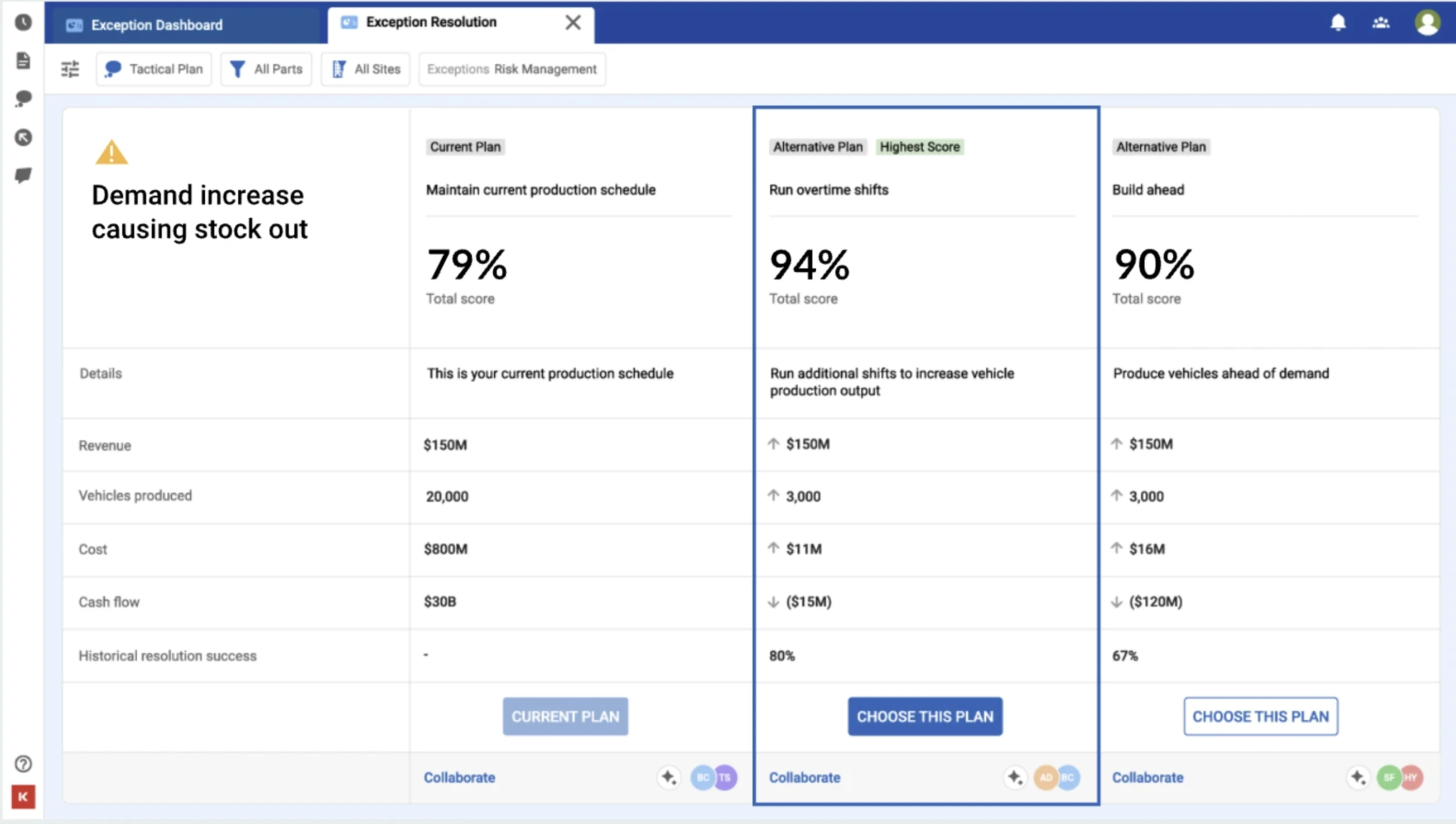
- Project44: Connects global shippers with real-time carrier telemetry, utilizing AI to automate exception management and customer communication when transit delays occur.
- Transporeon: Uses autonomous procurement algorithms to match spot freight demand with available carrier capacity, optimizing pricing and reducing empty-mile runs.
- ClearMetal (acquired by Descartes): Applies data science to international ocean shipping, predicting container roll rates and customs holds with unprecedented accuracy.
- Samsara Fleet AI: Combines dashcam computer vision with telematics to monitor driver safety, fuel efficiency, and route optimization in real time.
4. Risk Mitigation & Multi-Tier Supplier Intelligence
- Resilinc: The gold standard for multi-tier sub-tier mapping, using AI web-crawlers to monitor global news, weather, and financial health data to alert enterprises to supplier bankruptcies or factory fires before they impact production lines.
- Everstream Analytics: Combines artificial intelligence with human risk analyst oversight to deliver continuous predictive risk scoring across logistics lanes and supplier hubs.
- Interos: Operates an AI-driven operational resilience platform that maps complex enterprise supply chains down to raw material inputs, identifying hidden geopolitical, financial, and cybersecurity vulnerabilities.
- Coupa Risk Assess: Streamlines supplier onboarding and continuous monitoring by automating compliance checks, ESG reporting, and financial viability assessments.
- Siemens MindSphere / Industrial IoT: Integrates factory-floor machine telemetry with supply chain scheduling, ensuring raw material flows match real-time manufacturing consumption rates.
Verified Data & Metrics Breakdown
Institutional adoption of supply chain AI is underpinned by compelling performance metrics. The following comparative table highlights key operational impacts observed across Fortune 500 deployments:
| Metric / Performance Indicator | Legacy ERP Baseline | AI-Enabled Supply Chain Benchmark | Primary Business Impact |
|---|---|---|---|
| Demand Forecast Accuracy | 55% – 65% | 85% – 95% | Reduction in stockouts and costly emergency freight expediting. |
| Inventory Carrying Costs | Baseline (100%) | -18% to -25% | Freed-up working capital deployed toward high-yield corporate initiatives. |
| Disruption Lead-Time Warning | Reactive (Post-Event) | 14 to 28 Days Prior | Enables proactive dual-sourcing before production lines halt. |
| Warehouse Picking Productivity | Standard Human Pace | +30% to +45% Improvement | Mitigates severe warehouse labor shortages and rising hourly wages. |
Industry & Market Implications: Winners, Losers, and Economic Realignment
The economic ramifications of this technological shift extend far beyond corporate IT budgets. Wall Street equity research desks are increasingly penalizing conglomerates that maintain opaque, siloed supply chains while rewarding agile operators with multiple expansion.
The Winners: Enterprise software conglomerates that successfully acquired or developed native AI engines (such as SAP, Blue Yonder, and Coupa) are capturing massive enterprise SaaS recurring revenues. Furthermore, third-party logistics (3PL) providers that leverage platforms like FourKites and Project44 are winning lucrative contracts by offering unprecedented transparency to brand owners.
The Losers: Legacy consulting firms and traditional freight forwarders that rely on manual spreadsheet data entry, phone-tag communication, and reactive problem-solving are facing existential margin erosion. Enterprises are rapidly cutting out intermediaries that fail to provide real-time API integrations and predictive analytics.
From a macroeconomic perspective, widespread adoption of these 20 tools acts as a structural deflationary pressure valve. By eliminating excess safety stock, optimizing fuel burn through route intelligence, and preventing multi-million-dollar factory shutdowns, AI-driven supply chains protect corporate operating margins against persistent inflationary tailwinds.
Frequently Asked Questions (People Also Ask)
How do AI supply chain tools integrate with legacy ERP systems like SAP and Oracle?
Modern supply chain AI platforms utilize cloud-native API architectures and enterprise service buses (ESBs) to extract data from legacy ERP databases without disrupting core transactional systems. Rather than replacing systems of record like SAP, AI tools act as "systems of intelligence," layering advanced predictive analytics on top of historical ledger data.
What is the typical timeframe for realizing enterprise ROI on supply chain AI deployments?
According to industry benchmark studies, enterprises typically achieve positive ROI within 6 to 12 months of full deployment. Quick-win modules focused on inventory reduction and freight spot-rate optimization often pay for themselves within the first two quarters by immediately slashing excess working capital and reducing demurrage fees.
Do mid-market companies have access to these enterprise-grade AI tools, or are they strictly for Fortune 500 corporations?
While early implementations were cost-prohibitive and restricted to multinational giants, the proliferation of SaaS-based pricing models and pre-built connectors has democratized access. Mid-market distributors and manufacturers now routinely deploy scalable platforms like SlimTrim, Relex, and cloud-tier modules from major vendors.
How do these tools address regulatory compliance and ESG mandates in global trade?
Platforms like Resilinc and Interos incorporate deep tier-one through tier-four supplier mapping that tracks carbon emissions, labor practices, and raw material provenance. This enables corporations to comply seamlessly with tightening international regulations, such as the European Union Corporate Sustainability Due Diligence Directive (CSDDD).
Future Outlook: Autonomous Orchestration and the Autonomous Enterprise
As we look toward the remainder of the decade, the evolution of supply chain technology is moving inexorably toward "dark networks"—fully autonomous supply chains capable of self-healing, self-optimizing, and self-procuring without human intervention for routine disruptions. Generative AI interfaces will allow CSCOs to query complex multi-tier networks via natural language prompts, receiving instantaneous scenario simulations and automated execution pathways.
For executive leadership teams, capital allocation strategies must reflect this reality. Investing in cloud compute architecture, robust data governance, and best-of-breed AI orchestration tools is no longer a peripheral operational choice. It is the absolute cornerstone of competitive survival in an increasingly volatile global economy.