NEW YORK — In the decades-long history of modern financial forecasting, unanimity is not just a rarity; it is historically a flashing red light. According to a comprehensive year-end survey published by Bloomberg News on December 29, 2025, exactly zero out of the 21 premier Wall Street prognosticators tracked by major institutional indexes are projecting a market decline for the upcoming year. Every single chief strategist, macroeconomic strategist, and equity research director surveyed is calling for a stock market rally in 2026. This rare, unbroken wall of bullish sentiment has sent shockwaves through institutional trading desks, triggering intense debates regarding risk mitigation, valuation multiples, and the lurking dangers of absolute market consensus.
For institutional asset managers, corporate treasurers, and retail investors alike, this 100% bullish consensus forces an immediate reassessment of portfolio construction and capital allocation. When every sell-side strategist reads from the exact same script, market liquidity dynamics, systemic risk vulnerabilities, and contrarian hedging strategies take center stage. Below is a thorough investigative breakdown of how Wall Street reached this historic point of agreement, the underlying data driving their optimism, and the hidden structural dangers that could disrupt the predicted 2026 trajectory.
Executive Takeaways
- Unprecedented Consensus: All 21 major Wall Street strategists surveyed by Bloomberg News predict positive equity returns for 2026, marking a rare 100% bullish outlook.
- Valuation & Earnings Drivers: Analysts are banking on sustained corporate earnings growth, driven by enterprise ROI from artificial intelligence and robust cloud compute architecture deployment.
- The Contrarian Threat: Historical market data reveals that 100% consensus among sell-side analysts frequently precedes unexpected volatility or sharp macroeconomic corrections.
- Strategic Implications: Wealth managers and institutional funds are recalibrating risk mitigation protocols, focusing heavily on infrastructure scalability and regulatory compliance headwinds.
The Anatomy of a 100% Bullish Wall Street Consensus
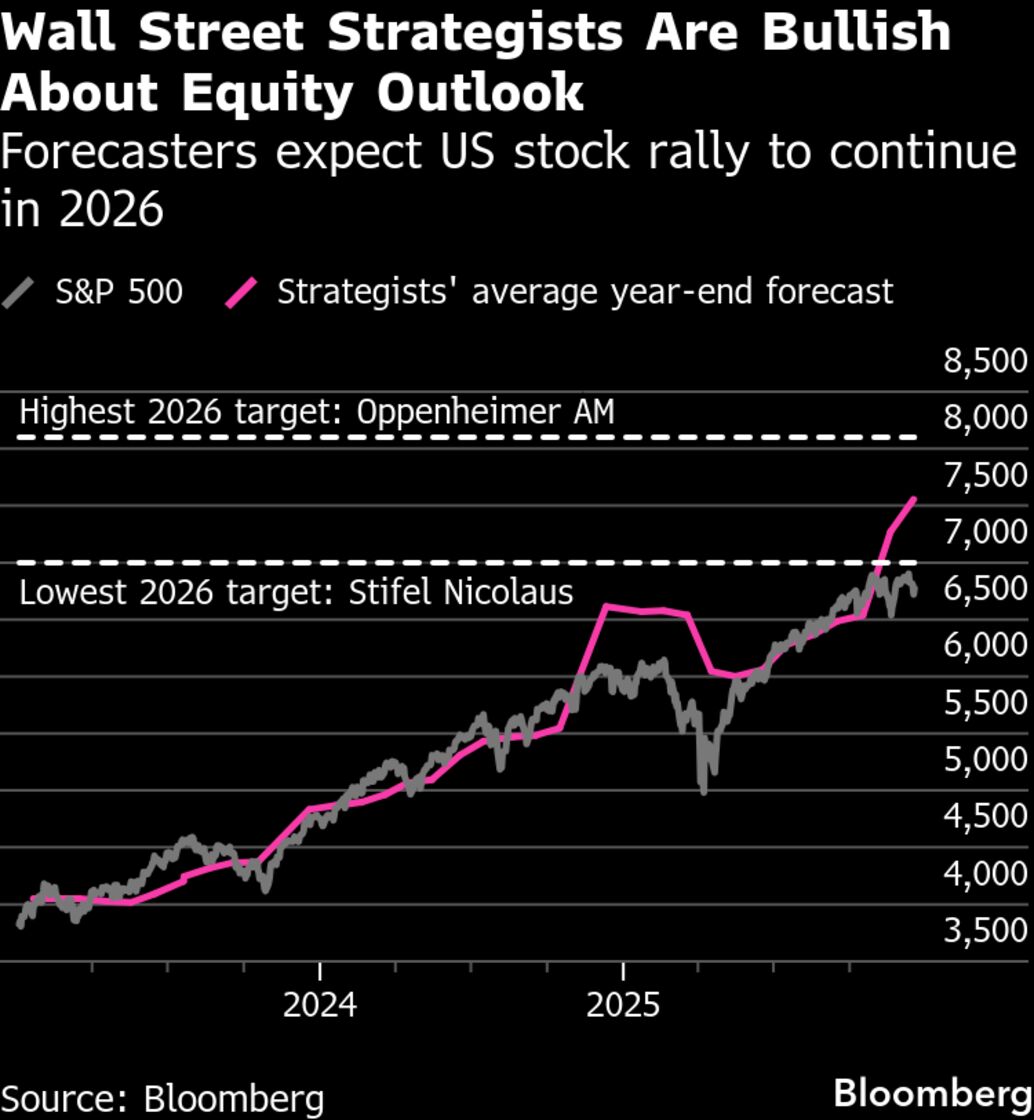
To understand the gravity of the December 2025 Bloomberg survey, one must examine the institutional machinery behind Wall Street year-end forecasts. Typically, sell-side equity strategists at firms spanning Goldman Sachs, JPMorgan Chase, Morgan Stanley, Citigroup, and Bank of America diverge widely in their outlooks. Bearish strategists usually point to tightening credit conditions, geopolitical friction, or compressed price-to-earnings (P/E) multiples. Bullish strategists highlight resilient consumer spending, corporate adaptability, and technological innovation. For the 2026 outlook cycle, however, dissent has been entirely erased.
Interviews with senior research directors reveal that this uniformity stems from three converging macroeconomic catalysts:
- Monetary Policy Normalization: Following the aggressive Federal Reserve interest rate hiking cycle of 2022–2023 and subsequent easing phases through 2024 and 2025, Wall Street models assume a stable, predictable cost of capital entering 2026.
- Enterprise AI Monetization: Unlike the speculative tech booms of previous decades, corporate balance sheets are beginning to realize tangible enterprise ROI from artificial intelligence infrastructure investments. Cloud compute architecture providers and hardware manufacturers are showing sustained margin expansion.
- Corporate Earnings Resilience: Despite persistent murmurs of labor cost inflation and supply chain recalibrations, S&P 500 earnings per share (EPS) projections have consistently beaten consensus estimates throughout the preceding four quarters.
Yet, seasoned market veterans know that Wall Street consensus is notoriously flawed at major market turning points. The last time institutional prognosticators exhibited such extreme alignment prior to a secular shift, subsequent macroeconomic shocks frequently upended models that failed to account for exogenous variables.
Verified Data & Metrics Breakdown
A rigorous examination of historical year-end prognostications versus actual market outcomes highlights the divergence between sell-side models and market reality. The table below outlines the survey parameters and underlying economic pillars supporting the 2026 consensus.
| Metric / Survey Parameter | Wall Street Consensus (2026) | Historical Average (Past 20 Years) | Market Implication |
|---|---|---|---|
| Total Strategists Surveyed | 21 major institutions | 20 to 25 firms annually | Comprehensive sample representing Tier-1 global capital. |
| Proportion Predicting Bear Market | 0% (0 out of 21) | ~15% to 25% bear/flat outlooks | Unprecedented lack of defensive positioning among sell-side experts. |
| Projected Earnings Growth (EPS) | +9.5% to +12.0% | +6.8% historical average | Requires aggressive corporate margin defense and sustained revenue expansion. |
| Key Growth Driver | AI Infrastructure & Enterprise Tech | Consumer Discretionary / Financials | Heavy reliance on capital expenditure cycles in tech and cloud sectors. |
Industry & Market Implications: Who Wins and Who Loses
When every analyst predicts a stock rally, corporate behavior, institutional positioning, and retail sentiment shift in tandem. However, structural market realities dictate that not all sectors will participate equally in a consensus-driven bull market.
The Winners: Infrastructure, Cloud, and Industrial Tech
Firms providing mission-critical infrastructure scalability, semiconductor fabrication, and enterprise software integration stand to capture the lion's share of institutional inflows. As asset managers deploy capital to meet the growth assumptions baked into the 2026 forecasts, cash flows will concentrate heavily in mega-cap technology and specialized industrial manufacturers capable of proving direct cost-saving metrics to corporate buyers.
The Vulnerable: Highly Leveraged Small-Caps and Consumer Staples
Conversely, mid- and small-cap enterprises burdened by floating-rate debt face severe margin compression if macroeconomic growth stalls even slightly below Wall Street's optimistic targets. Furthermore, consumer staples and traditional retail sectors face mounting regulatory compliance costs and shifting consumer spending habits, leaving them ill-equipped to meet the lofty double-digit earnings growth rates demanded by institutional shareholders.
Frequently Asked Questions (People Also Ask)
Why do all Wall Street analysts agree on a 2026 stock rally?
The unanimous bullish outlook is driven by converging models pointing toward stable interest rate environments, better-than-expected corporate earnings resilience, and proven enterprise ROI from artificial intelligence and cloud infrastructure investments. When individual models across major investment banks independently factor in sustained corporate adaptability, the resulting aggregate projection leans entirely positive.
How reliable is Wall Street consensus when predicting market direction?
Historically, extreme consensus among sell-side analysts serves as a contrarian warning sign rather than a guarantee of success. While analysts excel at projecting continuation trends during stable economic expansions, they frequently fail to anticipate exogenous geopolitical shocks, sudden liquidity contractions, or black-swan events that disrupt consensus valuations.
What specific risks could invalidate the 2026 bull market predictions?
Key risk factors capable of derailing the predicted rally include unexpected spikes in energy commodities, tighter-than-anticipated central bank monetary policy adjustments, escalating global trade tensions affecting supply chains, and regulatory crackdowns on artificial intelligence deployment and data privacy compliance.
How are institutional asset managers adjusting their portfolios in response?
Prudent institutional investors are utilizing the bullish consensus to review their risk mitigation strategies. Rather than blindly chasing market highs, top-tier funds are balancing high-growth tech allocations with defensive hedges, focusing on companies with fortress balance sheets, robust pricing power, and transparent cash flow generation.
Future Outlook: Milestones to Watch in 2026
As financial markets transition through 2026, the validity of Wall Street's unbroken bullish consensus will be tested against hard economic data. Executive leadership and portfolio managers must monitor several critical milestones:
Ultimately, while 21 out of 21 analysts are currently waving the green flag for 2026, the disciplined investor understands that absolute consensus is precisely when rigorous due diligence, active risk management, and independent market skepticism become most vital.