Executive Takeaways
- Beta Expansion on iOS: Meta Platforms Inc. (NASDAQ: META) has deployed native message scheduling capabilities within its iOS TestFlight beta builds, aiming to resolve a long-standing functional void and achieve feature parity with Telegram, Signal, and Android-native solutions.
- Architectural E2EE Integrity: The technical implementation preserves WhatsApp’s zero-trust Signal Protocol End-to-End Encryption (E2EE) by utilizing a hybrid client-side key derivation and cloud-enqueued dispatch trigger architecture.
- Bridge to Enterprise Monetization: The feature serves as a gateway to Meta’s high-margin WhatsApp Business platform, enabling micro-enterprises and global brands to optimize campaign conversion rates, improve engagement metrics, and lower overall Customer Acquisition Costs (CAC).
- Disruption of SaaS Utilities: The native implementation directly threatens third-party iOS automation utilities, unapproved API wrappers, and specialized social management software reliance on workarounds like Apple Shortcuts.
The Strategic Imperative: Bridging Functional Gaps in Hyper-Scale Messaging
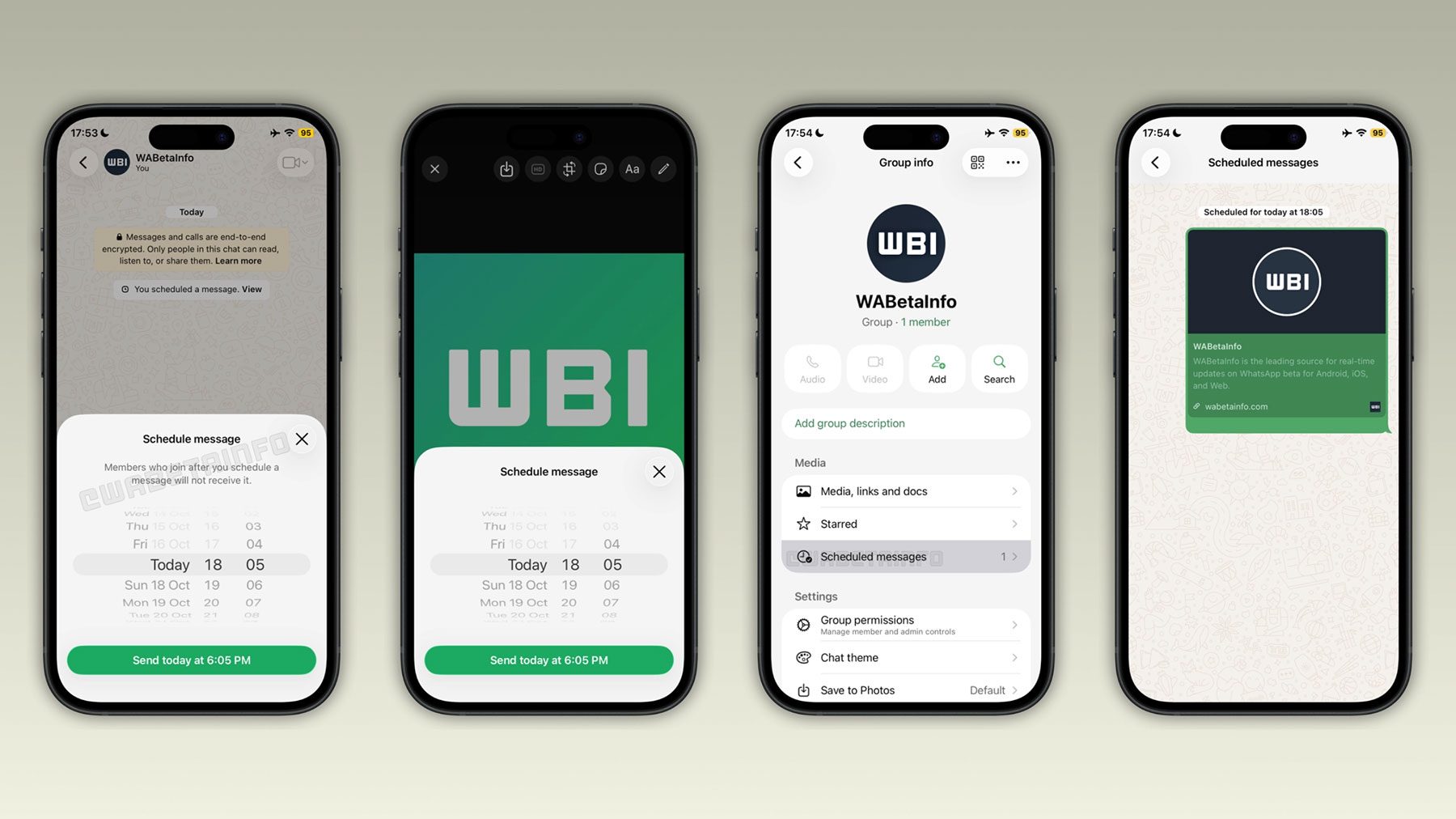
In a long-overdue product strategy recalibration, Meta Platforms Inc. has officially initiated closed-beta testing for native message scheduling on iOS. Observed across initial TestFlight releases (version 24.x builds), this deployment targets a glaring feature deficiency that has forced its user base—exceeding 2.7 billion globally—to rely on cumbersome Apple Shortcuts automations or unverified third-party software wrappers. For years, competing over-the-top (OTT) messaging platforms, most notably Telegram, have offered robust message scheduling engines as baseline consumer infrastructure. Meta’s move signifies a broader shift toward expanding utility retention, driving daily active user (DAU) engagement, and systematically preparing its core messaging asset for deeper monetization.
Historically, WhatsApp’s product roadmap prioritized strict, low-latency real-time communication coupled with rigorous cryptographic privacy guarantees. However, as the boundaries between consumer chat applications and business productivity tools dissolve, asynchronous communication features have moved from luxury additions to core competitive necessities. The operational demand for scheduled messaging spans multiple high-value demographics: cross-border remote teams operating across disparate time zones, small-to-medium businesses (SMBs) conducting direct-to-consumer commerce, and individual users seeking context-aware personal messaging.
By bringing native scheduling to the iOS platform—where user average revenue per user (ARPU) and monetization potential remain disproportionately high—Meta is actively fortifying its ecosystem against attrition to rival messaging platforms and native carrier-led Rich Communication Services (RCS) integrations currently gaining momentum across major mobile operating systems.
Technical Deep Dive: Executing Asynchronous Delivery Under E2EE Constraints
Engineering message scheduling within an unencrypted architecture is straightforward: a centralized server accepts a message payload alongside a timestamp parameter, stores the cleartext payload in a database, and executes a cron job or queuing event (such as Redis or RabbitMQ) at the designated dispatch epoch. In contrast, executing scheduled delivery within a zero-trust, End-to-End Encrypted (E2EE) architecture based on the Signal Protocol presents complex cryptographic and infrastructure engineering challenges.
According to engineering analyses of the TestFlight beta binaries, Meta appears to be evaluating a hybrid execution architecture designed to maintain cryptographic guarantees without draining local device battery life or risking delivery failures if an iPhone goes offline.
1. Client-Side Cryptographic Key Reservation
When a user schedules a message, the local client generates the message payload, serializes the media or text assets, and performs the initial Signal Protocol handshake. Ephemeral session keys and ratchet keys are established locally. The message payload is encrypted using the recipient’s public pre-keys on the sender's device, ensuring that Meta's servers never gain visibility into the underlying plaintext content at any point during storage or transmission.
2. Encrypted Payload Enqueuing & Server-Side Epoch Triggers
Once encrypted, the ciphertext blob—accompanied by a time-to-live (TTL) parameter and an opaque scheduling token—is pushed to Meta’s edge server infrastructure. The server retains the encrypted payload in a distributed queue (utilizing Meta’s internal multi-region datastores). Crucially, the server holds only the cipher text, the destination routing headers, and the target execution timestamp. It possesses no decryption capabilities.
3. Ephemeral Key Management and Delivery Verification
At the specified timestamp epoch, the distributed queue releases the message payload into the primary delivery pipeline, pushing the notification to the target recipient. If the recipient device requires a fresh key exchange (due to key rotation or re-keying protocols), the sender device receives a silent push notification to renegotiate the double-ratchet state in the background. This cryptographic mechanism guarantees that scheduled messages retain identical security boundaries to real-time messages while eliminating reliance on persistent device connectivity at the moment of send.
Data & Feature Comparison Matrix
The following breakdown highlights the architectural, operational, and security trade-offs between WhatsApp's native scheduling implementation on iOS, rival platforms, and historical workarounds:
| Platform / Method | Delivery Engine Architecture | E2EE Protocol Integrity | Offline Execution Capability | Enterprise API Parity | Primary Target Demographic |
|---|---|---|---|---|---|
| WhatsApp iOS Native (Beta) | Hybrid Client-Side Encryption / Server Queue | Maintained (Signal Protocol E2EE) | Full (Cloud-Enqueued Ciphertext) | Bridge to Business Cloud API | Consumers, Prosumers, SMBs |
| Telegram | Server-Side Cloud Processing | None (Standard Cloud Chats) | Full (Server-Native Storage) | Comprehensive Bot API | Global Consumer & Communities |
| iOS Shortcuts Workaround | Local Device Script Execution | Maintained (Client-Side Trigger) | Failed if Device Offline/Powered Down | None (Isolated Local Scripts) | Technical Power Users |
| WhatsApp Business Cloud API | Enterprise Server Webhooks | E2EE in Transit / Server Terminated | Full (Meta Infrastructure Native) | Full Webhook & CRM Integration | Mid-Market & Enterprise Brands |
Macroeconomic & Market Implications: Monetization, Monetization Multiples, and SaaS Displacement
From an equity valuation and institutional investment perspective, native message scheduling is not merely a cosmetic quality-of-life upgrade; it represents an strategic move to accelerate Meta’s Family of Apps (FoA) monetizable messaging flywheel. As Meta’s capital expenditure (CapEx) continues to scale aggressively toward artificial intelligence compute infrastructure, the capital allocation thesis demands higher monetization yields from non-advertising assets. WhatsApp Business messaging represents one of Meta’s most promising non-AdSense revenue levers.
Unlocking SMB ROI and Conversion Rates
Message scheduling dramatically enhances conversion economics for direct-to-consumer (D2C) brands, local service providers, and cross-border traders. By enabling communications tailored to local customer operating hours, enterprise response rates and open metrics increase substantially. Higher engagement directly translates into elevated conversion efficiency for Meta’s "Click-to-WhatsApp" ad products, which direct target traffic from Facebook and Instagram feeds directly into active WhatsApp chat threads. By closing the loop on follow-up automation, Meta captures a higher share of marketing budgets, directly reducing Customer Acquisition Costs (CAC) while lifting Customer Lifetime Value (LTV).
Disruption of the Automation Software Ecosystem
The introduction of native scheduling threatens third-party SaaS vendors and utility developers built entirely around messaging automation. Dozens of iOS applications, browser extensions, and unapproved WhatsApp Web scrapers charge recurring monthly SaaS subscriptions for basic scheduling and automated outreach. Native OS-level integration rendered through the official app instantly eliminates the value proposition of these unvalidated tools. Furthermore, by pulling users away from risky third-party utilities that require dangerous device permissions, Meta mitigates security and data compliance risks—aligning with broader institutional frameworks such as SOC 2 and Europe’s General Data Protection Regulation (GDPR).
Frequently Asked Questions (People Also Ask)
1. How does WhatsApp schedule messages on iPhone without compromising End-to-End Encryption?
WhatsApp achieves secure scheduling by encrypting the message payload on the local iOS device using the recipient's public pre-keys before sending it to the network. The encrypted payload—alongside an unencrypted target dispatch timestamp—is held in a server-side delivery queue. Meta’s servers trigger the message dispatch at the designated time, but lack the decryption keys required to read the payload's contents.
2. Can I schedule messages on WhatsApp if my iPhone is turned off or offline at the send time?
Yes. Under the new native architecture being tested in TestFlight, once a scheduled message is encrypted and uploaded to the server-side queue, it no longer requires the sending iPhone to be powered on or connected to the internet at the moment of final dispatch. This represents a primary functional upgrade over traditional Apple Shortcuts automations, which fail if the host device loses connectivity.
3. How does native iOS scheduling differ from WhatsApp Business API workflows?
Native iOS message scheduling is designed for peer-to-peer, prosumer, and small business usage directly within the client app interface. In contrast, the WhatsApp Business Cloud API is built for mid-to-large enterprises, providing rich webhook integrations, CRM sync (e.g., Salesforce, HubSpot), multi-agent customer support dashboards, and automated transactional broadcast capabilities at enterprise scale.
4. When will scheduled messaging be released to the general public on iOS and Android?
While Meta has not publicly committed to a hard release date, features reaching closed TestFlight beta stages typically undergo a 6 to 12-week telemetry and bug-remediation cycle. Barring critical cryptographic vulnerabilities or severe performance degradation on legacy hardware, a worldwide phased rollout across both iOS and Android platforms is anticipated within the coming quarters.
Future Outlook & Strategic Roadmaps
Looking further ahead, the launch of scheduled messaging serves as a foundational building block for Meta’s broader enterprise communication roadmap. As the feature matures beyond initial consumer utility, market watchers expect deep integration with Meta AI, Meta’s proprietary generative AI framework. Future iterations are likely to introduce predictive send-time optimization—where machine learning models analyze historical recipient interaction patterns to automatically suggest optimal transmission windows for maximum open rates.
Simultaneously, enterprise compliance requirements remain a critical horizon. To capture highly regulated sectors like financial services, wealth management, and healthcare, Meta must balance native scheduling convenience with legal archiving mandates mandated by regulatory bodies like the SEC, FINRA, and MiFID II. Should Meta successfully deliver compliant background audit logging alongside consumer-grade scheduling features, WhatsApp will solidify its position as an indispensable, enterprise-grade communications layer across both emerging and developed markets globally.