28 Miles and Counting: Inside the Edge-AI Breakthrough That Pushed NASA’s Perseverance Rover to a Historic Martian Driving Record
Executive Takeaways
- Historic Mobility Benchmark: NASA’s Mars 2020 Perseverance rover has officially crossed the 28-mile cumulative traverse mark across the treacherous terrain of Jezero Crater, eclipsing historic pacing rates and setting a modern deep-space autonomous driving standard.
- Architectural Paradigm Shift: The record is propelled by second-generation AutoNav (Autonomous Navigation), an onboard compute suite that operates without human-in-the-loop intervention, slashing traverse planning latency by over 85% compared to legacy Mars Science Laboratory architectures.
- Capital Efficiency & Mission ROI: At an estimated lifecycle cost of $2.7 billion, Perseverance’s enhanced velocity drastically de-risks the multi-billion-dollar Mars Sample Return (MSR) pipeline by accelerating core sampling timelines ahead of severe NASA programmatic budget pressures.
- Commercial Dual-Use Implications: The software, machine vision, and sensor-fusion protocols battle-tested on the Martian regolith are delivering actionable IP directly back to terrestrial autonomous mining, industrial robotics, and radiation-hardened defense edge-compute markets.
The 28-Mile Milestone: An Engineering Triumph Amid Deep-Space Isolation

When NASA’s Perseverance rover touched down on the floor of Jezero Crater on February 18, 2021, the vehicle inherited a daunting operational legacy. Opportunity, an endurance titan from the Mars Exploration Rover (MER) generation, took nearly a decade and a half to record its historic 28.06-mile (45.16-kilometer) marathon across Meridiani Planum. Perseverance has traversed equivalent distance at unprecedented speed, climbing complex delta deposits, navigating dense boulder fields, and scaling ancient crater rims in a fraction of that operating window.
This aggressive operational tempo is not an accident of geography; it is the calculated yield of an exhaustive engineering pivot. For decades, planetary surface exploration was fundamentally constrained by the speed of light. With round-trip telemetry delays between Earth and Mars fluctuating between 8 and 44 minutes depending on orbital geometry, ground operators at the Jet Propulsion Laboratory (JPL) in Pasadena, California, historically relied on a tedious "blind driving" protocol. Ground teams would reconstruct stereoscopic orbital and ground imagery, chart a path extending a few meters, verify the drive profile against worst-case tip-over metrics, and beam static commands for daily execution. The rover would creep forward, halt, capture post-drive telemetry, and idle until the next command cycle.
Perseverance shattered this operational paradigm. Crossing the 28-mile threshold marks the industrial maturation of fully decentralized, edge-deployed robotic autonomy in an off-world operational theater. As space agencies face escalating budget discipline and congressional audits, the rover's ability to compress operational years into months has emerged as the premier metric for planetary return on investment (ROI).
The Architectural Engine: How AutoNav Eradicated the "Think-Time" Bottleneck
To grasp the technical magnitude of Perseverance’s 28-mile traverse requires dissecting the compute architecture that drives the 2,260-pound rover. At the heart of the vehicle’s mobility stack is the second-generation Autonomous Navigation system, colloquially known as AutoNav. Whereas its predecessor, the Curiosity rover (MSL), possessed a rudimentary autonomous navigation routine, it was throttled by compute starvation.
Curiosity utilizes a single radiation-hardened BAE Systems RAD750 processor—clocked at a modest 133 MHz—to handle the entirety of the rover’s vehicle management, thermal regulation, scientific payload interfaces, and image processing. Under MSL’s autonomous modes, the rover was forced to follow a discontinuous "stop-and-think" cycle: drive 1.5 meters, freeze for two minutes while the RAD750 stitched stereo imagery, ran stereophotogrammetry algorithms, calculated hazard terrain maps, plotted avoidance arcs, and cleared the next meter of movement.
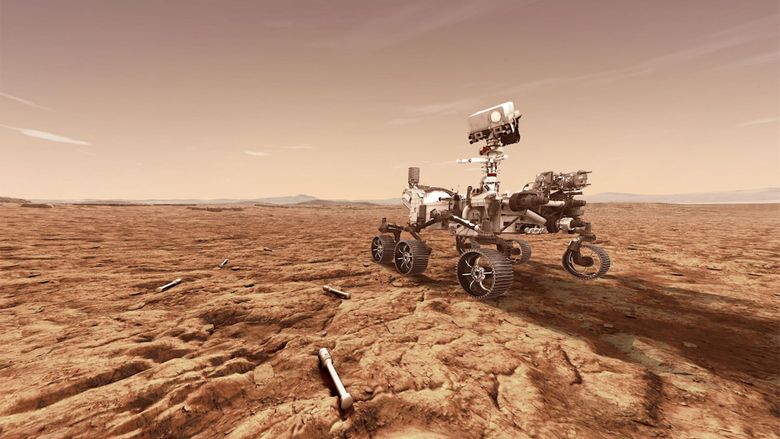
Perseverance eliminated the computational bottleneck by deploying dedicated visual compute hardware: a specialized Vision Compute Element (VCE) integrated alongside an auxiliary field-programmable gate array (FPGA) fabric. This bespoke sub-architecture takes the high-resolution, wide-angle imagery captured by Perseverance’s upgraded engineering cameras (Navcams)—featuring enhanced optical fidelity and full color fidelity—and processes depth maps concurrently. The rover maps, assesses, and plots continuous-motion path corrections while actively rolling across the Martian regolith at its mechanical top speed of 0.1 miles per hour (roughly 4.2 centimeters per second).
By executing real-time visual odometry—visually tracking ground features from frame to frame to measure exact slippage across loose Martian fines—Perseverance’s AutoNav continuously closes the loop on navigation errors. The system mathematically constructs a rolling geometric grid of the terrain, dynamically scoring obstacles across a 3D terrain mesh. The net operational impact: the rover has zero dedicated "think-time" latency during nominal transit runs, allowing continuous single-sol (Martian day) traverses exceeding 300 to 400 meters.
Comparative Analysis: Mars Surface Mobility Infrastructure Across Generations
The progression of Martian surface exploration highlights a compounding leap in compute capacity, autonomous efficiency, and capital investment efficiency over the past three decades:
| Mission / Platform | Launch Cost (Inflation Adjusted) | Compute Core & Clock Speed | Traverse Processing Method | Average Drive Rate (Meters / Sol) | Cumulative Miles Logged |
|---|---|---|---|---|---|
| Sojourner (1997) | ~$440 Million | Intel 80C85 @ 2 MHz | Pre-programmed open-loop scripts; terrestrial teleoperation | ~2 - 7 meters | 0.06 miles (100 meters) |
| Spirit & Opportunity (2004) | ~$1.4 Billion (Total) | BAE RAD6000 @ 20 MHz | Heuristic edge mapping; high terrestrial intervention latency | ~15 - 50 meters | 28.06 miles (Opportunity, 14.5 yrs) |
| Curiosity (MSL - 2012) | ~$3.2 Billion | BAE RAD750 @ 133 MHz | Stop-and-think AutoNav (single compute domain contention) | ~30 - 90 meters | ~20.5 miles (Current) |
| Perseverance (M2020 - 2021) | ~$2.7 Billion | BAE RAD750 + Dedicated VCE / FPGA Stack | Real-time continuous AutoNav with onboard visual odometry | ~120 - 340+ meters | 28+ miles (Current Record Pace) |
Industry Implications: De-risking Mars Sample Return and Private Sector Spinoffs
Perseverance’s traverse velocity is not merely a scientific point of pride; it is an economic imperative tethered to NASA's most contentious planetary flagship: the Mars Sample Return (MSR) program. An independent review board recently projected that the joint NASA-ESA MSR architecture could swell to an unprecedented $8 billion to $11 billion price tag, prompting agency-wide re-evaluations, contract redesigns, and high-stakes capital allocation hearings on Capitol Hill.
By covering 28 miles and ascending the treacherous, boulder-strewn margin of Jezero Crater's delta, Perseverance has fundamentally altered the mission's risk-reward geometry. The rover has already collected, sealed, and documented more than 20 scientifically precious core samples spanning igneous, sedimentary, and silica-rich rock layers. Because the vehicle can traverse vast distances autonomously without burning days of engineering cycles per obstacle, it has eliminated the immediate need for a dedicated, capital-intensive "Fetch Rover" to retrieve primary sample caches. Perseverance has become its own redundant transport system, directly derisking NASA's mission execution budget.
Concurrently, the architectural blueprints perfected on the Martian surface are generating substantial downstream commercial value in the defense, industrial, and terrestrial tech ecosystems:
- Autonomous Off-Highway & Industrial Robotics: Commercial heavy-machinery giants operating in unmapped, GPS-denied environments—such as autonomous underground mining, polar pipeline surveying, and defense logistics—are integrating algorithms directly descended from JPL's visual odometry and hazard-mesh pipelines.
- Radiation-Hardened Edge Compute Scaling: The success of the dedicated Vision Compute Element has accelerated private aerospace interest in modernizing flight computing. Space hardware innovators are pushing beyond decades-old, high-nanometer silicon architectures toward radiation-tolerant RISC-V compute engines and commercial ARM variants wrapped in fault-tolerant software envelopes.
- Enterprise Cloud & Remote Fleet Orchestration: The multi-agent orchestration frameworks developed to coordinate Perseverance and the Ingenuity Mars Helicopter have influenced terrestrial fleet logistics. Enterprise platforms managing mixed fleets of autonomous drones and ground vehicles under bandwidth-constrained, high-latency satellite uplinks rely on these exact multi-tier planning architectures.
Frequently Asked Questions (People Also Ask)
What makes Perseverance’s 28-mile driving record distinct from Opportunity's 28-mile record?
While Opportunity traversed 28.06 miles over an extraordinary mission lifespan of nearly 15 years (2004–2018), Perseverance achieved comparable distance in approximately a quarter of the time. This massive acceleration is driven by advanced second-generation AutoNav software, high-resolution color imaging suites, and dedicated vision coprocessors that enable continuous driving without the prolonged "stop-and-think" cycles that constrained older rover platforms.
How does the rover drive autonomously on Mars without real-time human control?
Because radio signals take between 4 and 22 minutes to travel each way between Earth and Mars, real-time joystick operation is physically impossible. Perseverance navigates using its AutoNav software suite. The rover captures stereoscopic images of the forward terrain using dual high-resolution Navcams, processes these images via an onboard Vision Compute Element (VCE), generates a 3D elevation map, evaluates hazards (such as slopes, drop-offs, and boulders), and continuously plots safe travel corridors—all while rolling at maximum speed.
What computing hardware handles the autonomous navigation on Perseverance?
Perseverance uses an enterprise-grade, radiation-hardened BAE RAD750 processor rated to withstand deep-space cosmic radiation and harsh thermal swings. Unlike Curiosity, which relied exclusively on its primary CPU for navigation math, Perseverance supplements this processor with a specialized Vision Compute Element (VCE) supported by Field-Programmable Gate Arrays (FPGAs). This dual-layer processing architecture executes image processing and hazard mapping in parallel, offloading intensive tasks from the main vehicle control computer.
Why are rover driving records crucial for NASA's budget and the Mars Sample Return mission?
Surface mobility speed directly dictates mission efficiency. With the multi-billion-dollar Mars Sample Return (MSR) mission facing intense scrutiny from Congress over total lifecycle costs, Perseverance’s high-speed autonomy enables it to quickly cross varied geological formations, gather diverse mineral samples, and potentially deliver them directly to a future sample retrieval lander. This operational efficiency eliminates the need for expensive secondary recovery infrastructure, saving billions in discretionary capital.
The Next Frontier: Climbing the Crater Rim and the Future of Edge Autonomy
Having surpassed the 28-mile threshold, Perseverance is executing its most challenging campaign to date: scaling the steep, boulder-choked inner walls of Jezero Crater. Known as the "Crater Rim Campaign," this operational phase will test the vehicle's autonomous algorithms against slope grades exceeding 20 degrees, complex rock strata, and dynamic traction loss in loose sand. Engineering teams anticipate that the machine-vision stack's real-time wheel-slip compensation will be the determining factor in whether the vehicle can ascend the crater's crest and exit the ancient lakebed environment entirely.
Looking further into the decade, the lessons learned from Perseverance’s 28-mile milestone will directly influence the development of autonomous architectures for humanity's return to the Moon and prospective crewed Mars missions. NASA's upcoming Lunar Terrain Vehicle (LTV) platforms and commercial landers will be expected to traverse hundreds of kilometers without constant operator supervision. By proving that advanced edge computation can overcome light-speed latency and hazardous terrain at high operating velocities, Perseverance has secured its place not merely as a sample-collection instrument, but as the foundational archetype for fully autonomous deep-space exploration.