Executive Takeaways
- From Trench Work to Enterprise Architecture: Founders Mike Murchison and David Hariri engineered Ada not from theoretical research, but after spending months manually working tier-1 customer support desks, exposing the structural failure modes of legacy decision trees and rigid rule-based IVR systems.
- The Bessemer Thesis: Venture capital titan Bessemer Venture Partners positions Ada’s “fanatical CX loops” as the definitive blueprint for applied AI agents—systems where real-time human-in-the-loop interactions systematically generate high-fidelity, domain-specific training telemetry.
- Arbitraging Enterprise Cost Structures: By pairing autonomous resolution agents with a context-aware Agent Copilot, enterprise deployments are shifting cost per contact from an industry baseline of $6.00–$12.00 down to sub-$0.50 levels, driving operational margin expansion across Fortune 500 balance sheets.
- The Incumbent Threat Matrix: Ada’s proprietary reasoning architecture directly challenges the seat-based software-as-a-service (SaaS) revenue models of legacy customer relationship management (CRM) giants, accelerating a market pivot toward consumption- and outcome-based pricing.
The Ground-Truth Origins: Why Answering Support Tickets Built an AI Moat

In the mid-2010s, before transformer architectures and large language models (LLMs) dominated venture capital capital allocation, Mike Murchison and David Hariri made an unorthodox operational decision: they sat on the frontlines of high-volume customer service desks. For months, the two founders answered live tier-1 support tickets across e-commerce, software, and logistics businesses. What emerged from those hundreds of hours of manual query resolution was an acute diagnosis of why the enterprise customer experience (CX) tech stack was structurally broken.
Legacy help desks—anchored by early software-as-a-service market incumbents—treated customer service strictly as a depreciating cost center. Automation in that era meant deterministic, labyrinthine decision trees and rigid keyword matchers that frustrated consumers and burdened human agents with cognitive fatigue. Murchison and Hariri recognized a distinct counter-thesis: the customer service ticket is the single highest-fidelity data exhaust an enterprise produces. Every customer inquiry reflects an unmet need, product failure, onboarding friction, or revenue opportunity.
When Bessemer Venture Partners published its analysis on Ada’s evolution, it spotlighted this founding realization as the genesis of Ada’s competitive advantage. By architecting customer interaction infrastructure from the baseline truth of agent workflows, Ada bypassed the classic trap that has afflicted recent generative AI startups: building elegant, horizontal wrappers around third-party foundational models that fundamentally fail when exposed to complex, edge-case-heavy enterprise environments.
Deconstructing the ‘Fanatical CX Loop’: Data Flywheels Over Raw Compute
The enterprise software landscape of 2026 has witnessed the erosion of foundational model moats. As commoditized open-source and proprietary weights converge on baseline reasoning parity, the primary driver of enterprise valuation multiples has shifted toward data architecture and domain-specific feedback loops. Ada’s framework—termed the "fanatical CX loop"—is a technical methodology for transforming raw customer conversations into self-improving agentic intelligence.
At the center of this architecture is a bidirectional telemetry pipeline:
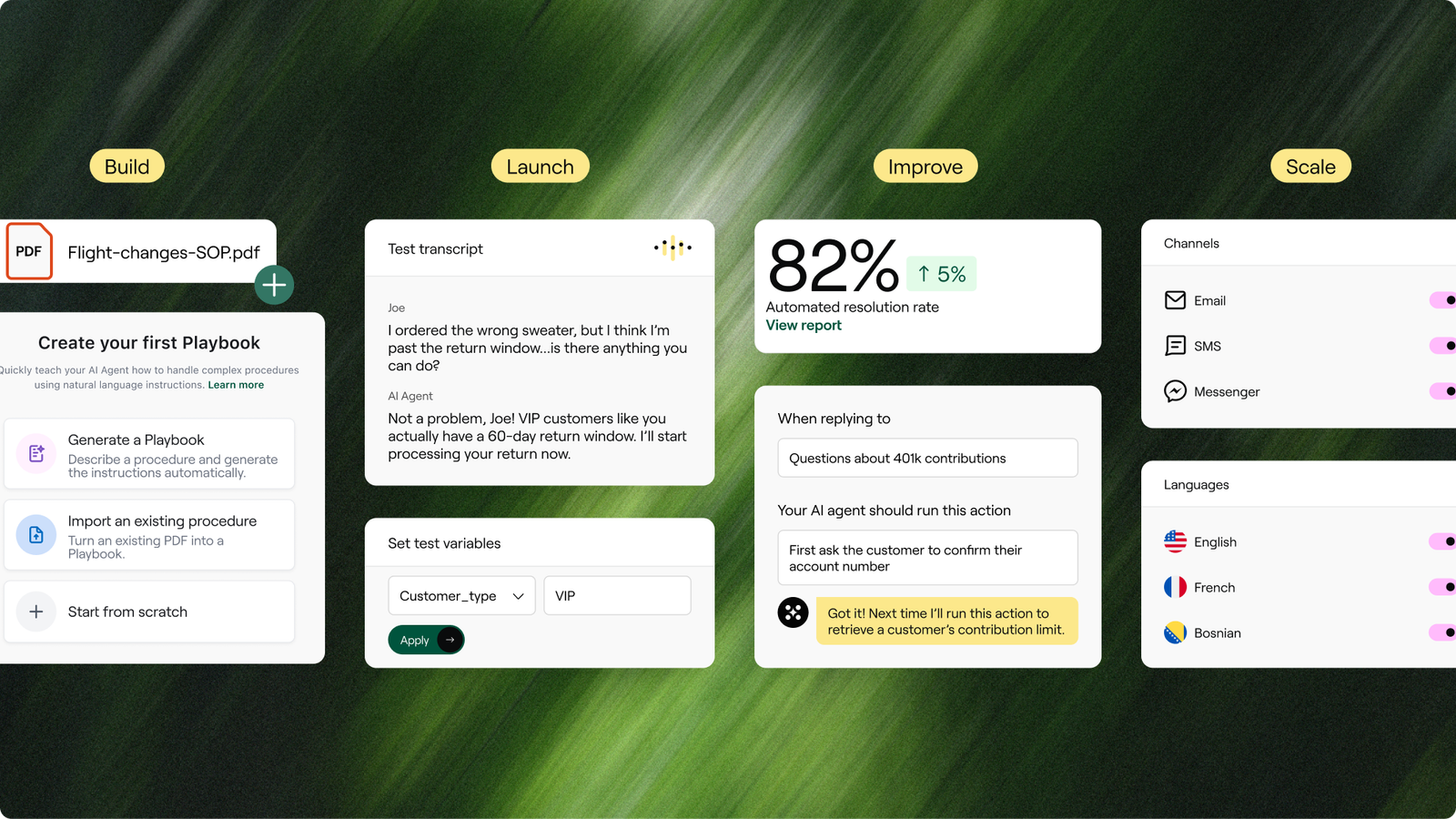
- Autonomous Intent & Policy Execution: Incoming multi-modal queries are routed through Ada’s proprietary reasoning engine, which assesses intent, sentiment, security guardrails, and enterprise context retrieved dynamically via Retrieval-Augmented Generation (RAG) from ERP, CRM, and knowledge databases.
- The Copilot Deployment Vector: When a query exceeds autonomous confidence thresholds or requires physical intervention, the system smoothly hands the interaction over to an enterprise representative. However, Ada’s Copilot does not merely hand off a conversation. It delivers real-time, context-aware reply suggestions, synthesizing internal documentation, past user behavior, and optimal resolution paths.
- Human-in-the-Loop Reinforcement Learning: As human agents accept, edit, or reject the Copilot’s suggested actions, that precise Delta is tokenized and logged. This active human feedback forms an immediate, high-fidelity Reinforcement Learning from Human Feedback (RLHF) loop. The human is no longer merely resolving a ticket; they are continuously training the downstream agentic runtime.
This closed loop transforms operational support expenditure into synthetic training capital. Rather than spending millions of dollars on post-hoc data cleaning and synthetic data generation, enterprises running Ada passively generate optimized, enterprise-specific alignment data through their daily core operations.
The Unit Economics of Disruption: Cost-per-Resolution vs. Seat Licenses
Chief Financial Officers and Chief Information Officers navigating enterprise AI transformation face intense pressure to demonstrate immediate enterprise ROI on enterprise software deployments. Traditional CRM pricing has relied on the per-seat SaaS license—a model fundamentally misaligned with labor automation. If an enterprise automates 70% of its incoming ticket volume, paying $150 per seat per month for hundreds of tier-1 human agents becomes financially illogical.
Ada’s architecture accelerates the shift toward resolution-based and outcome-driven economics. By deploying AI agents capable of end-to-end task completion (such as processing returns, modifying subscription tiers, troubleshooting API integrations, and reconciling ledger disputes), Ada repositions the cost structure of customer service from variable labor overhead to scalable cloud compute architecture.
| Operational Metric | Legacy Rule-Based Chatbots (Pre-2023) | Horizontal LLM Wrappers (2023-2024) | Ada Agentic CX Loops (Present) |
|---|---|---|---|
| Autonomous Resolution Rate | 15% – 25% (Deflection only) | 35% – 45% (High hallucination risk) | 70% – 85% (Deterministic execution) |
| Blended Cost Per Ticket | $5.50 – $9.00 | $3.50 – $6.00 | $0.30 – $0.90 |
| Latency to First Meaningful Response | Instant (Inaccurate) | 3.5s – 7.0s (Inference lag) | < 800ms (Optimized RAG & caching) |
| Data Flywheel Velocity | Static (Manual tree updates) | Low (Stateless prompt engineering) | Continuous (Live Copilot telemetry & RLHF) |
| Enterprise System Integration | Brittle Webhooks / API limits | Text-generation only | Deep multi-system read/write actions |
Wall Street & Silicon Valley: The Enterprise Software Battlefield
The broader market implications of Ada’s technological architecture, as highlighted by Bessemer, extend across the enterprise software sector. Enterprise incumbents like Salesforce, Zendesk, and ServiceNow have moved quickly to defend their high-margin service cloud franchises by deploying native AI copilots. However, these incumbents face the classic Innovator’s Dilemma: their core revenues are tied to seat count expansion.
If an enterprise customer service team can scale its throughput tenfold while reducing headcount by 40%, traditional seat-based software revenues contract unless replaced by high-margin platform consumption fees. AI-native agentic platforms like Ada do not carry this structural baggage. They are built specifically to decouple enterprise operational scale from human headcount, aligning their pricing models directly with successful, secure task completions.
Furthermore, private equity sponsors that spent billions acquiring legacy mid-market help desk software providers are confronting severe multiple compression. Without the engineering velocity or architectural foundations required to build deep, multi-tenant RAG systems with rigorous safety and observability layers, these legacy platforms risk being reduced to dumb transaction ledgers while agentic orchestration layers capture the lion's share of enterprise enterprise software budgets.
Risk Mitigation, Governance, and Hallucination Controls
For regulated industries—such as retail banking, healthcare, and insurance—unconstrained autonomous agents represent an existential compliance hazard. A single generative hallucination promising an unauthorized financial settlement or leaking protected health information (PHI) can trigger severe regulatory penalties and reputational damage.
The core of Ada’s enterprise acceptance lies in its deterministic governance framework. Rather than permitting LLMs to generate arbitrary execution code or unstructured promises, Ada decouples *understanding* from *execution*. The language model is utilized for semantic parsing, entity extraction, and conversational synthesis, but business actions are constrained by strict, pre-approved API contracts and enterprise policies. If a user’s request requires an action outside these guardrails, the system dynamically routes the context to Copilot, allowing human oversight to preserve regulatory compliance without abandoning automation efficiency.
Frequently Asked Questions (People Also Ask)
What is Ada’s "fanatical CX loop" in enterprise AI?
The "fanatical CX loop" is an architectural framework where customer service interactions are systematically captured and used to refine both autonomous AI agents and human support workflows. As customer inquiries arrive, autonomous agents resolve standard requests. Complex issues escalate to human agents equipped with an AI Copilot. The actions, corrections, and inputs provided by human agents are continuously fed back into the platform's reasoning engine, creating an ongoing reinforcement learning loop that improves resolution accuracy over time.
How does Ada Copilot differ from legacy customer service chatbots?
Legacy chatbots relied on static decision trees, keyword triggers, and simple deflection metrics, frequently leaving users in circular, unhelpful loops. Ada’s Copilot operates as an agentic assistant for human representatives: it analyzes the multi-turn context of a conversation in real time, queries underlying enterprise databases via secure APIs, and generates verified, context-aware reply suggestions and actionable next steps. This augments human capability, shortens handle times, and directly feeds real-world operational data back into the system's training pipeline.
What financial metrics are improved by deploying agentic CX platforms?
Enterprises implementing agentic CX solutions like Ada typically report three primary financial shifts: a dramatic reduction in cost-per-contact (often falling from over $6.00 to under $1.00), a sharp increase in First-Contact Resolution (FCR) rates reaching 75% to 85%, and an expansion in Net Revenue Retention (NRR). The latter is driven by automated, context-aware cross-selling and reduced customer churn, moving customer support from a cost center to an operational value driver.
How does Ada mitigate enterprise security and hallucination risks?
Ada addresses hallucination risks by decoupling conversational natural language understanding from transactional enterprise execution. The platform utilizes advanced Retrieval-Augmented Generation (RAG) combined with strict, deterministic guardrails. When an agent interacts with enterprise systems, it executes strictly defined API calls rather than improvising outputs. Additionally, interactions with high uncertainty or high financial risk are automatically escalated to human agents via the Copilot interface.
Future Outlook: The Multi-Modal, Autonomous Enterprise (2026–2028)
As enterprise software enters the latter half of the decade, the boundary between front-office customer service, mid-office operations, and back-office logistics is dissolving. The operational telemetry pioneered by Ada's fanatical CX loops is evolving beyond text-based chats into real-time voice, vision-based troubleshooting, and proactive, outbound workflow orchestration.
The critical milestone for CIOs over the next 24 months will be the seamless integration of agentic reasoning with cross-platform enterprise resource planning. When a customer contacts an organization regarding a supply chain delay, the AI agent of the near future will not merely explain the delay; it will independently reroute the shipment, issue a micro-refund within authorized governance boundaries, and trigger a vendor performance audit within internal procurement systems.
Bessemer Venture Partners’ spotlight on Ada underscores a fundamental reality of the enterprise AI era: winning platforms will not be defined by who commands the largest foundational models, but by who controls the most precise, operational, and self-reinforcing human-in-the-loop data flywheels. By transforming customer support from a neglected cost center into an enterprise AI training engine, Ada has laid down the architectural blueprint that the rest of enterprise software must now scramble to follow.