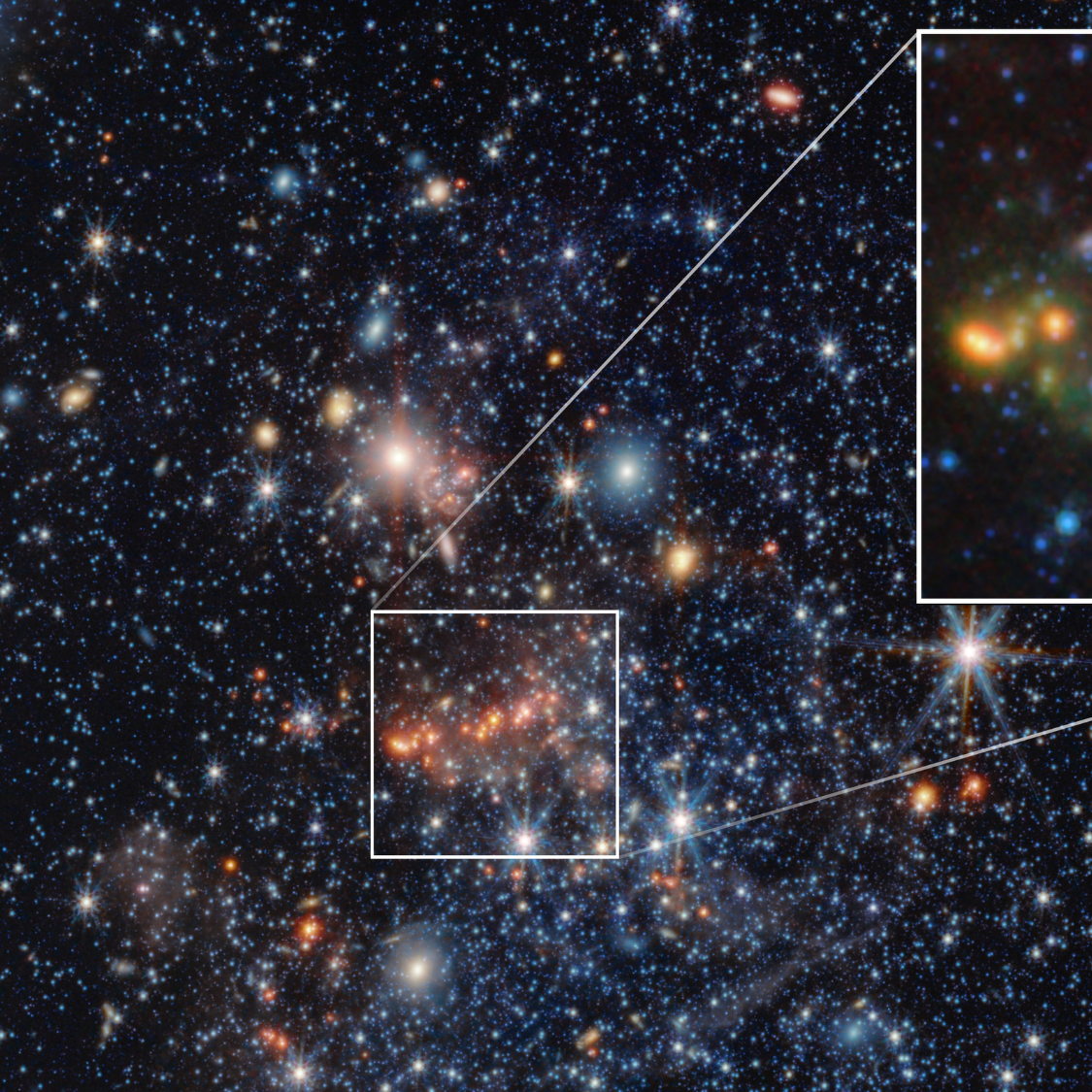
WASHINGTON, D.C. — For the past two years, the James Webb Space Telescope (JWST) has captivated the world with ultra-deep, pin-sharp needles in the cosmic haystack. But in the quiet cleanrooms of NASA and its aerospace partners, a different kind of revolution is being assembled. NASA is preparing to launch its next flagship astrophysics mission: the Nancy Grace Roman Space Telescope. If Webb is a state-of-the-art microscope, Roman is a world-class panoramic camera—one designed to solve the deepest mysteries of dark energy, dark matter, and the survival of our universe.
Recently highlighted on NPR’s Shortwave, the upcoming mission represents a massive paradigm shift. While the scientific community has spent years analyzing singular, highly focused patches of deep space, Roman will provide the sweeping, high-definition surveys that astrophysicists have desperately needed for decades. The mission is poised to do nothing less than map the evolution of the cosmos.
---The Wide-Angle Revolution: Why Roman is a Game-Changer
The primary limitation of both the Hubble Space Telescope and the James Webb Space Telescope is their narrow field of view. To capture a significant portion of the sky, they must take hundreds of individual shots and mosaic them together—a process that takes weeks of valuable observational time.
The Nancy Grace Roman Space Telescope changes the math entirely. Boasting a 2.4-meter mirror—the same size as Hubble’s—Roman’s optical design allows it to capture an area of the sky 100 times larger than Hubble in a single snapshot, without sacrificing resolution. What would take Hubble decades to map will take Roman mere days.
“We’ve been looking at the universe through a straw,” says one NASA astrophysicist associated with the program. “Roman gives us the windshield. We can finally see the large-scale structure of the cosmos in real-time.”
---Technical Specifications: How the Giants Compare

To understand the leap in capability Roman represents, it must be compared alongside its historic predecessors. Below is a breakdown of the technological shifts occurring in deep-space observation:
| Feature / Specification | Hubble Space Telescope (HST) | James Webb Space Telescope (JWST) | Nancy Grace Roman Telescope | ||||
|---|---|---|---|---|---|---|---|
| Primary Mirror Diameter | 2.4 meters | 6.5 meters | 2.4 meters | ||||
| Wavelength Coverage | UV, Visible, Near-Infrared | Infrared, Mid-Infrared | Visible, Near-Infrared | ||||
| Field of View (Relative) | 1x (Baseline) | ~0.1x to 0.5x (Deep/Narrow) | 100x Hubble | Orbit Location | Low Earth Orbit (LEO) | Lagrange Point 2 (L2) | Lagrange Point 2 (L2) |
| Primary Scientific Focus | General Astrophysics | Early Universe, First Galaxies | Dark Energy, Dark Matter, Exoplanets |
The Core Mission: Deciphering the Cosmic Dark Sector
The Roman Space Telescope is engineered to tackle two of the most unsettling questions in modern physics: What is dark matter, and what is dark energy? Together, these two invisible phenomena make up roughly 95% of the universe, yet scientists have no direct way of observing them.
1. Measuring the "Push" of Dark Energy
In the late 1990s, astronomers discovered that the expansion of the universe is not slowing down; it is accelerating. The mysterious force driving this acceleration was dubbed "dark energy." Roman will map tens of thousands of distant supernovae and hundreds of millions of galaxies to measure how the expansion of space has changed over cosmic time. This will help physicists determine if dark energy is a constant property of space (the Cosmological Constant) or a dynamic field that could eventually rip the universe apart.
2. Illuminating the Invisible: Dark Matter
Though invisible, dark matter acts as a cosmic scaffolding, holding galaxies together. Roman will observe "gravitational lensing"—the bending of light from distant galaxies by the gravitational pull of intervening dark matter. By cataloging these distortions across vast swaths of the night sky, Roman will construct the most precise 3D map of dark matter ever created.
3. The Exoplanet Census
Beyond the dark sector, Roman will utilize a technique called gravitational microlensing to detect thousands of exoplanets in the inner Milky Way. This will complement Kepler and TESS by finding planets that orbit far from their host stars, as well as "rogue planets"—worlds that drift through interstellar space without orbiting any star at all.
---The Economic and Aerospace Stakes
For industrial partners and aerospace contractors, the Roman Space Telescope is a major economic engine. Managed by NASA's Goddard Space Flight Center in Greenbelt, Maryland, the mission represents a multi-billion-dollar investment. Prime industrial contractors including L3Harris Technologies (which is assembling the telescope's optical system) and Ball Aerospace (now part of BAE Systems, developing the Wide Field Instrument) are pushing the boundaries of precision manufacturing.
For investors and defense contractors tracking the space economy, Roman's successful deployment will solidify the next-generation manufacturing pipelines for high-precision optical systems, which have direct dual-use applications in commercial and military earth-observation satellites.
---Executive Summary: Key Takeaways
- Unprecedented Scale: Roman’s field of view is 100 times larger than Hubble’s, allowing it to map the sky at speeds never before achieved.
- Solving the Dark Sector: The mission's primary goal is to study dark energy and dark matter, which constitute 95% of the cosmos.
- Economic Driver: Key aerospace firms like L3Harris and BAE Systems Space are spearheading the mission's sophisticated instrument development.
- Targeted Launch Window: Slated to launch on a SpaceX Falcon Heavy rocket no later than May 2027, the telescope will operate from Lagrange Point 2 (L2), 1 million miles from Earth.
Frequently Asked Questions
Will the Roman Space Telescope replace James Webb?
No. The Roman Space Telescope is designed to work in tandem with Webb. Roman will act as a "pathfinder," scanning vast areas of the sky to identify interesting phenomena, such as rare galaxies or exoplanetary systems. Once Roman finds these targets, scientists will use the highly focused, deeper-infrared capabilities of Webb to study them in microscopic detail.
How does Roman detect planets that are invisible to other telescopes?
Roman uses a method called "gravitational microlensing." If a rogue planet or distant star passes directly in front of a background star, its gravity acts like a magnifying glass, temporarily bending and brightening the light of the background star. By analyzing these tiny spikes in brightness, Roman can detect planets as small as Mars, even if they emit no light of their own.