Executive Takeaways
- The Port Dilemma: Take-Two Interactive’s decision to launch *Grand Theft Auto VI* exclusively on PlayStation 5 and Xbox Series X/S in Fall 2025 has created a vacuum in the high-end PC gaming market.
- The Generative AI Disruption: Rapid advancements in machine learning, neural rendering, and text-to-3D pipelines are enabling open-source developers and rogue studios to prototype functional, AI-generated approximations of urban sandbox environments.
- Market Capitalization Risks: While technical AI clones cannot replicate proprietary Rockstar narrative depth, the mere threat of grey-market substitutes introduces unprecedented brand dilution and forces institutional investors to re-evaluate valuation multiples.
- Capital Allocation and Infrastructure: Accelerated enterprise cloud compute architecture and scalable neural networks mean the financial barrier to entry for producing convincing open-world simulators is collapsing faster than traditional development lifecycles.
NEW YORK — In the high-stakes theater of global entertainment finance, few assets command the institutional attention of Take-Two Interactive Software’s intellectual property portfolio. As Wall Street analysts sharpen their financial models ahead of the anticipated Fall 2025 launch of Grand Theft Auto VI, a silent disruption is rippling through the corridors of Silicon Valley and the server farms of deep-learning laboratories. The PC gaming community, historically sidelined during initial console rollouts by Take-Two’s deliberate capital allocation strategy, is witnessing a technological paradigm shift. With generative artificial intelligence scaling at an exponential rate, industry insiders are confronting a radical question: Could potential AI-generated clones and neural simulations of *GTA VI* force Rockstar Games to accelerate its official PC port timeline?
To understand the gravity of this scenario, one must examine the intersection of enterprise software engineering, consumer demand, and risk mitigation. For decades, Rockstar Games has adhered to a disciplined sequential release cadence. By launching exclusively on current-generation consoles, the publisher maximizes initial hardware-bundle revenues, drives hardware sales, and effectively executes a phased risk-mitigation strategy that isolates development pipelines from the fragmentation of PC hardware configurations. However, this traditional playbook faces an unprecedented existential challenge: the democratization of high-fidelity generative AI.
The Catalytic Convergence: Neural Rendering Meets Open-World Engines
Test Our Free AI & Tech Utilities Suite
Calculate LLM API token costs, analyze article dwell-time, or simulate tech DCA returns.
The conversation surrounding generative AI in gaming has evolved past rudimentary text prompts and low-poly asset generation. Over the past twenty-four months, enterprise investments in neural graphics, real-time ray tracing via specialized tensor cores, and transformer-based physics engines have matured dramatically. Startups and open-source machine learning collectives are increasingly capable of synthesizing complex urban environments, non-player character (NPC) behavioral trees, and dynamic traffic systems using minimal human-in-the-loop intervention.
While an AI-synthesized clone cannot legally or technically duplicate the proprietary source code, narrative brilliance, and meticulously crafted satire of a Rockstar production, it does not need to achieve parity to disrupt market dynamics. In the digital economy, attention is a finite commodity. If rogue developers deploy sophisticated AI-driven sandbox simulators that mimic the aesthetic, vehicular mechanics, and satirical grit of Vice City, eager PC consumers starved of an official port may turn to these grey-market alternatives as a temporary high-engagement substitute.
This dynamic threatens the monetization funnel that Take-Two relies on. Institutional investors monitor user engagement metrics and digital retention rates as primary indicators of long-term enterprise ROI. Any diversion of the PC demographic toward unauthorized AI-generated proxies introduces frictional loss into the ecosystem, complicating future valuation multiples and cloud-compute infrastructure investments.
Economic Pressures and Valuation Multiples
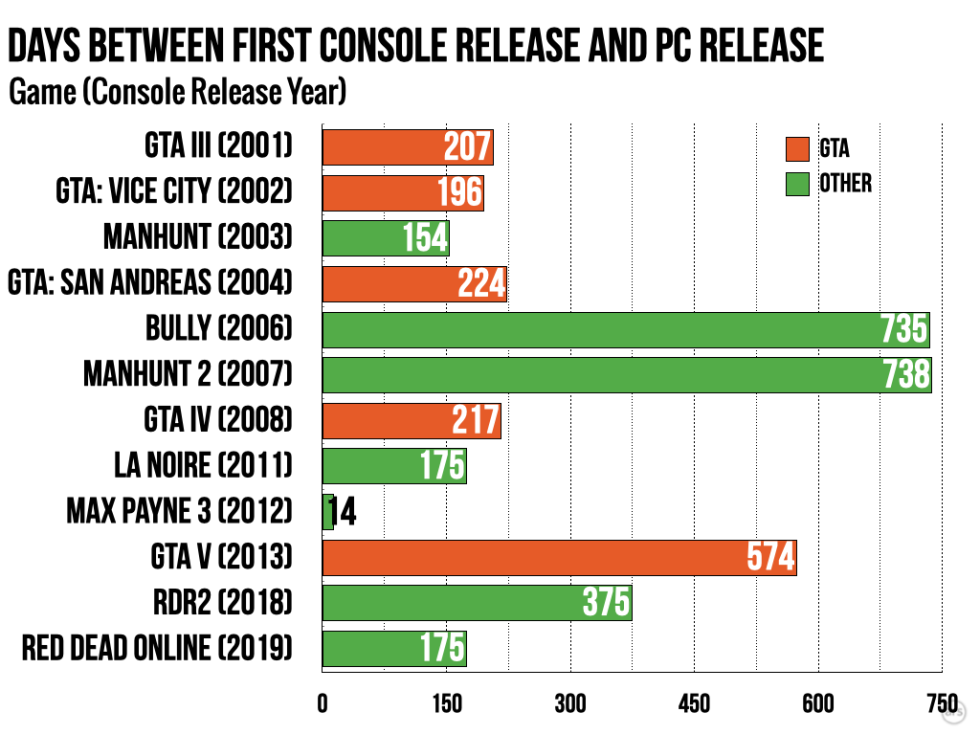
Take-Two’s stock price has historically traded at a premium relative to broader market indices, heavily underpinned by the perpetual cash-generation machine that is the *Grand Theft Auto* franchise. The eventual PC port has always been treated by equity research analysts as a secondary revenue wave—a calculated liquidity event that traditionally arrives 12 to 18 months post-console release to double-dip consumer wallets.
However, the proliferation of generative AI alters the velocity of market disruption. Consider the following structural impacts on the gaming sector:
- Erosion of Pricing Power: If decentralized developers flood alternative digital distribution channels with open-world simulators built using advanced AI pipelines, consumer price anchoring for premium AAA titles could face downward pressure.
- Regulatory and Compliance Headaches: The legal gray area surrounding AI training data, copyright infringement, and intellectual property misappropriation means Take-Two’s legal division is already engaged in pre-emptive risk mitigation, diverting capital from creative development to litigation infrastructure.
- Investor Sentiment Volatility: Wall Street hates uncertainty. Rumors regarding unofficial AI ports or high-fidelity replicas circulating on PC platforms can trigger algorithmic sell-offs, mispricing the stock based on speculative technological threats rather than fundamental financial performance.
To quantify the historical gap between console debuts and PC releases, alongside the modern variables introduced by artificial intelligence, consider the comparative metrics below:
| Metric / Parameter | GTA V (Historical Precedent) | GTA VI (Projected Reality) | AI Clone Market Impact |
|---|---|---|---|
| Console Launch Date | September 2013 (PS3/Xbox 360) | Fall 2025 (PS5/Xbox Series X/S) | N/A (Targeted at PC vacuum) |
| Console-to-PC Port Lag | 581 Days (19 Months) | Undisclosed (Expected 12-24 Months) | Pressure to compress timeline |
| Development Cost Baseline | ~$265 Million (Estimated) | Exceeding $1 Billion (Total lifecycle) | Minimal (Open-source/Cloud compute) |
| Primary Technical Barrier | Hardware optimization & anti-piracy | Advanced ray tracing & physics scaling | Copyright enforcement & legal liability |
Industry Implications: Who Wins, Who Loses?
The collision between traditional triple-A gatekeeping and generative AI decentralization creates distinct winners and losers across the global financial landscape.
The Winners
- Cloud Compute Infrastructure Providers: Companies providing high-performance GPU architecture and scalable neural network training clusters stand to gain massive enterprise revenue as indie developers experiment with complex world-building models.
- Aggressive Indie Studios: Nimble development teams that leverage AI tooling to quickly iterate on open-world concepts can capture early-adopter PC attention, monetizing micro-niches left vacant by delayed console exclusives.
- Cybersecurity and Legal Tech: Intellectual property law firms and digital rights management (DRM) specialists will experience a surge in demand as publishers aggressively defend their codebases and brand assets.
The Losers
- Traditional Console Manufacturers: If PC gamers feel less compelled to purchase secondary console hardware simply to access a timed exclusive—thanks to a booming ecosystem of high-tech alternatives—hardware sales synergies may weaken.
- Publisher Monopoly Control: Publishers accustomed to dictating exact consumer adoption timelines through hardware exclusivity face a loss of absolute scheduling control.
Frequently Asked Questions (People Also Ask)
Can generative AI legally replicate *GTA VI* without facing immediate copyright action?
No. While AI-generated code, assets, and textures can simulate the general aesthetic, mechanics, and open-world structure of a game, directly copying proprietary source code, trademarks, or copyrighted narrative elements constitutes clear intellectual property infringement. Take-Two Interactive maintains one of the most aggressive legal defenses in the entertainment industry and would swiftly issue cease-and-desist orders and pursue statutory damages against commercial infringers.
Why does Rockstar Games traditionally delay the PC version of its major titles?
The delay is primarily driven by capital allocation, optimization efficiency, and risk mitigation. Developing for fixed-spec hardware like the PlayStation 5 and Xbox Series X/S allows developers to maximize graphical fidelity and performance without accounting for the infinite hardware configurations present in the PC market. Furthermore, a staggered release allows publishers to secure a secondary wave of full-price software sales months after the initial console launch.
Will AI clones realistically force Take-Two to change its release schedule?
While AI clones create localized market noise and capture niche attention, they lack the narrative depth, cultural resonance, and massive multiplayer infrastructure (such as *GTA Online*) required to truly siphon core revenues from Rockstar. Therefore, it is highly unlikely that AI bootlegs will directly dictate Take-Two’s corporate roadmap. However, the broader normalization of generative tools in software development may indirectly encourage publishers to streamline port pipelines to capture eager PC liquidity faster.
How are financial markets viewing the intersection of gaming and generative AI?
Institutional investors and equity analysts view generative AI as both a margin-expanding production tool and a disruptive threat to traditional IP moats. While AI can reduce internal studio production costs over the long term, it simultaneously lowers the barrier to entry for independent creators, increasing market saturation and forcing major publishers to rely even more heavily on unmatched brand prestige and cinematic storytelling.
Future Outlook: Strategic Milestones to Monitor
As the industry marches toward the Fall 2025 release window, senior executives, equity analysts, and technology editors will be closely tracking several critical indicators. First, watch for any shifts in Take-Two’s official communications regarding the PC port timeline; any shortening of the historical 12-to-18-month window would signal an acute awareness of shifting market pressures. Second, monitor regulatory and judicial developments concerning generative AI copyright rulings in the United States and European Union, which will establish the legal boundaries for neural simulation tools.
Ultimately, while artificial intelligence is reshaping the velocity of software development, the moat surrounding multi-billion-dollar cultural phenomena like *Grand Theft Auto* remains anchored in human creativity, brand equity, and legal protection. AI clones may crowd the periphery, but the throne of open-world dominance will continue to rest firmly on execution, scale, and uncompromising production value.