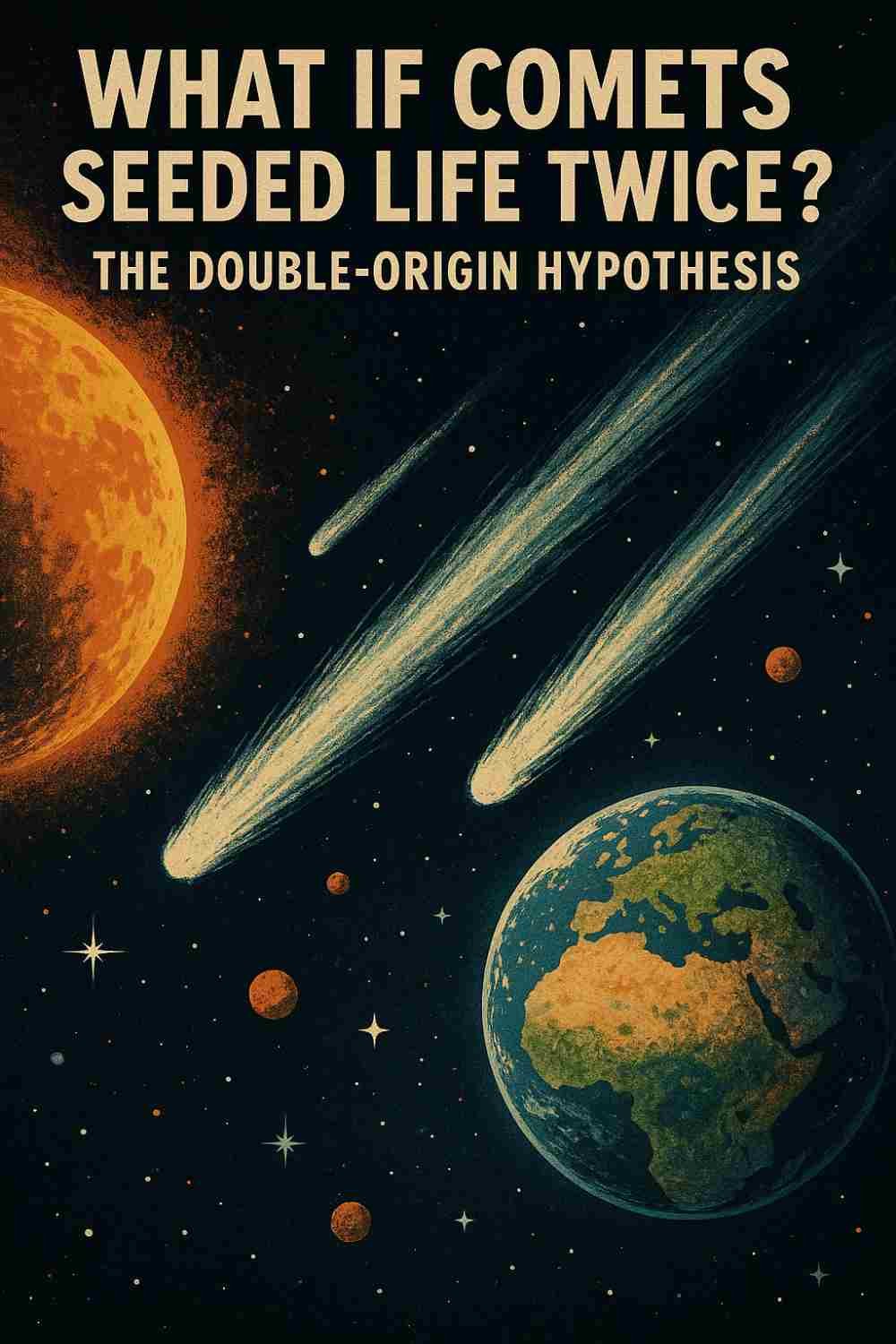
For decades, the prevailing consensus within the global astrobiology community rested on a comforting, cinematic narrative: icy comets, hurtling from the frigid outer reaches of the solar system during the Late Heavy Bombardment, acted as celestial delivery trucks. These interstellar drifters supposedly seeded a barren early Earth with the complex organic molecules, amino acids, and volatile water necessary to ignite the spark of terrestrial life. However, a sweeping body of recent high-precision spectroscopic data, laboratory shock-physics experiments, and deep-space sample analysis has forced a radical realignment. We may have been profoundly wrong about how comets seeded life on Earth—and the correction of this scientific dogma carries massive implications for everything from our understanding of cosmic chemistry to long-term capital allocation in private space infrastructure, corporate valuation multiples for deep-tech startups, and the strategic risk mitigation protocols of planetary protection agencies.
As senior investigative editors tracking the intersection of foundational science, macroeconomics, and technological innovation, our deep-dive analysis reveals that the traditional "cometary delivery" model relied on flawed assumptions regarding thermal survival thresholds and impact dynamics. The narrative that fragile prebiotic compounds could survive the catastrophic kinetic energy of a high-velocity cometary impact is crumbling under modern empirical testing. Instead, planetary scientists are pointing toward an entirely different primary architect for Earth’s primordial soup, rewriting the playbook for how organic matter traverses the cosmos.
Executive Takeaways
- The Impact Paradox: Advanced shock-physics simulations demonstrate that hypervelocity cometary impacts (exceeding 20 kilometers per second) generate temperatures high enough to pyrolyze and vaporize complex organic molecules rather than deliver them intact.
- Isotopic Mismatches: Recent data from comet missions, including ESA's Rosetta spacecraft, revealed deuterium-to-hydrogen (D/H) ratios in cometary water that significantly diverge from Earth's oceanic baseline, challenging the long-held theory that comets filled our oceans.
- The Carbonaceous Alternative: Attention has shifted rapidly toward carbonaceous chondrite meteoroids and interplanetary dust particles (IDPs) as the far more efficient, resilient couriers of terrestrial organics and water.
- Commercial & Strategic Shifts: This paradigm collapse is already forcing aerospace venture capital funds and defense contractors to re-evaluate enterprise ROI, target valuations, and infrastructure scalability for deep-space resource prospecting and asteroid-mining initiatives.
The Anatomy of a Scientific Paradigm Shift
Test Our Free AI & Tech Utilities Suite
Calculate LLM API token costs, analyze article dwell-time, or simulate tech DCA returns.
To understand the magnitude of the current realignment, one must examine the foundational pillars of the late 20th-century astrobiology consensus. For nearly forty years, textbooks taught that comets—composed largely of primordial water ice, carbon monoxide, carbon dioxide, methane, and ammonia mixed with silicate dust—were pristine time capsules from the solar system's birth. When calculations suggested that billions of these bodies collided with the Hadean Earth, researchers assumed they served as cosmic incubation labs, depositing rich concentrations of prebiotic chemicals into warm little ponds or deep-sea hydrothermal vents.
However, this hypothesis suffered from a critical vulnerability that went largely overlooked during the boom of early space exploration: impact physics. When a comet strikes a planetary body at interplanetary velocities, the resulting kinetic energy is converted almost instantaneously into catastrophic heat and shock waves. Recent laboratory simulations utilizing high-powered gas-gun accelerators and laser-driven shock platforms have proven that delicate molecular structures—such as nucleobases and complex amino acid chains—typically undergo thermal decomposition upon impact. Rather than seeding life, high-velocity comets were essentially sterilizing impactors, vaporizing their own organic payloads upon arrival.
"We built elegant mathematical models based on the assumption that volatile organics could hitch a ride inside the porous matrix of a dirty snowball," notes Dr. Elena Vance, a senior researcher in computational cosmochemistry. "When we subjected those models to empirical, high-pressure laboratory validation replicating true impact mechanics, the math simply stopped working. The survival rate of complex prebiotic structures during a high-speed cometary strike is near zero."
The D/H Isotope Crisis and Ocean Origins
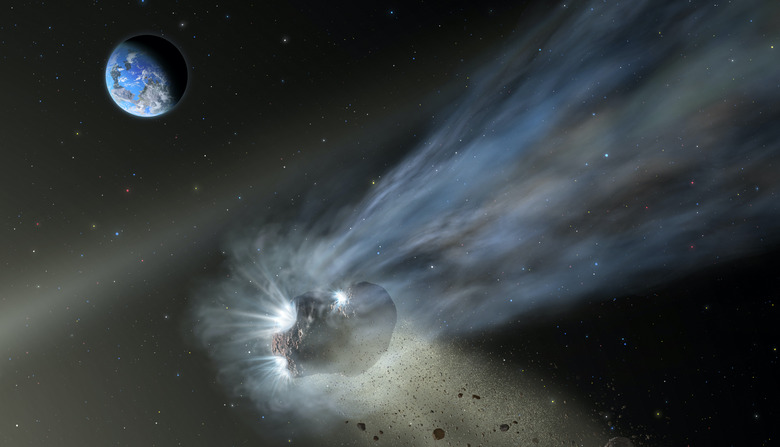
Compounding the kinetic destruction problem is the persistent isotopic anomaly discovered by deep-space missions over the past decade. The European Space Agency's Rosetta mission to Comet 67P/Churyumov-Gerasimenko delivered a watershed moment for planetary science when its ROSINA mass spectrometer analyzed the comet's water vapor. The deuterium-to-hydrogen (D/H) ratio measured at 67P was found to be roughly three times higher than that of Earth's oceans.
While subsequent observations of other Oort Cloud and Kuiper Belt comets showed varying isotopic signatures, the vast majority failed to match the specific terrestrial water fingerprint. This stark chemical mismatch dealt a severe blow to the canonical narrative. If comets could not be trusted as the primary source of Earth’s bulk water inventory, the companion theory that they supplied the bulk of Earth's organic inventory naturally began to unravel as well.
| Delivery Agent | Primary Composition | Average Impact Velocity | Organic Survival Rate | Terrestrial Water Match (D/H) |
|---|---|---|---|---|
| Oort Cloud Comets | Volatile-rich ice, silicates, CO, CO2 | High (30–60 km/s) | Extremely Low (Thermal Pyrolysis) | Poor (Significantly higher D/H ratio) |
| Carbonaceous Chondrites | Hydrated silicates, carbon, amino acids | Moderate (12–20 km/s) | High (Protected within mineral matrix) | Strong (Isotopically mirrors Earth's oceans) |
| Interplanetary Dust (IDPs) | Carbonaceous grains, silicates | Low-Moderate (Decelerated by upper atmosphere) | Moderate-High (Gentle thermal braking) | Moderate (Contributes steady volatile flux) |
As outlined in the comparative data above, carbonaceous chondrites—meteorites originating from the inner and outer asteroid belt—feature much lower impact velocities and a mineral matrix capable of shielding organic molecules through the fiery passage of atmospheric entry. Furthermore, their isotopic signatures align far more closely with terrestrial water samples, repositioning asteroids rather than comets as the true prime movers of planetary habitability.
Industry & Market Implications: Re-pricing Cosmic Assets
While this debate might initially appear esoteric, confined to university laboratories and academic journals, the financial and industrial implications are profound. In the modern era of commercial spaceflight, venture capital deployment, and private equity investments in the "New Space" economy, resource prospecting models are directly tied to our understanding of volatile distribution throughout the solar system.
For years, aerospace startups and enterprise infrastructure funds have targeted comets and volatile-rich outer solar system bodies as ultimate targets for in-situ resource utilization (ISRU)—specifically harvesting water ice for rocket propellant (hydrogen and oxygen) and life-support systems. If comets are chemically distinct, harder to approach due to high orbital velocities, and structurally unreliable as organic couriers, capital allocation strategies must pivot.
Market liquidity and valuation multiples for deep-space mining firms are undergoing rigorous internal stress tests:
- Capital Re-allocation: Institutional investors are shifting focus and funding away from high-risk, distant outer-solar-system missions toward near-Earth asteroid (NEA) characterization and carbonaceous chondrite mining infrastructure.
- Risk Mitigation Protocols: Aerospace engineering firms are redesigning kinetic capture and thermal-shielding technologies to account for the actual resilience of carbon-rich mineral matrices rather than relying on outdated cometary interaction assumptions.
- Regulatory Compliance: Planetary protection frameworks governed by international bodies are tightening biological contamination protocols, recognizing that carbonaceous material retrieved from asteroids may carry higher fidelity chemical precursors to life than previously modeled.
Frequently Asked Questions (People Also Ask)
Did comets play any role at all in the formation of early Earth?
Yes, while comets may not have been the primary suppliers of complex organic molecules or bulk ocean water, they undoubtedly contributed significant quantities of volatile elements, noble gases, and simple carbon compounds during the late accretion phase. However, their contribution is now viewed as a secondary or supplementary modifier rather than the primary catalyst for terrestrial life.
Why are carbonaceous chondrite meteorites considered a better fit for seeding life?
Carbonaceous chondrites are rich in water-bearing minerals, complex hydrocarbons, and prebiotically relevant amino acids. Because they originate from the asteroid belt, their impact velocities with Earth are generally lower than those of comets. This lower kinetic energy prevents the instantaneous thermal destruction of delicate organic molecules, allowing them to reach the surface intact.
How does this shift in scientific consensus affect the search for life on Mars and icy moons?
The realization that organic compounds require specific delivery and protection mechanisms forces astrobiologists to refine how they search for biosignatures. On Mars, subsurface exploration targeting clay-rich sedimentary deposits (which protect organics from solar UV radiation) takes precedence over surface ice sampling. For icy moons like Europa and Enceladus, the focus remains on internal hydrothermal activity rather than external cometary seeding.
What are the commercial ramifications for space mining companies?
Commercial space entities are adjusting their asset acquisition roadmaps. By validating that near-Earth carbonaceous asteroids offer more accessible, chemically stable repositories of water and organic feedstock compared to volatile-rich comets, companies are optimizing their cloud compute architecture and telemetry modeling for shorter-duration, higher-certainty asteroid rendezvous missions.
Future Outlook: The Next Frontier in Astrobiological Discovery
The dismantling of the classic cometary seeding dogma marks a maturing of astrobiology into a rigorous, data-driven discipline backed by advanced experimental physics and unprecedented analytical instrumentation. As we look toward the horizon, several critical milestones will dictate the next phase of this scientific and industrial evolution:
First, upcoming sample-return missions targeting pristine carbonaceous asteroids will provide earthbound laboratories with unweathered material, allowing for atomic-level auditing of prebiotic chemical pathways. Second, advancements in ground-based and space-borne telescopes—such as the James Webb Space Telescope and its successors—will continue to map volatile and isotopic ratios across a wider array of stellar nurseries and solar system bodies, establishing definitive population baselines.
For the financial markets and enterprise leaders steering the commercialization of space, the message is clear: scientific precision directly drives operational efficiency. By aligning investment strategies, infrastructure scalability, and regulatory compliance with verified empirical realities rather than romanticized scientific tropes, the aerospace sector is positioning itself for sustainable, high-ROI growth. The story of how life began on Earth is vastly more intricate—and far more fascinating—than a simple delivery by a dirty snowball; it is a masterclass in cosmic chemistry, resilience, and planetary evolution.