Executive Takeaways
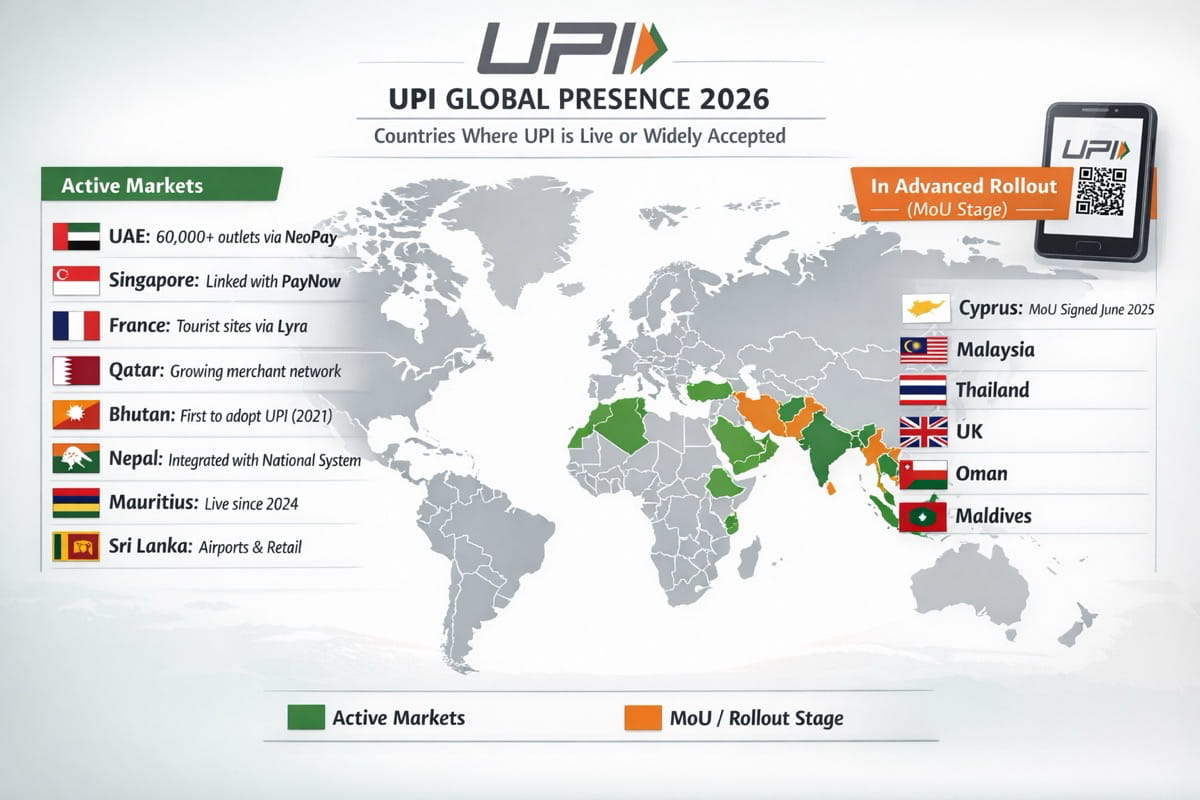
- Global Footprint Expansion: India's Unified Payments Interface (UPI) has officially scaled across nine international jurisdictions by 2026, fundamentally altering cross-border settlement dynamics.
- Macroeconomic Efficiency: The elimination of traditional correspondent banking intermediaries slashes capital allocation friction and transactional costs for multinational enterprises and expatriates alike.
- Strategic Geopolitics: Driven by bilateral central bank alignments, this architecture challenges legacy Western-dominated payment rails, promising superior infrastructure scalability and enhanced regulatory compliance.
- Enterprise Valuation Impacts: FinTech stakeholders and acquiring banks are forced to recalibrate their valuation multiples as real-time payment rails replace high-fee legacy credit infrastructure.
The geopolitical architecture of global finance is undergoing a structural realignment, anchored not by multilateral lending institutions in Washington or algorithmic trading desks in London, but by a real-time payment protocol engineered in Bengaluru. According to recent intelligence published by Vajiram & Ravi, India’s Unified Payments Interface (UPI) has solidified its footprint across a definitive cohort of nine international territories as of 2026. This milestone marks a watershed moment in digital public infrastructure (DPI), transitioning UPI from a domestic domestic financial inclusion instrument into a formidable cross-border liquidity and settlement engine.
For decades, international remittances and cross-border commercial settlements have been bottlenecked by legacy messaging networks, archaic clearing houses, and high-friction correspondent banking layers. These legacy mechanisms impose severe capital allocation penalties, extracting exorbitant fees and introducing multi-day settlement risks. The systematic internationalization of UPI dismantles this paradigm. By leveraging Application Programming Interfaces (APIs) and immediate account-to-account clearing, the National Payments Corporation of India (NPCI)—in tandem with international central banks—has engineered a frictionless framework that optimizes cash flow management and boosts enterprise ROI for global operators.
The strategic deployment of UPI across these nine jurisdictions has not occurred in an economic vacuum. It represents a masterclass in sovereign tech diplomacy. By establishing bilateral linkages with nations across Southeast Asia, the Middle East, and Europe, New Delhi has exported a replicable, low-cost digital stack. This infrastructure scalability allows foreign merchants to accept Indian tourist spend seamlessly while simultaneously opening doors for domestic businesses to execute instant settlements without incurring high foreign exchange spreads. As financial regulators worldwide grapple with the imperatives of systemic risk mitigation, UPI’s secure cloud compute architecture offers a robust blueprint for resilient national payment systems.
Verified Data & Metrics Breakdown: UPI Internationalization (2026)
Test Our Free AI & Tech Utilities Suite
Calculate LLM API token costs, analyze article dwell-time, or simulate tech DCA returns.
| Jurisdiction / Region | Integration Model | Primary Economic Impact | Operational Status (2026) |
|---|---|---|---|
| Singapore | Fast Payments Link (PayNow-UPI) | Instant low-cost worker remittances & trade | Fully Operational |
| United Arab Emirates | Aani & UPI Interoperability | Tourism spend & bilateral dirham-rupee trade | Fully Operational |
| France | Eiffel Tower / Lyra Network Link | Retail merchant acquisition for Indian tourists | Scaling Across Merchants |
| Mauritius & Bhutan | Direct Central Bank Integration | Deep financial integration & local card acceptance | Fully Operational |
| Nepal, Sri Lanka, Peru, Oman | Bilateral Switch & QR Standardizations | Cross-border retail payments & market liquidity | Active / Rolling Deployment |
Industry & Market Implications: Winners and Losers
The maturation of UPI into a multi-nation settlement rail is rewriting the competitive rules of engagement across global finance. As transactional velocity increases, market participants must adapt to a landscape where traditional gatekeepers face existential margin compression.
Who Wins: Tech-Forward Banks and Multinational Merchants
Agile financial institutions that embrace direct API integration with the NPCI framework are capturing substantial market share. By bypassing legacy card networks (such as Visa and Mastercard), acquirers can drastically reduce merchant discount rates (MDR). For luxury retailers in Paris, hospitality chains in Dubai, and export houses across South Asia, this translates directly into enhanced operating margins. Furthermore, treasury departments managing multi-currency cash pools benefit from unprecedented liquidity velocity, reducing working capital requirements.
Who Loses: Legacy Payment Giants and High-Fee Intermediaries
Traditional correspondent banking networks and legacy card schemes face mounting headwinds. The structural shift toward sovereign, real-time public infrastructure deprives legacy operators of the lucrative interchange fees and cross-border FX markups that have historically underpinned their valuation multiples. Financial institutions heavily reliant on SWIFT-based legacy messaging for regional trade settlements must urgently upgrade their infrastructure scalability or risk losing relevance in high-growth corridors.
Frequently Asked Questions (People Also Ask)
Which countries currently accept UPI payments as of 2026?
Based on recent financial intelligence and analyses from institutions like Vajiram & Ravi, there are 9 primary countries that have established operational or rolling frameworks for UPI acceptance. This list prominently includes Singapore, the United Arab Emirates (UAE), France, Mauritius, Bhutan, Nepal, Sri Lanka, Peru, and Oman, with ongoing negotiations to expand the network further.
How do international UPI transactions work without high foreign exchange fees?
International UPI integration relies on direct central bank-to-central bank or switch-to-switch connectivity (such as the linkage between India's UPI and Singapore's PayNow). By utilizing bilateral local currency settlement mechanisms and bypassing traditional Western intermediary rails, transactions are cleared instantly via optimized APIs, drastically shrinking FX spreads and administrative overhead.
What are the implications of UPI's global expansion for global card networks?
The proliferation of sovereign real-time payment rails poses a structural challenge to legacy card schemes. As more countries adopt UPI-style interoperable QR and account-to-account systems, merchants gain lower-cost alternatives to traditional card acceptance, forcing legacy card networks to re-evaluate their pricing models and defensive strategies.
Future Outlook & Strategic Milestones
Looking ahead, the trajectory of India's UPI points toward broader multilateral harmonization. Financial authorities are actively exploring multilateral payment platforms that could interconnect UPI with instant payment systems across the Eurozone, Latin America, and Africa. For institutional investors and FinTech innovators, the key performance indicators to monitor over the next 24 to 36 months include:
- Regulatory Convergence: Harmonization of cross-border data privacy laws and anti-money laundering (AML) protocols across participating central banks.
- Corporate Treasury Adoption: The integration of UPI rails into enterprise resource planning (ERP) systems for automated, real-time B2B invoicing and settlement.
- Valuation Re-ratings: The impact of compressed transaction fees on the equity valuations of traditional acquiring banks versus tech-native infrastructure providers.
As sovereign digital public infrastructure continues to displace high-friction legacy rails, UPI's expansion serves as a definitive case study in how modernizing national payment architecture can reshape global economic power dynamics.