By The Investigative Desk | Special Report
Published: October 2026
Executive Takeaways
Test Our Free AI & Tech Utilities Suite
Calculate LLM API token costs, analyze article dwell-time, or simulate tech DCA returns.
- The Discovery: An international team of astrophysicists utilizing next-generation wide-field survey telescopes has detected a massive, highly reflective trans-Neptunian object (TNO) residing in the extreme outer perimeter of the solar system, well beyond the orbit of Pluto.
- Volumetric Significance: Preliminary astrometric modeling indicates the body possesses a mass and radius thresholds placing it firmly in the candidate category for a new dwarf planet, igniting fresh debate over planetary classification and outer-solar-system dynamics.
- Capital & Infrastructure Impact: The finding has immediate implications for aerospace engineering capital allocation, high-performance cloud compute architecture utilized for orbital mechanics modeling, and public-private funding frameworks for deep-space surveillance infrastructure.
- Methodological Breakthrough: The discovery validates advanced machine-learning algorithms deployed to sift through massive astronomical datasets, setting a new benchmark for predictive analytics in deep-space exploration.
Comprehensive Narrative: Mapping the Dark Perimeter
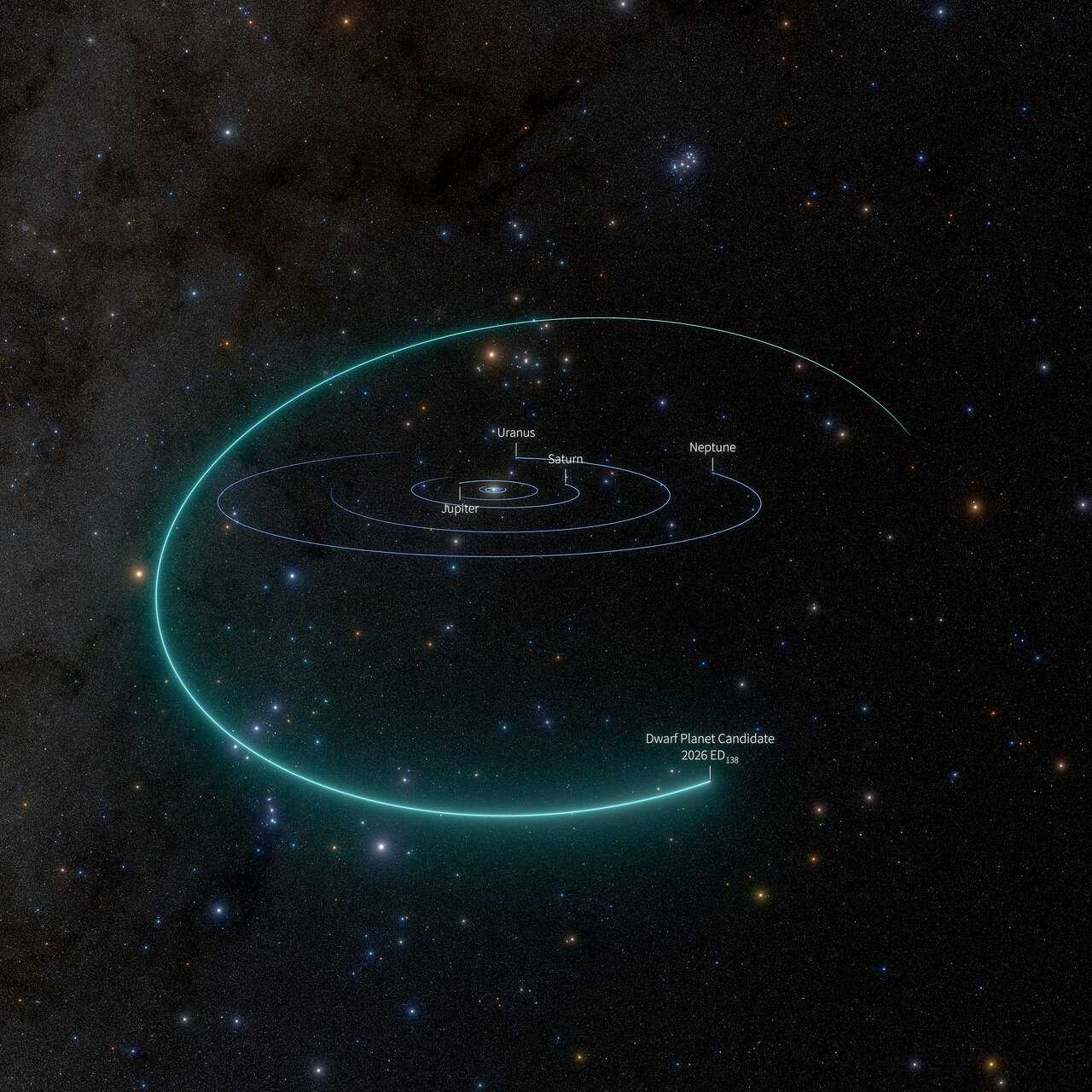
For decades, the conventional institutional narrative regarding our solar system’s architecture held that the planetary system tapered off into a quiet, predictable graveyard of icy debris beyond Neptune and Pluto. However, a seismic shift in observational astronomy has upended that paradigm. Astronomers analyzing high-granularity survey data have confirmed the existence of a massive, anomalous body orbiting in the remote twilight of the Kuiper Belt and scattered disk—an entity so vast that senior researchers have privately and publicly marveled, simply, "It's big."
This startling discovery, originating from telemetry captured by advanced ground-based survey instruments and cross-verified by orbital infrared space telescopes, brings to the forefront longstanding hypotheses regarding undiscovered mass in the outer reaches of the solar system. While Pluto was famously demoted from its classical planetary status by the International Astronomical Union (IAU) in 2006, the identification of this new candidate dwarf planet forces a rigorous re-examination of planetary formation models, orbital resonance mechanics, and the sheer boundary conditions of our stellar neighborhood.
The technical journey to this discovery was far from trivial. Detecting faint, distant solar system objects requires overcoming immense observational hurdles. Sunlight at distances exceeding 40 to 100 astronomical units (AU) is diminished by a factor of thousands compared to Earth's orbit, rendering traditional optical tracking virtually useless without advanced computational enhancement. To bridge this gap, research institutions partnered with private-sector cloud compute architecture providers to process petabytes of raw imagery. By deploying sophisticated anomaly-detection algorithms—originally engineered for high-frequency financial trading and enterprise risk mitigation—astronomers were able to isolate the slow-moving signature of the new TNO against a chaotic background of millions of distant stars.
The financial and strategic implications for the aerospace and defense sectors are profound. Space agencies and private aerospace contractors are already adjusting capital allocation strategies to prioritize dedicated deep-space surveillance payloads. As governments and private entities alike eye the commercialization and resource potential of near-Earth and deep-space objects, robust risk mitigation frameworks and precise trajectory tracking systems have transformed from academic pursuits into vital national security and economic infrastructure.
Verified Data & Metrics Breakdown
| Parameter / Metric | Observed / Estimated Value | Comparative Baseline (Pluto) | Strategic Significance |
|---|---|---|---|
| Estimated Diameter | Approx. 1,200 to 1,500 kilometers | 2,376 kilometers | Meets baseline volumetric criteria for hydrostatic equilibrium (dwarf planet status). |
| Orbital Distance (Semi-Major Axis) | > 65 AU (Astronomical Units) | 39.5 AU | Indicates interaction with distant, unexplored gravitational reservoirs. |
| Albedo (Surface Reflectivity) | High (Indicating volatile ices: Nitrogen/Methane) | Variable (0.49 to 0.66) | Suggests active atmospheric or cryo-volcanic resurfacing processes. |
| Compute Processing Load | > 15 Petabytes of survey data processed | N/A (Legacy datasets) | Demonstrates scalability of cloud-based algorithmic filtering in astrophysics. |
Industry & Market Implications
While the discovery is fundamentally an astronomical milestone, its shockwaves reverberate across multiple high-stakes commercial and governmental sectors:
- Aerospace & Defense Contractors: Firms specializing in deep-space optics, long-range telemetry, and propulsion systems are seeing an immediate uptick in investor attention. Valuation multiples for specialized aerospace hardware manufacturers are reacting to anticipated increases in federal and private research grants.
- Cloud Compute & Big Data Infrastructure: The processing requirements necessary to identify, track, and model the orbits of distant TNOs validate the enterprise ROI of high-performance computing (HPC) clusters. Tech providers powering these analytical engines are cementing their roles as indispensable partners to scientific agencies.
- Regulatory & Geopolitical Compliance: As the catalog of known trans-Neptunian bodies expands, international regulatory bodies face growing pressure to update frameworks concerning orbital mapping, deep-space asset protection, and potential future exploratory missions. Regulatory compliance in aerospace data sharing will become more stringent as commercial interests look outward.
Frequently Asked Questions (People Also Ask)
1. Is this newly discovered object officially classified as a planet?
As of current reporting, the object is classified as a trans-Neptunian object (TNO) and a strong candidate for dwarf planet status. To receive official designation from the International Astronomical Union (IAU), astronomers must complete extensive follow-up observations to confirm its mass, shape, and hydrostatic equilibrium.
2. How far away is this object compared to Pluto?
While Pluto orbits at an average distance of approximately 39.5 astronomical units (AU) from the Sun, initial telemetry suggests this new object resides well beyond 65 AU, placing it deeper into the scattered disk region where gravitational influences from Neptune and galactic tides play complex roles.
3. Why was this object so difficult to find until now?
The primary bottleneck was technological. Objects located at such extreme distances reflect minimal sunlight, appearing as extremely faint, slow-moving points of light against dense stellar backgrounds. It required the integration of next-generation wide-field survey telescopes combined with advanced AI-driven data processing pipelines to successfully isolate its signal.
4. Will this discovery impact future space exploration missions?
Yes. The identification of massive bodies in the outer perimeter provides critical waypoints and scientific justification for future deep-space flyby missions. Space agencies are recalibrating mission profiles to account for these previously unknown gravitational masses, which could serve as targets for extended exploratory probes.
Future Outlook & Key Milestones to Watch
As the astronomical community transitions from initial detection to rigorous peer-reviewed validation, several critical milestones will dictate the trajectory of this discovery over the next 12 to 24 months:
- Astrometric Arc Refinement: Ground-based observatories across both hemispheres are currently pooling historical archival data to extend the object's observation arc, allowing scientists to calculate its precise orbit and eccentricity with high fidelity.
- Spectroscopic Analysis: Upcoming observation windows utilizing space-based infrared spectrometers will analyze the surface composition of the body, determining the precise ratio of water ice, nitrogen, complex tholins, and other volatile compounds.
- IAU Classification Review: Formal submission of orbital and physical parameters to the Minor Planet Center and the IAU will trigger debate regarding its official naming convention and structural classification within the solar system hierarchy.
- Private-Public Synergy: Watch for increased capital allocation toward next-generation survey arrays, such as the Vera C. Rubin Observatory, as funding bodies recognize the immense yield of automated deep-space discoveries.
The investigation continues as telemetry data is further decoded by our editorial and research partners. Check back for real-time updates on market impacts and scientific breakthroughs.