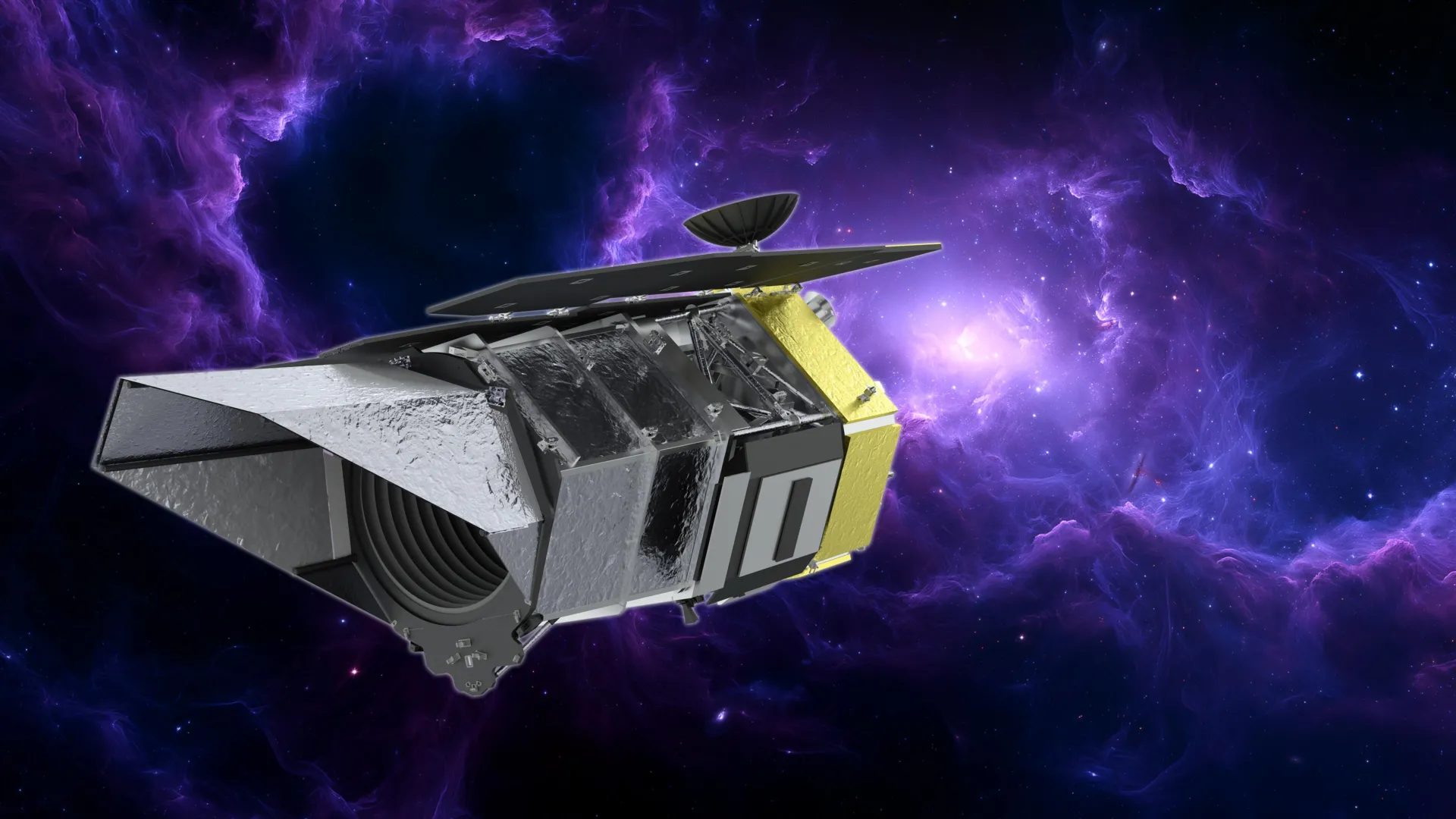
WASHINGTON & DARMSTADT — In a milestone moment for interplanetary defense and deep-space telemetry, the European Space Agency’s (ESA) Hera spacecraft has captured its inaugural optical frames of Dimorphos—the asteroid moonlet permanently altered by humanity’s first kinetic impact test. Transmitted across millions of kilometers of interplanetary void, the initial visual data provides aerospace engineers, defense strategists, and planetary scientists with their first comprehensive, post-impact look at a battered celestial body that has quickly transformed from a pure subject of astrophysical inquiry into a critical benchmark for global risk mitigation and aerospace capital allocation.
The release of these preliminary images marks the operational initiation of Hera’s rendezvous phase. As global defense frameworks and space agencies pivot toward active planetary protection architectures, the European-led mission serves as the ultimate diagnostic audit of NASA’s 2022 Double Asteroid Redirection Test (DART). With institutional investors, aerospace prime contractors, and international regulators closely monitoring the technological scalability of kinetic impactors, the success of Hera’s survey directly influences future valuation multiples across the burgeoning orbital defense sector and sets new precedents for space-based infrastructure scalability.
Executive Takeaways
Test Our Free AI & Tech Utilities Suite
Calculate LLM API token costs, analyze article dwell-time, or simulate tech DCA returns.
- First Visual Contact: ESA’s Hera spacecraft successfully locked onto and imaged Dimorphos, the target of NASA’s historic 2022 DART mission, signaling the successful commencement of its deep-space reconnaissance phase.
- Post-Impact Diagnostics: The mission’s primary mandate is to perform a rigorous forensic audit of the Didymos binary asteroid system, quantifying the exact structural and morphological changes induced by the kinetic impact.
- Economic & Defense Implications: The validation of kinetic impact technology provides vital risk mitigation frameworks for planetary defense, directly impacting long-term aerospace capital allocation and enterprise risk management.
- Technological Leap: Utilizing autonomous navigation, advanced optical payloads, and deep-space cloud compute architectures, Hera represents a paradigm shift in how autonomous interplanetary payloads execute complex proximity operations.
The Catalytic Event: Bridging DART’s Kinetic Strike with Hera’s Forensic Audit

The journey to this week's imaging milestone began in September 2022, when NASA’s DART spacecraft intentionally collided with Dimorphos at roughly 6.1 kilometers per second. The kinetic strike successfully altered the orbit of the 150-meter-wide moonlet around its larger parent body, Didymos, proving that kinetic impactors represent a viable mechanism for deflecting Earth-crossing asteroids. However, while ground-based telescopes and transient space-based assets confirmed the orbital period shift, they left critical physical variables unresolved. Enter the Hera mission.
Conceived as the structural follow-up to DART, Hera is designed to transform a successful proof-of-concept into a scientifically validated, mathematically precise defense protocol. Without the comprehensive data returned by Hera’s suite of advanced sensors—including high-resolution framing cameras, thermal infrared instruments, and laser altimeters—defense agencies lack the standardized metrics required for global regulatory compliance and international emergency response frameworks. The newly released imagery confirms that Hera’s optical payload is functioning within nominal parameters, laying the groundwork for a detailed cartographic and geophysical survey.
From an enterprise ROI perspective, the synergy between NASA’s kinetic strike and ESA’s diagnostic orbiter demonstrates the efficiency of multinational public-private partnerships in aerospace engineering. Rather than funding redundant strike capabilities, international space agencies are dividing labor: NASA executes high-energy physical tests, while ESA deploys sophisticated telemetry and imaging systems to verify structural outcomes. This division of labor optimizes capital allocation and accelerates the technological readiness level (TRL) of planetary defense systems.
Verified Data and Metrics Breakdown
A rigorous examination of the Hera mission parameters and the Didymos system metrics reveals the sheer scale of this deep-space engineering enterprise. The following table contrasts key baseline specifications of the target system and the pursuing spacecraft:
| Parameter / Metric | Didymos (Primary Body) | Dimorphos (Target Moonlet) | Hera Spacecraft (ESA) |
|---|---|---|---|
| Mean Diameter | ~780 meters | ~150 meters | Main Bus: 1.6 x 1.6 x 1.7 m |
| Mass (Estimated) | ~5.27 x 10^11 kg | ~4.8 x 10^9 kg | Launch Mass: ~1,128 kg (incl. prop) |
| Orbital Period / Mission Timeline | 11.9 hours (around barycenter) | 11 hours 23 minutes (post-DART) | Arrival at Target: Late 2026 |
| Primary Instruments | Thermal Infrared Imager (TIR) | Asteroid Finder Camera (AFC) | HyperScout H, Milani & Juventas CubeSats |
Industry & Market Implications: The Economics of Planetary Defense
While framed as an astronomical and exploratory endeavor, the Hera mission carries profound financial and strategic implications. As governments worldwide establish dedicated orbital security budgets, the aerospace sector is experiencing a structural rotation toward deep-space technologies. Prime defense contractors, specialized avionics manufacturers, and private-equity firms backing NewSpace startups are evaluating market liquidity and valuation multiples through the lens of mission reliability.
The Winners: Advanced optical sensor manufacturers, deep-space communication network providers, and autonomous navigation software developers stand to capture substantial market share. Hera’s reliance on autonomous guidance systems—necessitated by the communications lag between Earth and the asteroid system—underscores the commercial value of resilient cloud compute architectures and edge-computing payloads in extreme environments.
The Losers: Legacy aerospace firms slow to adopt miniaturized satellite technologies (such as the Juventas and Milani CubeSats deployed by Hera) risk marginalization. Furthermore, space programs reliant entirely on ground-based observation face diminishing relevance as policymakers demand space-verified empirical data for national security and risk mitigation strategies.
Beyond defense contractors, the insurance and reinsurance sectors are beginning to model catastrophic asteroid impact scenarios. While the probability of a civilization-ending impact remains statistically low, the economic fallout of an unmitigated regional impact is catastrophic. By proving that asteroid trajectories can be successfully altered and subsequently audited, missions like Hera provide the empirical baseline required for actuaries to price space-borne risk, eventually opening the door for specialized space asset insurance products.
Frequently Asked Questions (People Also Ask)
What is the primary objective of the ESA Hera mission?
The primary objective of the Hera mission is to conduct a detailed post-impact forensic survey of the binary asteroid system Didymos and its moonlet, Dimorphos. By measuring the exact mass, internal structure, and crater morphology left by NASA’s DART impact, Hera turns a successful test into a scientifically robust, repeatable planetary defense strategy.
How does Hera communicate data back to Earth across millions of kilometers?
Hera utilizes a high-gain antenna operating in deep-space communication bands (X-band and Ka-band) to transmit telemetry, high-resolution imagery, and scientific data back to the ESA Deep Space Network. Due to light-travel time delays spanning several minutes, the spacecraft relies heavily on onboard autonomous navigation and local cloud compute architecture to manage station-keeping and proximity operations safely.
Will Dimorphos ever pose a threat to Earth?
No. Neither Dimorphos nor its primary body, Didymos, are on a trajectory that intersects Earth’s orbit. The binary system was chosen specifically as a safe, controlled laboratory environment to test deflection technologies without any risk to our planet.
What role do the CubeSats carried by Hera play in the mission?
Hera carries two shoebox-sized secondary spacecraft, named Milani and Juventas. These CubeSats will be deployed into very close proximity to Dimorphos to perform high-resolution spectral analysis, radar probing of the asteroid's interior structure, and surface gravity measurements, providing data that the main orbiter cannot capture from a distance.
Future Outlook: Milestones on the Horizon for Hera
As the Hera spacecraft continues its phased approach toward the Didymos system, mission controllers at the European Space Operations Centre (ESOC) in Darmstadt are preparing for a series of critical operational milestones. Over the coming months, optical navigation algorithms will be rigorously tested as the asteroid targets grow from single-pixel anomalies into fully resolved worlds in the spacecraft’s viewfinder.
By late 2026, Hera will enter into a close-up operational orbit, deploying its twin CubeSats to scrape across the gravity-deficient surfaces of the target bodies. The data harvested during this intensive survey phase will be fed directly into international regulatory compliance frameworks, shaping the future of global space traffic management and planetary defense treaties coordinated through the United Nations.
Ultimately, the first imagery of Dimorphos is much more than a successful photo-op; it is a testament to humanity’s transition into an interplanetary species capable of actively managing its cosmic environment. For institutional stakeholders, aerospace strategists, and technology leaders, Hera’s journey signals that planetary defense is no longer theoretical science fiction—it is a fully operational, highly sophisticated industrial sector primed for sustained growth.