The Global South’s Quiet Revolution: How Pix and UPI Rewrote the Rules of Digital Payments—And What Wall Street is Missing
For decades, the architecture of global finance was defined by proprietary rails, exorbitant merchant discount rates (MDR), and entrenched intermediaries that extracted a toll from every swipe, tap, and cross-border transfer. Today, a structural paradigm shift is quietly upending that hegemony. Emerging from the Global South, Digital Public Infrastructure (DPI)—anchored by Brazil’s Pix and India’s Unified Payments Interface (UPI)—has redefined how nations think about capital allocation, financial inclusion, and infrastructure scalability. What began as regional experiments in instant payments has matured into multi-trillion-dollar macroeconomic engines, forcing legacy payment giants, multinational banks, and enterprise fintechs to rethink their valuation multiples, risk mitigation models, and enterprise ROI strategies.
As policymakers, central bankers, and institutional investors converge on the lessons of Pix and UPI, the implications stretch far beyond retail remittances. We are witnessing the birth of state-backed, open-source transactional layers that rival—and in many cases outperform—the private monopolies of Silicon Valley and Wall Street. For institutional allocators and chief technology officers, understanding the inner mechanics, regulatory compliance frameworks, and cloud compute architectures of DPI is no longer optional; it is a fiduciary imperative for navigating the next decade of digital commerce.
Executive Takeaways
- Macroeconomic Scale: Brazil’s Pix and India’s UPI process tens of billions of transactions monthly, systematically displacing cash and legacy card rails while drastically lowering the friction of market liquidity.
- Disintermediation Risk: The proliferation of zero-cost or ultra-low-cost instant DPI threatens traditional interchange fee models, forcing legacy card networks and acquiring banks to pivot toward value-added enterprise software and cross-border monetization.
- The DPI Blueprint: Built on interoperable, modular architecture—identity, payments, and data sharing—DPI offers a replicable template for developing and developed economies alike seeking to accelerate financial inclusion and stimulate digital entrepreneurship.
- Strategic Reallocation: Financial institutions must recalibrate their infrastructure investments, moving away from closed-loop proprietary networks toward API-first, cloud-native frameworks capable of interfacing seamlessly with national instant payment switches.
The Catalytic Evolution: From Friction to Foundation
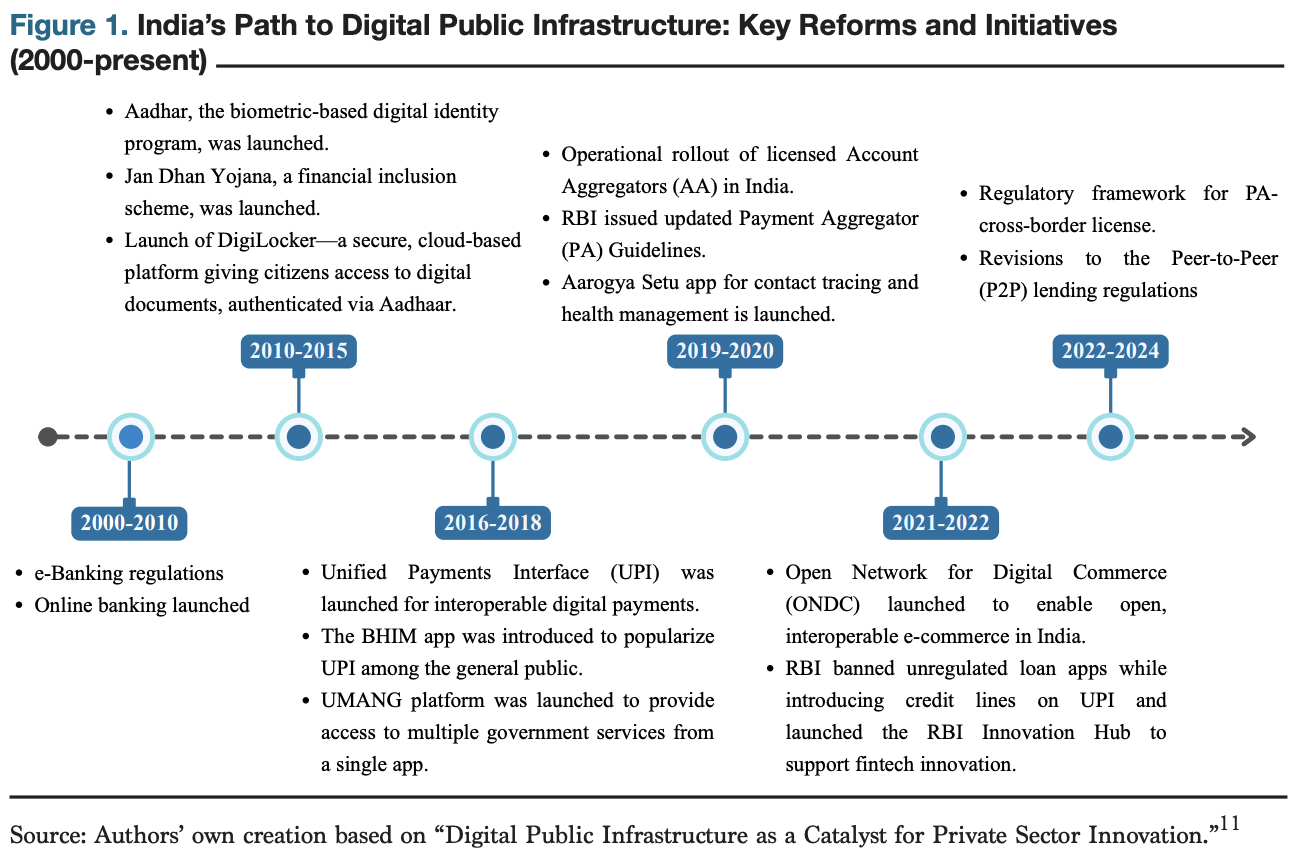
To comprehend the disruptive velocity of Pix and UPI, one must examine the baseline inefficiencies they were engineered to dismantle. In India, a cash-dominated economy with historically low banking penetration, the journey began with the India Stack—a foundational digital identity layer (Aadhaar) paired with biometric verification. When the National Payments Corporation of India (NPCI) launched UPI in 2016, it leveraged this identity bedrock to create a mobile-first, interoperable payment rail. By abstracting complex bank account details into simple virtual payment addresses (VPAs) and utilizing dynamic QR codes, UPI democratized digital acceptance for street vendors and enterprise conglomerates alike.
Simultaneously, across the Atlantic, Brazil’s Banco Central do Brasil faced a parallel challenge: a highly concentrated banking sector characterized by high borrowing costs, lagging settlement times (historically taking days for debit and clearing), and prohibitive merchant fees. Launched in November 2020, Pix bypassed the traditional credit and debit card duopolies altogether. By mandating that all financial institutions with over 500,000 active accounts integrate with the Pix instant payment system, the Brazilian central bank engineered immediate market adoption. Pix did not merely digitize existing workflows; it altered consumer behavior overnight, drawing millions of unbanked citizens into the formal financial ecosystem.
The technical architecture underpinning both systems relies on relentless innovation in cloud compute architecture and real-time processing capabilities. Unlike legacy batch-processing systems that rely on end-of-day clearing houses, Pix and UPI operate 24/7/365, utilizing centralized instant payment engines capable of validating, clearing, and settling transactions in a matter of seconds. This immediate finality eliminates counterparty credit risk for merchants and frees up working capital that was previously trapped in settlement limbo.
Verified Data & Metrics Breakdown Table
| Metric / Dimension | Brazil (Pix) | India (UPI) |
|---|---|---|
| Launch Date | November 2020 | April 2016 |
| Governing Authority | Banco Central do Brasil (BCB) | National Payments Corporation of India (NPCI) |
| Monthly Transaction Volume | Exceeds 4 Billion Transactions | Exceeds 13 Billion Transactions |
| Primary Technological Edge | Mandatory bank integration & proxy keys (CPF/Email) | API-driven abstraction layer & Virtual Payment Addresses (VPAs) |
| Economic Impact Focus | Reduction of credit card dominance & informal economy formalization | Mass financial inclusion & micro-merchant digitization |
Industry & Market Implications: Winners, Losers, and Capital Reallocation
The maturation of DPI creates a zero-sum dynamic across the financial services value chain. As transaction volumes migrate en masse to government-backed public rails, the revenue models of legacy stakeholders face severe compression.
Who Wins:
Who Loses:
From an institutional investment perspective, private equity and venture capital firms are shifting their capital allocation strategies. Funding is receding from pure-play payment gateway plays that merely shuttle transactions over traditional rails, pivoting instead toward B2B SaaS enablers that leverage DPI APIs to automate enterprise treasury, tax compliance, and automated accounting workflows.
Frequently Asked Questions (People Also Ask)
How do Pix and UPI generate revenue if consumer transactions are largely free?
While peer-to-peer (P2P) transfers for individuals are mandated to be free or heavily subsidized to encourage adoption, revenue is generated through merchant-facing services, enterprise APIs, and value-added services. Governments and central banks view DPI as core public infrastructure analogous to roads or electricity, where the broader macroeconomic dividend—such as tax compliance, reduced cash management costs, and expanded GDP formalization—far outweighs direct transactional toll collection. Furthermore, private fintechs operating atop UPI and Pix monetize through cross-selling credit, insurance, and wealth management products.
Can the Pix and UPI models be successfully replicated in developed economies like the United States or the European Union?
Replication faces distinct structural and political headwinds in Western markets. Unlike Brazil and India, where central banks exercised strong regulatory mandates or centralized coordination (such as the NPCI), the U.S. and European banking landscapes are heavily fragmented, dominated by entrenched private card networks and legacy financial institutions with vested interests in interchange fees. While the U.S. has introduced FedNow and Europe utilizes SEPA Instant Credit Transfer, these initiatives lack the aggressive mandates, unified digital identity layers, and consumer-facing user experience standardization that propelled Pix and UPI to ubiquitous adoption.
What are the primary risk mitigation and regulatory compliance challenges associated with DPI?
As financial transactions centralize onto state-backed digital rails, cybersecurity and systemic operational risk become paramount. Central banks and operators must fortify their cloud compute architectures against sophisticated distributed denial-of-service (DDoS) attacks, state-sponsored cyber espionage, and data privacy breaches. Additionally, strict regulatory compliance frameworks—such as anti-money laundering (AML) and know-your-customer (KYC) protocols—must be embedded directly into the transaction streaming architecture without sacrificing processing speed.
How does DPI impact monetary policy transmission and central bank liquidity management?
Digital Public Infrastructure dramatically enhances the velocity of money. Because transactions settle in real-time, central banks gain unprecedented, granular visibility into macroeconomic activity and consumer spending patterns. This high-frequency data allows monetary authorities to calibrate interest rates and liquidity injections with greater precision, reducing the lag time historically associated with monetary policy transmission.
Future Outlook: The Next Frontier of Global Payments
As we look toward the horizon, the evolution of Digital Public Infrastructure is entering its next phase: cross-border interoperability. Initiatives are already underway to link India’s UPI with Singapore’s PayNow, and discussions are advancing to connect Pix across Latin American trade blocs. The holy grail of modern payments is a frictionless, multi-currency, instant cross-border settlement network that bypasses legacy correspondent banking networks like SWIFT entirely.
For executive leadership teams, corporate treasurers, and institutional investors, the mandate is clear. The era of walled-garden payment monopolies is giving way to open, interoperable public rails. Success in this new paradigm requires embracing API-first modernization, designing resilient cloud infrastructures, and pivoting business models away from transaction toll-booths toward high-value enterprise software. Those who adapt to the DPI reality will capture outsized market share; those anchored to legacy rails risk becoming financial relics of the past.