The second half of 2025 will be remembered by Chief Information Security Officers (CISOs) and enterprise risk committees as the inflection point where artificial intelligence transitioned from a capital-allocation darling to ground zero for systemic cyber risk. According to the landmark TrendAI™ State of AI Security Report published by Trend Micro, the hyper-accelerated deployment of Large Language Models (LLMs), machine learning (ML) frameworks, and decentralized AI supply chains has exposed critical architectural vulnerabilities. As organizations race to protect enterprise ROI and secure cloud compute infrastructure, bad actors are weaponizing the very layers designed to drive intelligence, creating an unprecedented threat landscape.
This investigative report breaks down the structural fault lines destabilizing the global AI ecosystem, examining how vulnerabilities in foundational ML frameworks, compromised open-source repositories, and persistent prompt injection attacks are forcing a radical re-evaluation of enterprise governance, risk mitigation, and compliance frameworks worldwide.
Executive Takeaways
- Ground Zero for Cyber Risk: The second half of 2025 marked a historic surge in targeted attacks against enterprise AI infrastructure, turning machine learning deployment pipelines into primary vectors for corporate espionage and data exfiltration.
- Supply Chain Fragility: Threat actors are systematically exploiting unverified third-party ML models, poisoned training datasets, and compromised open-source framework repositories to implant persistent backdoors.
- The Prompt Injection Epidemic: Advanced evasion techniques—exemplified by Layered Prompt Injection methodologies—are bypassing standard guardrails, allowing adversaries to hijack autonomous agents and manipulate enterprise logic layers.
- Mandatory Risk Realignment: Boards and executive leadership teams are being forced to reallocate capital toward comprehensive AI security postures, balancing infrastructure scalability against stringent regulatory compliance mandates.
The Anatomy of an Ecosystem Under Siege: Background and Catalytic Events
To understand the current crisis, one must trace the trajectory of enterprise capital allocation over the past thirty-six months. Spurred by surging valuation multiples and the promise of unprecedented efficiency gains, corporations aggressively integrated generative AI into core workflows. However, this rush to production occurred within a vacuum of standardized security protocols. Traditional cybersecurity paradigms—built around perimeter defense, firewalls, and identity access management—proved ill-equipped to secure probabilistic systems where data, code, and execution logic intertwine.
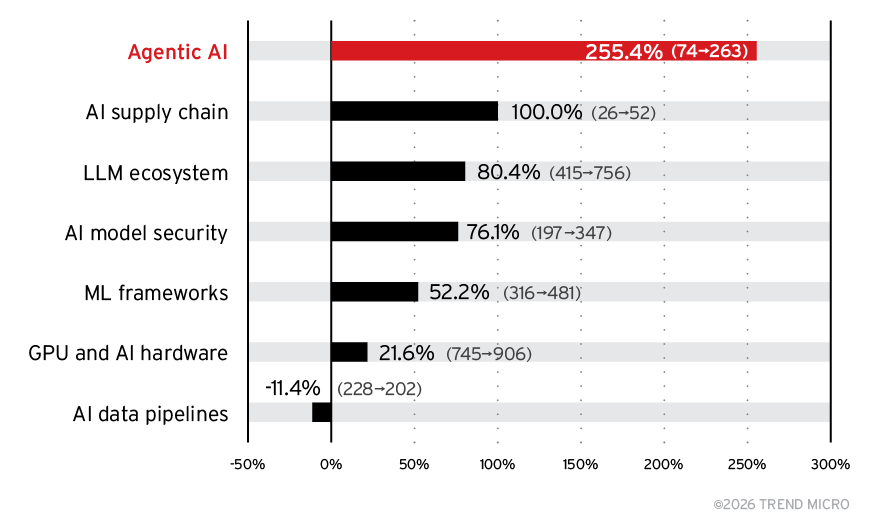
By mid-2025, the Trend Micro intelligence network began registering a fundamental shift in threat actor methodology. Rather than attacking traditional endpoint architectures, sophisticated groups—ranging from state-sponsored APTs to agile cybercrime syndicates—began probing the foundational layers of the AI stack. The TrendAI™ report highlights that vulnerabilities in popular ML frameworks (such as PyTorch and TensorFlow extensions) and insecure model-serving endpoints became favored entry points.
Furthermore, the democratization of AI development through open-source repositories created an expansive, largely unregulated supply chain. Much like the software supply chain crises of previous decades, the AI ecosystem suffers from a profound lack of provenance tracking. Developers routinely pull pre-trained weights and models from public hubs without cryptographic verification, opening the door for malicious actors to publish trojanized models that perform standard utility tasks while executing covert unauthorized operations in the background.
Deconstructing the Threat Vectors: From ML Frameworks to Layered Prompt Injection

The fragility of the AI ecosystem stems from vulnerabilities embedded across multiple technological strata. Security researchers analyzing the post-2025 landscape have categorized these exposures into three primary vectors:
1. Machine Learning Framework and Infrastructure Vulnerabilities
Modern AI pipelines rely on complex dependency trees connecting data ingestion pipelines, vector databases, inference engines, and orchestration layers. Flaws in these components allow attackers to execute arbitrary code remotely. For instance, insecure deserialization vulnerabilities in model serialization formats (such as Pickle files) have enabled threat actors to gain full execution rights over enterprise GPU clusters, compromising entire cloud environments.
2. The AI Supply Chain Crisis
Enterprise reliance on third-party foundation models and decentralized datasets introduces severe third-party risk. If an adversary successfully poisons a training dataset or compromises an upstream model repository, the resulting model inherits systemic vulnerabilities that standard vulnerability scanners cannot detect. This creates latent risks that can remain dormant inside enterprise production environments for months before discovery.
3. Guarding LLMs Against Advanced Prompt Injections
As organizations deploy autonomous agents capable of executing database queries and API calls, prompt injection has evolved from a novel parlor trick into a lethal corporate weapon. Trend Micro’s analysis emphasizes the necessity of advanced defenses, such as Layered Prompt Injection Representation. Traditional guardrails relying on simple keyword filters are easily circumvented by obfuscation, linguistic steganography, and multi-step semantic manipulation. Effective risk mitigation now requires multi-layered validation frameworks that inspect inputs and outputs across semantic, syntactic, and behavioral dimensions.
Verified Data & Metrics Breakdown
The empirical data compiled in the TrendAI™ State of AI Security Report underscores the scale and severity of vulnerabilities affecting modern artificial intelligence deployments:
| Security Metric / Indicator | Pre-2025 Baseline | H2 2025 Reality (TrendAI Report) | Enterprise Impact |
|---|---|---|---|
| ML Framework Exploits | Sporadic / Theoretical | Significant YoY Surge | RCE and cluster compromise |
| Supply Chain Provenance Verification | < 15% of Deployments | < 30% of Deployments | High vulnerability to trojanized models |
| Prompt Injection Evasion Success | High (Basic Filters Failed) | Moderate (Requires Layered Defense) | Agent hijacking & data exfiltration |
| Regulatory Compliance Exposure | Emerging Guidelines | Enforced Penalties & Audits | Financial liabilities and reputational damage |
Industry & Market Implications: Winners, Losers, and Economic Realities
The exposure of systemic fault lines within the AI ecosystem is triggering a profound reallocation of capital across global financial markets. As boards recognize that unsecured AI implementations present existential business risks, market dynamics are shifting rapidly.
Who Wins: Specialized Cybersecurity and Governance Leaders
Enterprise security vendors specializing in AI posture management, runtime threat detection, and model cryptographic provenance are experiencing explosive demand. Investors are rewarding firms that offer robust risk mitigation tools capable of securing cloud compute architecture without crippling developer velocity. Consultancies specializing in regulatory compliance and AI governance are also capturing record advisory revenues.
Who Loses: Unvetted Open-Source Proponents and Legacy Vendors
Organizations and developers relying entirely on unverified open-source models without rigorous internal auditing face severe operational and financial penalties. Furthermore, legacy cybersecurity vendors slow to adapt their product suites to the probabilistic nature of machine learning are seeing enterprise clients migrate toward native AI-security specialists.
From a macroeconomic perspective, these security friction points temporarily compress enterprise ROI on AI initiatives. The capital expenditure required to implement layered prompt injection defenses, continuous model monitoring, and rigorous supply chain auditing adds a new operational overhead. However, market analysts agree that this friction is a necessary maturation phase, separating sustainable enterprise deployments from reckless experimentation.
Frequently Asked Questions (People Also Answer)
What are the primary fault lines identified in the TrendAI™ State of AI Security Report?
The report highlights critical vulnerabilities spanning machine learning frameworks, insecure AI supply chains (including unverified third-party models and poisoned datasets), and advanced prompt injection techniques capable of bypassing conventional LLM guardrails and hijacking autonomous agent workflows.
How do layered prompt injection attacks threaten enterprise systems?
Unlike basic prompt injections that attempt to trick a chatbot into revealing system prompts, advanced layered attacks use multi-step semantic manipulation, obfuscation, and steganography. These methods bypass standard keyword filters, allowing malicious actors to exploit connected APIs, execute database commands, and exfiltrate sensitive corporate data.
Why is the AI supply chain considered a major cybersecurity risk?
The AI supply chain relies heavily on open-source repositories and pre-trained models distributed without standardized cryptographic provenance. Just as vulnerable software libraries compromised traditional applications, malicious actors can insert backdoors or poisoned weights into public model hubs, leaving downstream enterprise applications completely exposed.
How can enterprises mitigate these emerging AI security risks effectively?
Organizations must adopt a comprehensive, multi-layered security strategy that includes continuous model monitoring, cryptographic verification of AI supply chain assets, runtime behavior analysis, and advanced guardrails such as Layered Prompt Injection Representation to secure inference pipelines and agentic workflows.
Future Outlook: What Comes Next for AI Security
As the AI ecosystem moves deeper into the post-2025 landscape, the convergence of artificial intelligence and cybersecurity will define enterprise technology strategy. Several critical milestones will shape market trajectory over the next 12 to 18 months:
- Standardization of AI Bill of Materials (AIBoM): Regulatory bodies and industry consortia are moving rapidly toward mandating cryptographic provenance and transparent documentation for all commercial and open-source models, mirroring the software bill of materials (SBOM) movement.
- Autonomous Security Operations: Security teams will increasingly deploy specialized AI agents to defend against AI-driven attacks, creating an automated cyber arms race at machine speed.
- Rigorous Regulatory Enforcement: Global compliance frameworks will transition from advisory guidelines to strict liability mandates, holding executive leadership personally accountable for unsecured AI infrastructure and data governance failures.
Ultimately, the fault lines exposed in the TrendAI™ report are not indicative of an artificial intelligence dead end, but rather the painful, necessary adolescence of a transformative technology. Enterprises that proactively reallocate capital toward robust, comprehensive security architectures will secure long-term market dominance, while those that ignore these structural vulnerabilities do so at their own peril.