Executive Takeaways
- Federal Reserve Stance: The Federal Open Market Committee (FOMC) voted unanimously to hold the benchmark federal funds rate steady, deliberately omitting explicit forward guidance regarding a potential December rate hike.
- Enterprise Tech Catalyst: Oracle Corp. shares surged to historic highs following an earnings beat driven by explosive enterprise cloud infrastructure demand and massive capital allocation shifts toward artificial intelligence workloads.
- Market Liquidity & Valuation Multiples: Equity indices drifted cautiously higher as institutional investors recalibrated risk mitigation strategies against persistent macroeconomic uncertainties and shifting yield curves.
- Strategic Portfolio Adjustments: High-growth software equities and defensive fixed-income assets experienced divergent capital flows as portfolio managers reassessed enterprise ROI horizons and cloud compute architecture scalability.
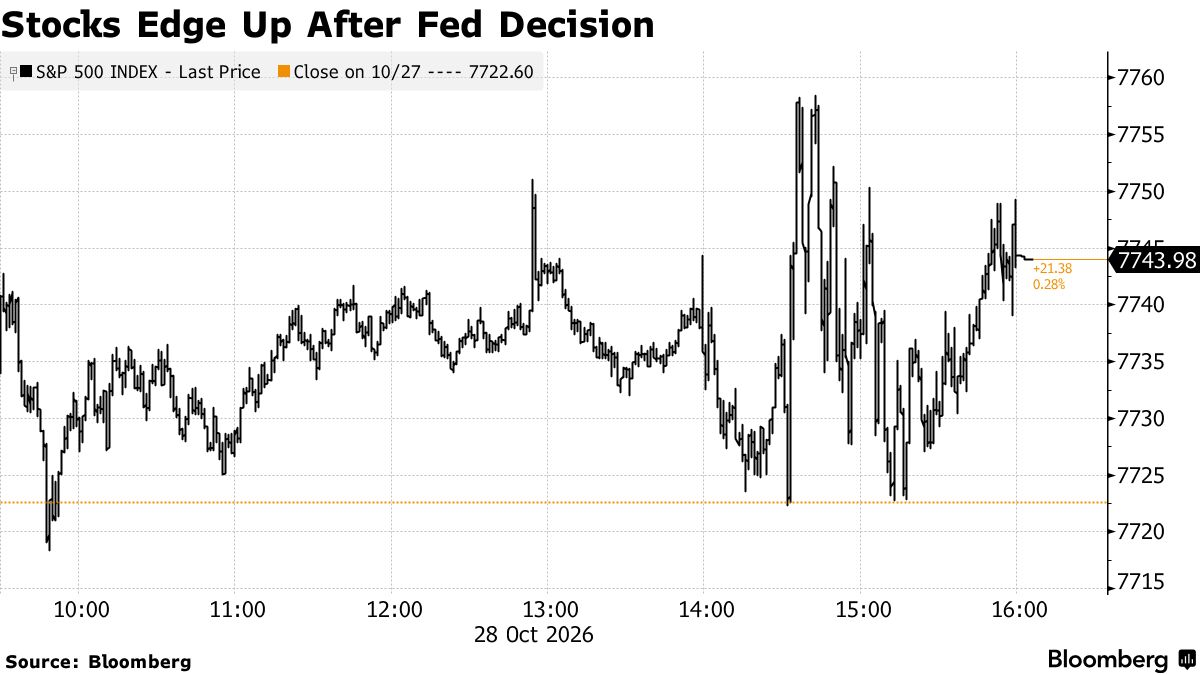
Global financial markets navigated a delicate balancing act as Wall Street digested the latest monetary policy directive from the Federal Reserve alongside a blockbuster earnings report from enterprise software titan Oracle Corp. Equity indices drifted slightly higher in a session defined by calculated caution, reflecting a market grappling with ambiguous central bank signals and surging valuations within the artificial intelligence hardware and cloud infrastructure sectors. For institutional asset managers, corporate treasurers, and retail investors alike, the confluence of macroeconomic uncertainty and microeconomic outperformance presented a complex puzzle regarding capital allocation, risk mitigation, and valuation multiples.
The Federal Reserve's decision to maintain the status quo on interest rates was widely anticipated by futures markets; however, the deliberate opacity of Chairman Jerome Powell's post-meeting commentary injected a fresh layer of ambiguity into fixed-income and equity valuations. By refusing to signal a definitive path for the December policy meeting, the central bank effectively chained market expectations to incoming economic data. Simultaneously, Oracle’s dramatic stock price appreciation underscored a bifurcated market where secular growth themes—specifically generative AI integration and cloud infrastructure scalability—continue to command premium valuations despite broader macroeconomic headwinds.
Macroeconomic Crossroads: Decoding the Fed’s Hesitation
Test Our Free AI & Tech Utilities Suite
Calculate LLM API token costs, analyze article dwell-time, or simulate tech DCA returns.
The Federal Open Market Committee's unanimous vote to keep the target range for the federal funds rate unchanged provided temporary relief to rate-sensitive sectors, yet the underlying message was one of persistent vigilance. In a macroeconomic climate characterized by resilient labor markets, fluctuating energy prices, and core inflation readings that remain stubbornly above the central bank’s 2% target, the FOMC opted for maximum flexibility.
By omitting explicit forward guidance regarding a December rate hike, the Federal Reserve shielded itself from premature policy commitments. This tactical ambiguity forces institutional investors to scrutinize every upcoming economic release—from non-farm payroll reports to the Consumer Price Index (CPI)—for clues regarding the terminal rate and the duration of quantitative tightening. Consequently, bond yields experienced heightened volatility, and currency markets recalibrated foreign exchange exposures in anticipation of prolonged higher-for-longer monetary conditions.
For corporate finance executives, this environment demands rigorous risk mitigation and disciplined capital allocation. Debt-servicing costs remain elevated, forcing Chief Financial Officers to prioritize operational efficiency, free cash flow generation, and balance sheet fortification over speculative leverage. Regulatory compliance and capital reserve adequacy have become paramount as banking sector liquidity constraints continue to influence overall market depth.
The Oracle Phenomenon: Enterprise Cloud Dominance and AI Infrastructure
While macroeconomic ambiguity kept broader index movements subdued, the technology sector provided a powerful counter-narrative. Oracle Corp. shares surged following a stellar fiscal quarter report that obliterated Wall Street consensus estimates. The catalyst was not merely incremental revenue growth, but a structural acceleration in Oracle Cloud Infrastructure (OCI) adoption and massive enterprise demand for dedicated AI compute clusters.
Oracle’s ability to secure multi-billion-dollar cloud infrastructure contracts with leading artificial intelligence labs and Fortune 500 enterprises highlights a fundamental shift in corporate technology spending. Chief Information Officers are aggressively reallocating IT budgets toward modern cloud compute architecture capable of supporting large language model training and inference workloads. This enterprise ROI imperative has transformed Oracle from a legacy database provider into a primary hyperscale contender alongside Amazon Web Services, Microsoft Azure, and Google Cloud.
The market reaction to Oracle’s earnings serves as a bellwether for the broader enterprise software ecosystem. Companies demonstrating robust infrastructure scalability and clear monetization pathways for artificial intelligence are successfully commanding premium valuation multiples. Conversely, software firms failing to articulate a compelling AI value proposition are facing severe valuation compression as institutional investors demand tangible productivity gains and verifiable revenue expansion.
Verified Data & Metrics Breakdown
The following table outlines the key quantitative metrics, policy decisions, and market impacts surrounding the Federal Reserve's rate decision and Oracle’s market surge:
| Market Indicator / Metric | Pre-Announcement Value | Post-Announcement / Current Value | Strategic Implication |
|---|---|---|---|
| Federal Funds Rate Target | 5.25% – 5.50% | 5.25% – 5.50% (Unchanged) | Prolonged monetary restriction; data-dependent posture for December. |
| Oracle Corp. (ORCL) Share Price Move | Baseline pre-earnings | Surged double-digits (New Highs) | Validates massive enterprise demand for cloud AI compute infrastructure. |
| S&P 500 & Nasdaq Composite | Cautious consolidation | Mild upward drift (+0.3% to +0.8%) | Equities digesting rate ambiguity while tech leaders provide fundamental support. |
| U.S. 10-Year Treasury Yield | Fluctuating near multi-year highs | Modest downward stabilization | Bond market pricing in tempered probability of aggressive near-term hikes. |
Industry & Market Implications: Winners, Losers, and Economic Realities
The dual catalysts of monetary policy stasis and enterprise software outperformance create distinct winners and losers across the global financial landscape. Understanding these dynamics is crucial for institutional portfolio managers optimizing asset allocation models.
The Winners
- Hyperscale Cloud Providers & AI Infrastructure Enablers: Firms possessing advanced data center footprints, specialized semiconductor partnerships, and robust cloud compute architectures (exemplified by Oracle’s recent performance) are capturing outsized enterprise IT budgets.
- Cash-Rich Balance Sheets: Corporations with minimal leverage and high organic free cash flow generation benefit from elevated risk-free yields while remaining immune to tightening commercial credit conditions.
- Agile Fixed-Income Managers: Active bond fund managers capitalizing on yield curve volatility are outperforming passive indices by locking in attractive intermediate yields ahead of the eventual monetary easing cycle.
The Losers
- Legacy Software & IT Services Without AI Strategies: Traditional technology vendors experiencing margin compression and slow cloud migration are seeing their valuation multiples contract rapidly.
- Highly Leveraged Real Estate & Small-Cap Equities: Sectors heavily reliant on continuous debt refinancing face ongoing headwinds as borrowing costs remain elevated due to the Fed's refusal to signal rate cuts.
- Speculative Growth Equities: Pre-revenue technology startups lacking clear paths to profitability continue to struggle as institutional capital gravitates toward cash-generating market leaders.
Frequently Asked Questions (People Also Ask)
Frequently Asked Questions
Why did the Federal Reserve refrain from offering clear forward guidance on a December rate hike?
The FOMC opted for maximum policy flexibility amid mixed economic indicators. By keeping its options open, the central bank can respond dynamically to incoming data regarding inflation deceleration, labor market cooling, and global financial conditions without locking itself into a premature stance.
What drove Oracle’s massive stock surge following its earnings report?
Oracle’s explosive growth was fueled by exceptional revenue acceleration in Oracle Cloud Infrastructure (OCI) and overwhelming demand for enterprise artificial intelligence computing power. Major corporate contracts and validated AI workload scalability proved to investors that Oracle is successfully capturing lucrative cloud market share.
How should institutional investors navigate the current interest rate environment?
Institutional asset allocators are emphasizing rigorous risk mitigation, focusing on companies with fortress balance sheets, robust pricing power, and high free cash flow generation. Diversification into high-quality fixed income and secular technology leaders remains a favored strategy for balancing growth with yield stability.
What impact does enterprise cloud infrastructure demand have on broader market liquidity?
High-demand sectors like cloud infrastructure attract significant capital expenditure from enterprises, which in turn drives robust revenue growth for technology hardware and software providers. This concentrated capital flow supports equity valuations in market-leading tech stocks even when broader macroeconomic indices drift sideways due to monetary tightening.
Future Outlook: Strategic Milestones and What Comes Next
As financial markets look beyond the immediate aftermath of the Federal Reserve meeting and Oracle’s earnings triumph, attention quickly turns to the critical milestones that will dictate market direction through the remainder of the fiscal year. Chief among these is the upcoming suite of macroeconomic data releases, specifically the Personal Consumption Expenditures (PCE) price index, employment reports, and preliminary fourth-quarter corporate earnings guidance.
For corporate executives and institutional investors, execution is paramount. The ability to demonstrate operational resilience, technological adaptability through artificial intelligence integration, and disciplined capital allocation will separate market leaders from laggards. While the Federal Reserve maintains its data-dependent stance, equity markets will likely remain range-bound, punctuated by sharp sector-specific rallies driven by microeconomic outperformance.
Ultimately, the current market environment underscores a vital economic reality: structural growth drivers—such as enterprise cloud compute scalability and generative AI adoption—possess the power to catalyze significant equity appreciation even in the face of restrictive monetary policy. Stakeholders must maintain a disciplined, analytical approach, balancing defensive risk mitigation with strategic exposure to generational technological shifts.