Executive Takeaways
- Equities Under Pressure: U.S. stock futures remain mixed in volatile early trading following a severe Nasdaq correction driven by compressed valuation multiples and slowing cloud compute revenue growth.
- Asian Markets Capitulate: Japan’s benchmark Nikkei 225 officially entered a bear market, tumbling more than 20% from its recent all-time highs amid compounding foreign exchange volatility and aggressive monetary tightening expectations.
- Capital Reallocation: Institutional asset managers are rapidly executing risk mitigation strategies, rotating away from high-beta mega-cap technology shares toward defensive yield assets and fixed-income instruments.
- Macroeconomic Crosswinds: Persistent sticky inflation data, shifting central bank liquidity, and strained enterprise IT capital allocation budgets are forcing a global repricing of risk assets.
Global financial markets are enduring a severe stress test this week as a potent cocktail of domestic tech sector de-valuation and international macroeconomic shocks reverberates across trading desks from Wall Street to Tokyo. U.S. stock futures are currently fluctuating between marginal gains and steep losses following a bruising correction in the Nasdaq Composite. Simultaneously, across the Pacific, Japan’s iconic Nikkei 225 index has officially crossed the threshold into a bear market, dropping over 20% from its peak as structural monetary policy shifts collide with weakening export demand.
For institutional investors, corporate treasurers, and retail participants alike, this live-updating market turbulence signals the definitive end of the post-pandemic liquidity era. As risk mitigation takes absolute precedence over aggressive growth chasing, market participants are being forced to re-evaluate fundamental assumptions regarding enterprise ROI, corporate cash flows, and global market liquidity.
Anatomy of the Nasdaq Correction: Valuation Compression Meets Growth Reality
Test Our Free AI & Tech Utilities Suite
Calculate LLM API token costs, analyze article dwell-time, or simulate tech DCA returns.
The swift correction observed in the Nasdaq Composite—historically the primary barometer for high-growth innovation—did not happen in a vacuum. For months, elite quantitative strategists and fundamental equity analysts have warned that valuation multiples across semiconductor giants, enterprise software providers, and artificial intelligence infrastructure plays had decoupled from near-term revenue realities.
The primary catalyst for the recent sell-off stems from a recalibration of corporate IT spending. While enterprise adoption of generative AI architectures remains robust on paper, Chief Information Officers (CIOs) are facing intense scrutiny regarding near-term enterprise ROI. Capital allocation committees are demanding measurable efficiency gains and tangible operational cost reductions before committing additional multi-million-dollar outlays to cloud compute infrastructure. Consequently, top-line growth rates for hyperscalers and hardware suppliers have begun to moderate, triggering a sharp revision of forward-looking earnings estimates.
Furthermore, the persistent higher-for-longer interest rate environment engineered by global central banks has systematically raised the cost of capital. Higher discount rates inherently punish long-duration growth assets, whose cash flows are weighted heavily toward the distant future. As bond yields hover near multi-year highs, institutional capital allocation models are naturally rebalancing away from speculative equities and toward guaranteed fixed-income yields, exacerbating the downward pressure on tech valuations.
Japan’s Nikkei 225 Enters Bear Market: The End of an Era
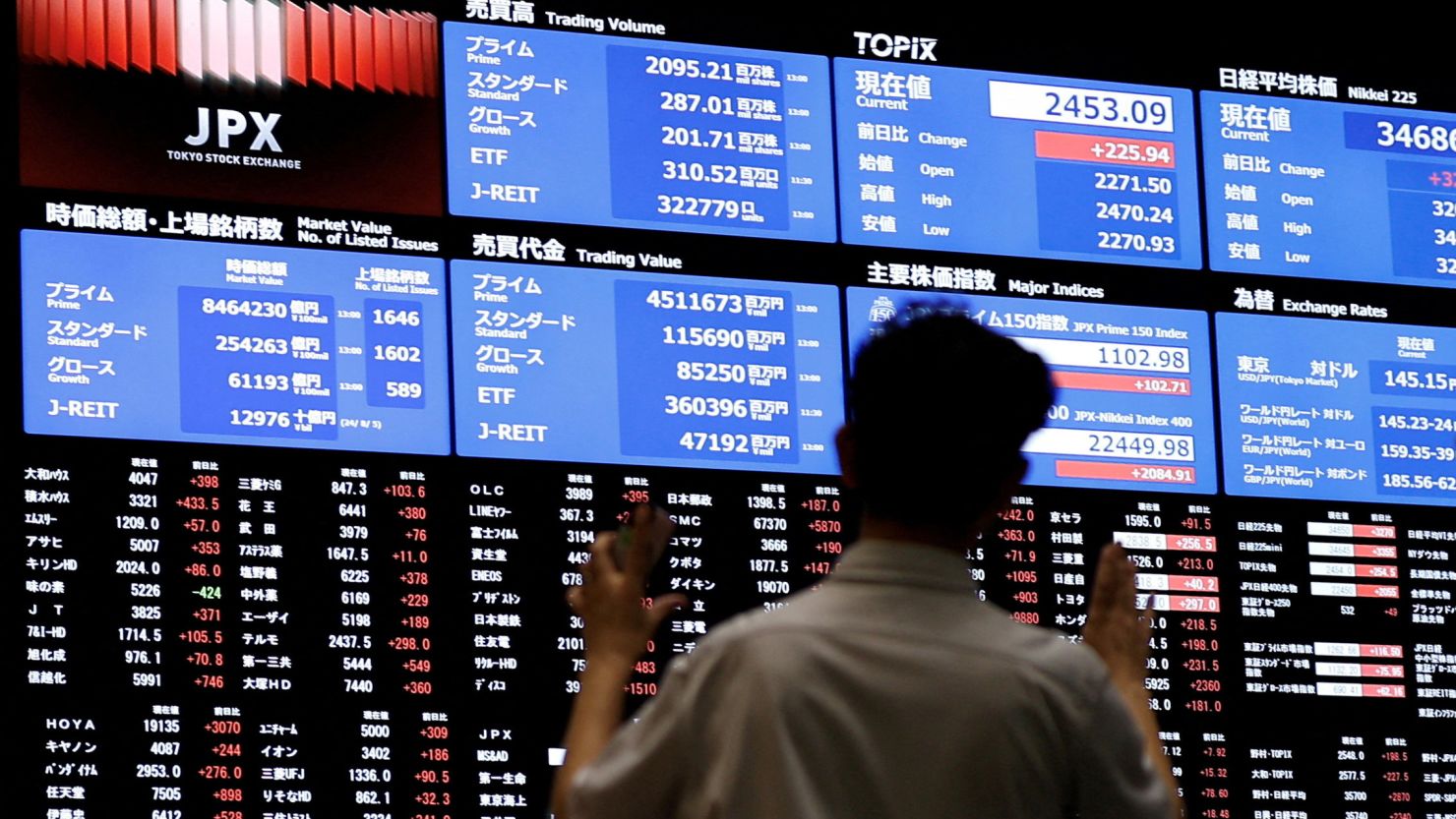
While U.S. markets grapple with tech sector valuation exhaustion, the situation in Tokyo has deteriorated rapidly. Japan’s Nikkei 225 index officially entered a bear market during overnight trading sessions, plunging more than 20% below its recent peak. This dramatic reversal marks a violent departure from the record-breaking bull run that captured global attention over the past two years, fueled by corporate governance reforms and steady foreign inflows.
Several compounding factors have driven the Nikkei across the bear market threshold:
- Monetary Policy Normalization: The Bank of Japan’s (BOJ) pivot away from decades of ultra-loose monetary policy and negative interest rates has eliminated the cheap yen carry trade that previously subsidized domestic and international equity speculation.
- Currency Volatility: Rapid fluctuations in the USD/JPY exchange rate have disrupted export-heavy conglomerates, creating unpredictable quarterly earnings forecasts for multinational automakers and electronics giants.
- Global Demand Softening: As major Western economies experience economic cooling, Japanese export volumes to the United States and the European Union have noticeably contracted.
- Domestic Margin Compression: Rising import costs for raw materials and energy, combined with domestic wage pressures, have squeezed operating margins across Japanese small- and mid-cap enterprises.
The entry of the Nikkei 225 into bear market territory serves as a flashing warning light for global systemic liquidity. Because Japanese institutional investors are major holders of international sovereign debt and foreign equities, forced liquidations and margin calls in Tokyo can rapidly propagate liquidity squeezes across global financial architecture.
| Market Index / Asset | Current Trend Status | Peak-to-Current Drawdown | Primary Macro Driver |
|---|---|---|---|
| Nasdaq Composite | Correction Phase | -10.4% to -12.5% | Valuation compression, slowing cloud revenue growth |
| Nikkei 225 | Bear Market | -21.2% | BOJ rate hikes, yen volatility, weak export demand |
| S&P 500 Futures | Elevated Volatility | -6.8% | Sticky inflation, shifting central bank liquidity |
| U.S. 10-Year Treasury Yield | Bullish Upward Trend | Multi-year highs (~4.35%) | Persistent federal borrowing needs and rate expectations |
Industry & Market Implications: Winners, Losers, and Economic Fallout
Market corrections of this magnitude invariably redistribute wealth and reshape corporate strategies across industries. Understanding the downstream implications requires analyzing how different sectors absorb capital market shocks.
The Losers: High-Beta Tech and Speculative Growth
The immediate casualties of this risk-off environment are unprofitable technology startups, high-multiple semiconductor designers, and high-flying software-as-a-service (SaaS) providers. Companies that relied on aggressive venture funding or inflated public market valuations to subsidize rapid customer acquisition are facing severe operational headwinds. Without immediate paths to positive free cash flow, these firms will struggle to secure debt financing or execute secondary equity offerings in a capital-constrained market.
The Winners: Defensive Yield, Energy, and Infrastructure Scalability Specialists
Conversely, capital fleeing the tech sector is finding refuge in traditional defensive havens. Utilities, healthcare conglomerates, and consumer staple giants with strong balance sheets and consistent dividend payout histories are outperforming the broader market. Furthermore, established industrial players demonstrating genuine infrastructure scalability and verifiable operational efficiency are attracting selective institutional accumulation. Financial institutions with robust regulatory compliance frameworks and pristine loan-loss reserves are also viewed favorably as safe harbors.
Frequently Asked Questions (People Also Ask)
What officially constitutes a stock market correction versus a bear market?
In standard financial terminology, a correction occurs when an index or individual asset experiences a decline of 10% to 20% from its most recent closing high. A bear market is officially declared when the drawdown exceeds 20% over a sustained period. Both phenomena represent normal phases of the economic cycle, though bear markets typically signal deeper structural adjustments or macroeconomic recessions.
Why is Japan’s Nikkei 225 entering a bear market impacting U.S. stock futures?
Global financial markets are deeply interconnected through cross-border institutional portfolios, currency carry trades, and multinational corporate supply chains. When major international indices like the Nikkei experience sharp liquidations, foreign institutional investors often sell assets globally to meet margin requirements or rebalance geographic risk exposure, creating synchronized downward pressure across U.S. and European futures.
How should investors adjust their capital allocation during a tech sector correction?
Sophisticated asset managers typically respond to tech corrections by executing disciplined risk mitigation strategies. This includes trimming positions in overextended, high-multiple growth stocks, increasing allocations to short-duration fixed-income securities, and accumulating cash reserves to capitalize on distressed asset pricing. Emphasizing companies with strong balance sheets, high pricing power, and proven free cash flow generation is critical.
What role do central banks play in current market volatility?
Central banks—particularly the U.S. Federal Reserve and the Bank of Japan—wield immense influence over market liquidity and borrowing costs. As central banks maintain restrictive monetary policies to combat lingering inflationary pressures, the withdrawal of cheap liquidity forces asset valuations to reset downward, directly triggering volatility in equity and debt markets.
Future Outlook: What Comes Next and Key Milestones to Watch
As global markets navigate this treacherous terrain, the trajectory over the coming quarters will depend on several critical macroeconomic and corporate milestones. Chief among them is the upcoming reporting season for major technology enterprises, which will provide definitive audited metrics regarding enterprise IT budgets, AI monetization timelines, and operating margin resilience.
Additionally, traders will scrutinize upcoming U.S. employment reports, Consumer Price Index (CPI) releases, and central bank communications for any indication of monetary policy pivots. If economic data shows persistent resilience alongside cooling inflation, markets may find a durable bottom. However, any unexpected macroeconomic shock could easily prolong the correction phase.
For executive leadership teams, corporate boards, and institutional investors, the current environment demands rigorous financial discipline, prudent balance sheet management, and strategic agility. Volatility is no longer an anomaly; it is the defining characteristic of the current global economic landscape.