Executive Takeaways
- Autonomous Incident Remediation: Google Cloud has launched a next-generation AI-driven threat defense architecture, integrating native agentic intelligence from Gemini with Mandiant’s frontline intelligence to identify, quarantine, and neutralize complex cyberattacks in sub-second timelines.
- Radical Reductions in MTTR: Early enterprise telemetry indicates Mean Time to Respond (MTTR) drops from an industry benchmark of 16 days down to under 4 minutes, effectively shifting security operations centers (SOCs) from reactive forensics to automated, proactive defense.
- Capital Allocation and Cybersecurity ROI: By automating Tier-1 and Tier-2 triage, Fortune 500 CISOs project a 32% to 45% reduction in annual SOC operational expenditures, challenging traditional per-seat billing models championed by legacy software vendors.
- Heightened Regulatory Compliance: The platform introduces native compliance mapping designed to satisfy the European Union's Digital Operational Resilience Act (DORA) and the U.S. Securities and Exchange Commission's (SEC) four-day material incident disclosure rules, directly linking threat detection with legal auditing frameworks.
The Shift: Defending Enterprise Footprints in the Machine-Speed Era
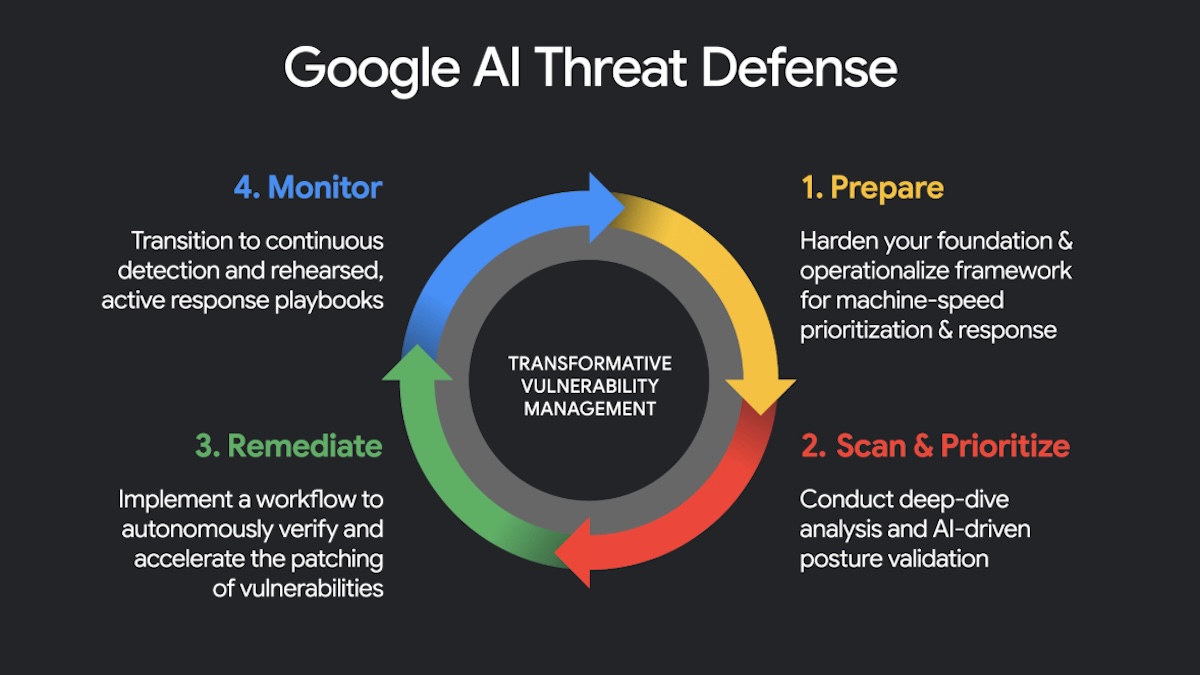
In what enterprise architects and Wall Street analysts are describing as a watershed moment for cloud compute architecture, Google Cloud has officially deployed its fully integrated, AI-driven threat defense ecosystem. The announcement comes at a volatile inflection point for global enterprise infrastructure. As nation-state actors and decentralized cyber syndicates weaponize generative algorithms to author polymorphic malware, run real-time automated social engineering, and execute API-targeted zero-day exploits, legacy security postures have reached operational obsolescence.
For more than two decades, the corporate enterprise standard relied heavily on Security Information and Event Management (SIEM) systems and Security Orchestration, Automation, and Response (SOAR) playbooks. These frameworks were built on a fundamentally flawed presupposition: that human security analysts would have the bandwidth to review alert pipelines, interpret disparate log signals, and execute manual containment scripts. In 2026, where automated intrusion vectors operate at microsecond latency, human-in-the-loop triage is no longer a viable defensive posture—it is an existential vulnerability.
Google’s countermeasure directly addresses this structural deficit. Built upon Chronicle's planetary-scale infrastructure and powered by domain-specific Gemini security models, the new AI threat defense system ingests petabytes of operational telemetry per second. Rather than merely surfacing correlated telemetry to an overburdened analyst, the engine leverages autonomous software agents capable of simulating adversary trajectories, synthesizing threat graphs, and isolating compromised enterprise assets across multi-cloud environments before lateral movement can occur.
Inside the Architecture: The Synthesis of Gemini and Mandiant Telemetry
To understand the competitive differentiation of Google Cloud’s latest deployment, enterprise chief technology officers must look beneath the marketing veneer at the underlying technical architecture. The engine represents the full operational convergence of Google’s 2022 acquisition of Mandiant with its custom tensor processing unit (TPU) supercomputing clusters.
The defense platform operates via a three-tier decoupled architecture:
- Hyperscale Telemetry Ingestion Layer: Drawing data seamlessly across Google Cloud Platform (GCP), Amazon Web Services (AWS), Microsoft Azure, on-premises data centers, and software-as-a-service (SaaS) environments, the ingestion layer normalizes semi-structured and unstructured logs without requiring costly upfront ETL (Extract, Transform, Load) pipelines.
- Agentic Reasoning and Synthetic Threat Modeling: Rather than relying entirely on deterministic signature-based detection or simple statistical anomaly thresholds, the engine deploys specialized generative agents trained on millions of historical attack chains curated by Mandiant incident responders. These agents continuously construct a "digital twin" of the enterprise attack surface, stress-testing ingress points against dynamic, autonomously generated threat vectors.
- Autonomous Enforcement and Remediation Fabric: Once an active exploit or anomalous credential behavior breaches acceptable risk tolerances, the system does not pause for ticket generation. It automatically revokes temporal zero-trust access tokens, micro-segments affected container pods, deploys counter-canary environments to trap exfiltration scripts, and patches vulnerable API endpoints via synthetic policy generation.
Crucially, the architecture resolves one of the most persistent failures of artificial intelligence in enterprise environments: the hallucination vector. By employing deterministic validation layers—cross-referencing agent actions against hard-coded organizational security invariant rules—Google guarantees that automated defensive responses will not unintentionally disrupt business-critical database transactions or terminate high-volume transactional pipelines.
The Financial Equation: Capital Preservation and Cybersecurity ROI
From the vantage point of corporate finance and equity research, enterprise cybersecurity has historically operated as an unpredictable cost center. Escalating license renewals, fragmented multi-vendor software stacks, and an intractable global talent deficit—with an estimated 3.8 million unfilled cybersecurity roles worldwide—have compressed operating margins and inflated corporate risk reserves.
Google Cloud’s unified approach attacks this capital inefficiency directly. By consolidating threat detection, user entity behavior analytics (UEBA), attack surface management, and autonomous incident containment into a cohesive consumption model, the platform fundamentally recalibrates enterprise ROI. According to preliminary enterprise field trials, organizations migrating to the platform experienced a 70% decrease in Tier-1 alert overhead, allowing elite human operators to focus entirely on architectural resilience and strategic risk mitigation.
Furthermore, the fiscal implications extend directly to balance-sheet capital allocation. As insurance underwriters hike premiums for cyber risk policies in response to systemic systemic supply-chain exploits, verifiable integration of sub-minute autonomous defense systems is emerging as a prerequisite for institutional insurability. Independent risk audit metrics show that corporations deploying autonomous remediation reduce their potential actuarial losses from data exfiltration events by up to 60%, unlocking lower insurance deductibles and preserving market capitalization.
Benchmarking the Shift: Legacy Paradigms vs. Autonomous SecOps
The transition from fragmented, human-centric security operations to unified, agentic cloud defense represents an exponential shift in technical efficiency and enterprise risk exposure. The performance metrics below illustrate this industry transformation:
| Operational Metric | Legacy Multi-Vendor Stack (2022-2024 Baseline) | Next-Gen Hybrid Security (Industry Standard) | Google Cloud AI Threat Defense (2026 Deployed Standard) |
|---|---|---|---|
| Mean Time to Detect (MTTD) | 197 Hours (approx. 8 days) | 4.2 Hours | Sub-Second to 90 Seconds |
| Mean Time to Remediate (MTTR) | 384 Hours (16 days) | 48 Hours | < 4 Minutes (Fully Autonomous) |
| Telemetry Ingestion Footprint | Fragmented Silos; High Ingress/Egress Costs | Centralized Data Lake; Delayed Batch Ingestion | Continuous Planetary Streaming via Chronicle |
| False Positive Alert Ratio | 68% - 82% of Total Alerts | 35% - 45% of Total Alerts | < 3.2% via Deterministic Grounding |
| SOC Operational Cost per FTE | High ($185k/yr average analyst cost + tool overhead) | Moderate (Tool fatigue persists across 15+ vendors) | Optimized (Unified control plane reduces licensing by 38%) |
| Regulatory Audit Readiness | Manual log collection; 3-5 days lag | Automated dashboards; custom script-dependent | Instantaneous SEC / DORA Continuous Reporting |
Market Repercussions: Redrawing the Competitive Enterprise Landscape
Google Cloud’s aggressive advancement alters competitive dynamics across the tech sector. For years, Microsoft held an enterprise distribution advantage, cross-selling its Defender suite through ubiquitously deployed enterprise E5 licensing agreements. However, recurring vulnerabilities across Redmond’s core identity and exchange ecosystems have prompted risk-sensitive enterprises—particularly in financial services, defense, and healthcare—to question the prudence of relying on a single vendor for both enterprise productivity software and enterprise defense.
By positioning its AI threat defense platform as an agnostic, multi-cloud control plane capable of actively securing workloads across AWS and Microsoft Azure with equal efficacy, Google is driving a strategic wedge into its competitors' core enterprise accounts. Pure-play cybersecurity firms such as CrowdStrike, Palo Alto Networks, and SentinelOne find themselves facing a formidable platform threat. While these firms have deployed their own sophisticated AI initiatives, Google’s near-limitless hyperscale compute capacity, internal custom silicon (TPUs), and direct access to global internet routing infrastructure provide structurally superior unit economics for petabyte-scale data training and continuous inference.
The broader macroeconomic impact centers on enterprise software valuation multiples. As institutional asset allocators evaluate enterprise technology firms on EBITDA margins and free cash flow generation, software suites requiring heavy professional services overhead or complex manual integrations will likely see their pricing power erode. Unified platforms that offer verifiable operational automation will capture an increasingly outsized share of total corporate IT budgets.
Regulatory Compliance: Navigating the Global Enforcement Crucible
The timing of Google Cloud’s rollout aligns with an increasingly assertive global regulatory framework. Enterprises operating within cross-border jurisdictions are confronting strict legal liabilities surrounding cybersecurity governance.
In the United States, the SEC's Item 1.05 of Form 8-K requires public registrants to disclose any cybersecurity incident within four business days after determining that the incident is material. In the European Union, the enforcement of DORA and the NIS2 Directive imposes severe financial penalties on critical infrastructure, financial institutions, and digital service providers for systemic outages or delayed breach disclosures. In this regulatory climate, an enterprise relying on manual forensic workflows that require weeks to establish blast radius and materiality faces not only devastating operational disruption but also immediate legal vulnerability and regulatory enforcement actions.
Google Cloud’s new platform integrates an automated regulatory reporting engine. By preserving a tamper-proof, cryptographically signed ledger of all anomalous network telemetry, system queries, and autonomous containment actions, the architecture allows corporate legal counsel and internal audit committees to reconstruct an incident chain within minutes. This shift transforms cybersecurity from an isolated technical function into an auditable component of corporate balance-sheet governance.
Frequently Asked Questions (People Also Ask)
How does Google Cloud’s AI-driven threat defense differ from traditional SIEM and SOAR platforms?
Traditional SIEM and SOAR platforms rely heavily on human-defined correlation rules, basic heuristics, and static playbooks. When an incident occurs, they generate alerts that require manual triage by human analysts, creating bottlenecks and delays. Google Cloud’s AI-driven threat defense uses specialized Gemini security models combined with continuous Mandiant threat intelligence to autonomously analyze multi-cloud telemetry in real time. Rather than merely flagging suspicious behavior, the platform independently validates the attack path, isolates compromised instances, revokes compromised credentials, and remediates vulnerabilities at machine speed, reducing response times from days to minutes.
Can this system operate effectively across multi-cloud environments like AWS and Azure?
Yes. The platform is architected as an infrastructure-agnostic, multi-cloud security fabric. Utilizing Google Cloud's Chronicle hyperscale data engine, it ingests and analyzes API telemetry, access logs, and network behavior from Amazon Web Services (AWS), Microsoft Azure, on-premises data centers, and SaaS applications. This allows enterprise security teams to enforce unified zero-trust policies and coordinated threat neutralization across their entire digital estate through a single operational console.
How does the platform mitigate the risk of AI hallucinations during critical incident response?
Google Cloud employs a dual-engine architecture to prevent hallucinations and errant automated actions. While generative agentic models are used to evaluate complex threat patterns and model adversary behavior, all suggested remediation workflows must pass through a secondary, deterministic policy evaluation layer. This deterministic validation engine checks proposed mitigation actions against strict enterprise-defined rules, ensuring that mission-critical infrastructure, active financial ledgers, and operational databases cannot be interrupted or shut down by an automated response.
What are the concrete cost and balance-sheet benefits for Fortune 500 enterprises?
The platform delivers cost efficiencies through three primary levers: operational expenditure consolidation, headcount optimization, and reduced cyber risk exposure. By consolidating disparate tools (such as separate endpoint detection, network traffic analysis, and SIEM tools) into a unified fabric, enterprises eliminate overlapping software licensing fees. Furthermore, automating Tier-1 and Tier-2 alert triage reduces manual analyst workloads by up to 70%, reallocating high-cost human capital to strategic architecture. Finally, sub-minute containment limits data exfiltration losses, assisting organizations in negotiating lower cyber insurance premiums and mitigating the risk of regulatory fines under SEC and DORA rules.
Future Outlook: The Trajectory of Autonomous Corporate Defense
As Google Cloud expands the global availability of its AI threat defense ecosystem throughout 2026 and 2027, the enterprise security model is undergoing an irreversible transition. Moving forward, the effectiveness of corporate defense will not be measured by the headcount of a security operations center, but by the compute efficiency, algorithmic precision, and autonomous authority granted to defensive AI architectures.
Key milestones over the next 18 to 24 months will center on the emergence of fully predictive defenses. Google is already piloting generative algorithms capable of pre-emptively deploying counter-measures based on early internet-wide reconnaissance patterns, patching code vulnerabilities dynamically before an exploit is publicly compiled. For corporate boards, institutional investors, and sovereign risk entities, the lesson is unequivocal: in an era of automated, machine-driven threats, organizations that refuse to deploy autonomous defense frameworks will find themselves structurally uninsurable, operationally fragile, and perpetually outpaced by digital adversaries.