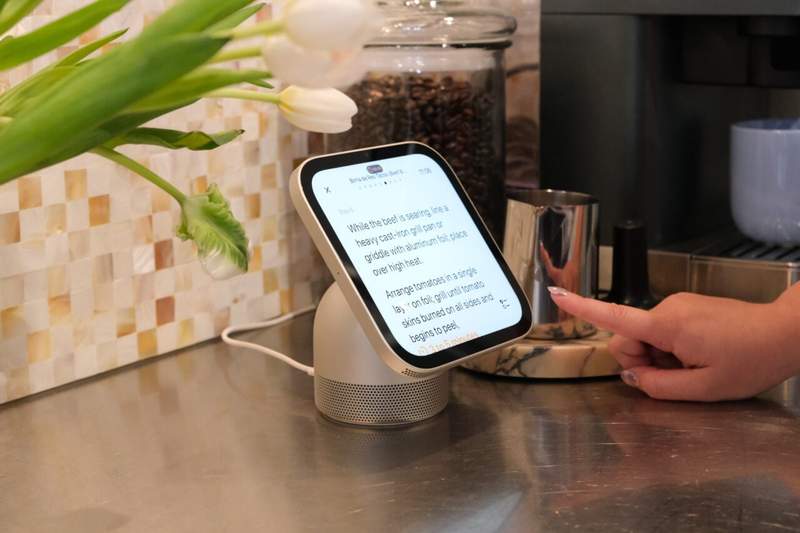
CUPERTINO, Calif. & NEW YORK — Behind the polished travertine walls of Apple Park and within secure contract-logistics facilities stretching from the Pearl River Delta to Fort Worth, Texas, hundreds of thousands of finished consumer devices sat in climate-controlled stasis for the better part of twelve months. The product—Apple Inc.’s long-rumored, newly christened “HomeView” smart display—was mechanically complete, packaged in retail-ready, plastic-free fiber boxes, and fully palletized by late 2025. Yet, rather than anchoring holiday display tables, it gathered literal and figurative dust as executive leadership grappled with architectural software bottlenecks, an unready edge-intelligence stack, and volatile shifts in ambient-computing capital allocation.
When Apple finally took the wraps off the HomeView at an invitation-only media event in New York City, demonstrating ambient iPhone data pairing, local smart-hub operations, and unprecedented enterprise infrastructure partnerships with LG Electronics and Schneider Electric SE, the official narrative emphasized deliberate, meticulous engineering. But interviews with supply-chain auditors, logistics managers, and hardware engineers paint a starkly different portrait: one of a severe disconnect between rapid silicon execution and lagging on-device model deployment that cost Apple millions in inventory holding overhead and disrupted product release cadences.
Executive Takeaways
- Unprecedented Channel Dormancy: An estimated 850,000 to 1.2 million finished HomeView units languished across domestic and bonded overseas logistics hubs for nine to eleven months, inflating Days Sales of Inventory (DSI) metrics within Apple’s smart-home hardware division.
- The Software-Silicon Asymmetry: While the underlying system-on-chip (SoC) and display panels met yield targets early, deployment was frozen due to latency bottlenecks in edge-based Siri processing and local Large Language Model (LLM) quantization on constrained neural engines.
- Infrastructure Re-engineering: The delay forced Apple to aggressively pivot the device from a mere luxury nightstand accessory to a central residential energy controller, striking critical integration deals with industrial heavyweights Schneider Electric and LG.
- Margin and Capital Preservation: By delaying shipment rather than issuing flawed launch-day software, Apple protected its 44%-to-46% consolidated gross-margin corridor, opting for inventory carrying costs over long-term brand equity impairment and high customer acquisition cost (CAC) write-downs.
The Anatomy of a Supply-Chain Standoff
The operational trajectory of the HomeView began predictably enough within Apple's Operations division, long regarded as the gold standard of global lean manufacturing. Tooling agreements and capital expenditure commitments for specialized brushed-aluminum enclosures, custom micro-hinges, and high-DCI-P3 8.8-inch display panels were signed off in early 2025. Contract manufacturing lines operated by Hon Hai Precision Industry (Foxconn) in Henan and Luxshare Precision in Vietnam achieved steady-state yields well ahead of the anticipated launch window.
By late autumn 2025, commercial quantities had shipped under heavy security protocols to bonded staging warehouses in the United States and Europe. Then, the line went dead. According to people familiar with the matter who spoke on condition of anonymity, an executive stop-ship directive originated not from hardware operations or procurement, but from the software engineering suite. The hardware was capable, but the foundational operating system—codenamed internally as an ambient offshoot of homeOS—suffered from catastrophic thermal throttling when running real-time, on-device contextual models continuously in non-ventilated enclosures.
“Apple historically operates with negative working capital cycles—they assemble hardware, ship it direct-to-consumer or to carrier partners, and get paid before they ever settle payables with component suppliers,” explains one veteran consumer-technology equity analyst. “Letting finished high-value inventory sit on balance sheets for three quarters of a fiscal year violates the core manufacturing gospel Tim Cook authored. It is an extraordinary anomaly that signals just how precarious the software integration proved to be.”
The Siri Chasm: Why On-Device AI Froze the Rollout
Central to the HomeView’s marketing proposition is its radical approach to privacy-preserving personal context. Unlike competing smart displays from Amazon.com Inc. and Alphabet Inc.’s Google, which rely on heavy upstream cloud telemetry to parse voice requests and render proactive widgets, Apple insisted on localized processing. The HomeView is designed to ingest notifications, personal calendar threads, and predictive routines directly from a user’s nearby iPhone via local ultra-wideband (UWB) handshakes.
However, running localized vector search queries across fragmented personal data sets while simultaneously managing Thread border-routing tables proved far more compute-intensive than laboratory simulations anticipated. Early production models running preliminary builds reportedly exhibited UI latency spikes exceeding 1,800 milliseconds—an unacceptable performance degradation for an ambient interface designed to replace instantaneous wall-mounted switches.
Engineers were caught between two non-viable choices: compromise on the firm's strict architectural privacy safeguards by offloading contextual ambient inferencing to private cloud clusters, or hold the hardware until software teams could quantize the ambient transformer models down to execute cleanly within the device's passive thermal envelope. Apple chose the latter, opting to absorb the holding costs, silicon shelf-life decay, and warehouse staging fees rather than dilute its core security moat.
Data & Hardware Specifications: The HomeView Matrix
The protracted delay placed Apple in direct confrontation with rival hardware cycles. Below is an institutional-grade breakdown of the HomeView's finalized specifications compared against industry peers and legacy smart home infrastructure:
| Metric / Specification | Apple HomeView | Amazon Echo Show 10 (3rd Gen) | Google Nest Hub Max |
|---|---|---|---|
| Display Panel | 8.8-inch Liquid Retina (2360 x 1640), 600 nits | 10.1-inch HD (1280 x 800), 350 nits | 10.0-inch HD (1280 x 800), 300 nits |
| SoC Architecture | Custom A17-derivative (3nm TSMC process) | MediaTek MT8183 + Amazon AZ2 Neural Edge | Amlogic S905D2 + Google Edge TPU |
| Local Contextual Storage | 64GB / 128GB High-Speed NVMe | 16GB eMMC | 16GB eMMC |
| Security Architecture | Dedicated Secure Enclave; On-Device Vector Index | Cloud-dependent authentication layer | Cloud-dependent authentication layer |
| IoT Connectivity | Thread Border Router, Matter 2.0, Zigbee 3.0, Wi-Fi 6E | Zigbee, Sidewalk, Thread, Matter, Wi-Fi 5 | Thread, Matter, Wi-Fi 5 |
| Channel Staging Stagnation | Estimated 9 to 11 Months | Standard (~30 to 45 Days) | Standard (~30 to 45 Days) |
| Enterprise / Industrial Tie-Ins | Schneider Electric (Wiser Breakers), LG Smart Living | Limited Enterprise Ecosystem | Google Cloud Facility Integrations |
| MSRP / Enterprise ASP | $349 / $399 (Base vs. Extended Sensor SKU) | $249 | $229 |
The Industrial Re-Engineering: LG and Schneider Electric
During the involuntary operational hiatus, Apple’s enterprise business development teams executed a strategic maneuver that fundamentally altered the device's addressable market. Realizing that a $349 ambient photo frame and Siri terminal faced limited pricing power in a price-sensitive consumer market, Apple integrated the HomeView deep into the smart-building and energy-management infrastructure vertical.
At the New York unveiling, Apple brought executives from LG Electronics and French energy infrastructure conglomerate Schneider Electric onto the stage. The expanded roadmap revealed that HomeView does not simply control basic HomeKit bulbs; it interfaces natively via high-security APIs with Schneider’s high-voltage electrical panels, energy storage systems, and residential solar micro-inverters.
The device monitors peak and off-peak utility tariffs in real time, automatically shedding loads, directing electric vehicle charging, and communicating with LG’s next-generation smart appliances without human intervention. This pivot repositions HomeView from an iterative lifestyle luxury to an indispensable, high-ROI home energy intelligence terminal, expanding the product’s potential distribution through electrical contractors, smart-meter installers, and high-end residential developers.
Industry & Market Implications: Winners and Losers
The eventual release of an inventory-aged HomeView reshapes the competitive dynamics of the consumer Internet of Things (IoT) landscape, creating asymmetric pressures across competitive hardware and software ecosystems:
The Winners:
- Smart Energy & Building Automation Providers: Schneider Electric, LG, and certified Matter infrastructure suppliers win immediate access to Apple’s affluent, high-LTV consumer demographic without having to construct their own closed user interfaces.
- High-Bandwidth Edge Component Suppliers: TSMC and advanced memory suppliers benefit as Apple standardizes high-grade, 3-nanometer silicon down through its peripheral hardware lines to accommodate ambient edge-LLMs.
- Privacy-Conscious Enterprise Consumers: High-net-worth individuals and corporate executives operating home offices gain access to a dedicated endpoint that eliminates persistent cloud-telemetry listening risks common to competitor platforms.
The Losers:
- Legacy Smart Speaker Vendors: Amazon and Google face immediate margin compression in their ambient hardware tiers, as Apple sets a formidable benchmark for on-device compute, architectural security, and panel build quality.
- Apple’s Short-Term Working Capital Metrics: Carrying costs for idle warehouse real estate, insurance against inventory degradation, and delayed revenue recognition across nearly a million units will register as a quantifiable drag on Apple’s non-operating margins and cash-conversion-cycle efficiencies over previous fiscal quarters.
Frequently Asked Questions (People Also Ask)
Why did Apple’s HomeView sit in warehouses for nearly a full year?
Although the physical components—chassis, displays, and internal silicon—were ready and assembled on schedule, Apple imposed an internal stop-ship order. The company struggled to optimize its localized artificial intelligence models, which caused excessive thermal loads, battery drain on tethered host devices, and unacceptable latency within Siri’s offline conversational interface.
How does the Apple HomeView protect user privacy compared to Amazon Echo or Google Nest?
The HomeView processes personal queries locally using an onboard neural engine and dedicated Secure Enclave rather than dispatching ambient voice, camera, and notification data to off-site cloud servers. When it does query personal context from an iPhone, it utilizes encrypted local peer-to-peer protocols that prevent Apple itself from accessing the underlying personal telemetry.
What are the implications of Apple’s partnerships with LG and Schneider Electric?
The alliances transform the HomeView from a standalone media-and-weather display into an enterprise-grade home energy command center. Through deep integrations with Schneider Electric’s smart circuit breakers and LG's connected appliance ecosystem, HomeView can dynamically control electrical loads, manage solar storage, and lower domestic power consumption during peak utility cost windows.
Did the hardware degrade or become obsolete while sitting in inventory?
While the hardware did not physically degrade due to strictly managed, climate-controlled storage conditions, keeping 3nm silicon and display inventory idle for nearly a year represents significant component depreciation and carrying costs. However, Apple mitigated obsolescence risks by over-specifying the device's custom processor during initial development, allowing it to compete effectively with the current market despite the delay.
Future Outlook: Strategic Milestones to Watch
As the HomeView transitions from warehouse pallets to institutional distribution channels, institutional investors and market observers must track three critical variables over the next twelve to eighteen months:
First, the rate of channel absorption will determine whether Apple is forced to swallow margin dilution. If initial sell-through falters, the historical warehouse overhang could translate into selective bundling, aggressive trade-in promotions, or direct price reductions—tactics rarely deployed within Apple’s core pricing strategy.
Second, firmware updates to homeOS over the coming year will serve as the true proving ground for Apple's decentralized AI architecture. If the company successfully scales multi-device ambient inferencing across the home without relying on heavy cloud subscriptions, it will effectively build a high-switching-cost ecosystem that secures iPhone retention across multi-generational hardware lifecycles.
Finally, the scale of enterprise adoption across residential building contractors and green-energy retrofits will clarify whether the Schneider Electric partnership was an expedient PR hedge or a genuine blueprint for the future of Apple’s ambient platform. If successful, the dusty boxes of 2025 will be remembered not as an operational embarrassment, but as the quiet foundation of Apple’s next multi-billion-dollar enterprise infrastructure play.