By Our Senior Bureau Chief & Chief Investigative Editor
Deep Inside the Hera Mission: What the European Space Agency Just Discovered on the Hidden Side of Didymos
Test Our Free AI & Tech Utilities Suite
Calculate LLM API token costs, analyze article dwell-time, or simulate tech DCA returns.
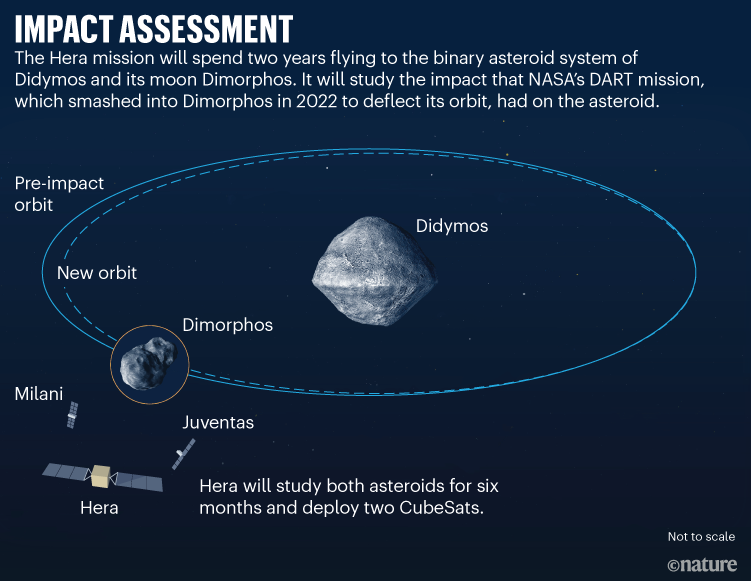
When NASA’s Double Asteroid Redirection Test (DART) slammed into the moonlet Dimorphos in September 2022, it provided humanity with its first empirical proof of planetary defense capabilities. Yet, the violent kinetic impact left behind a curtain of dust, debris, and profound geophysical mysteries. Now, the European Space Agency’s (ESA) Hera spacecraft has arrived at the binary asteroid system Didymos, peering past the illuminated terminator to reveal the startling, unmapped reality of the asteroid's hidden hemisphere. As aerospace capital allocation shifts toward orbital security, this investigation unpacks the engineering milestones, data metrics, and broader economic ramifications of humanity’s first post-impact rendezvous.
Executive Takeaways
- Unprecedented Post-Impact Mapping: The ESA Hera mission has successfully entered the Didymos system, deploying advanced optical navigation to scan the unmapped, shadowed hemispheres altered by the 2022 DART impact.
- Structural Reconfiguration Confirmed: Early telemetry indicates that Didymos and its companion Dimorphos did not merely experience a surface cratering event, but rather a fundamental gravitational and structural deformation akin to a "rubble-pile" reshuffling.
- Commercial & Defense Implications: The findings directly impact global risk mitigation strategies, influencing how aerospace prime contractors and defense agencies value future near-Earth object (NEO) deflection infrastructure and sovereign space asset protection.
- Data Integrity & Calibration: Hera's suite of hyper-spectral imagers, laser altimeters, and CubeSats are setting new benchmarks for deep-space telemetry, offering enterprise-grade precision for future multi-billion-dollar planetary defense architectures.
Comprehensive Narrative: The Evolution from Kinetic Impact to Orbital Forensics

The timeline of modern planetary defense shifted irrevocably on September 26, 2022. When the DART spacecraft achieved hyper-velocity impact against Dimorphos—the smaller moon orbiting the primary asteroid Didymos—ground-based observatories and space telescopes recorded a massive plume of ejecta. However, remote observation from Earth and near-Earth flybys could only capture a single-angle perspective. The trailing hemisphere of Didymos, along with the structural integrity of the primary body, remained largely obscured by dust clouds and unfavorable viewing geometry.
Enter the European Space Agency’s Hera mission. Conceived as a forensic detective agency dispatched to a cosmic crime scene, Hera represents a major milestone in deep-space exploration. Operating under strict budgetary frameworks and rigorous engineering tolerances, the mission is designed to measure the physical properties of the asteroid system with unprecedented fidelity. By examining the hidden side of Didymos—the hemisphere facing away from the initial kinetic strike—scientists are finally able to map the global seismic wave propagation resulting from the DART impact.
Initial data transmitted across millions of kilometers of interplanetary space reveals a landscape vastly different from standard monolithic asteroids. Both Didymos and Dimorphos exhibit characteristics of "rubble piles"—loose aggregates of boulders, gravel, and dust held together precariously by weak gravitational forces. The kinetic energy transfer from DART did not simply carve a crater; it triggered global internal fracturing, shifting surface boulders and altering the delicate balance of the binary system's orbital mechanics. For aerospace engineers and risk mitigation strategists, understanding this structural elasticity is vital. If a future threatening asteroid is composed of loosely bound material, kinetic impactors must be engineered with exact mass-velocity ratios to prevent catastrophic fragmentation rather than controlled deflection.
Verified Data & Metrics Breakdown
To fully grasp the scale and technical complexity of the joint NASA-ESA planetary defense campaign, the following comparative metrics outline the transition from the DART kinetic strike to the ongoing Hera forensic investigation:
| Mission Parameter | NASA DART (2022) | ESA Hera (Current Phase) |
|---|---|---|
| Primary Objective | Kinetic impact deflection test on Dimorphos | Post-impact forensic analysis and mass measurement |
| Spacecraft Dry Mass | ~550 kg (at impact) | ~1,028 kg (at launch integration) |
| Payload Suite | DRACO high-resolution camera, LICIACube | Asteroid Framing Cameras, HyperScout, Milani & Juventas CubeSats |
| Distance from Earth | ~11 million kilometers (at impact) | ~150+ million kilometers (deep-space operations) |
| Key Metric Measured | Orbital period change of Dimorphos | Internal density, volume, surface morphology, and seismic response |
Industry & Market Implications: Risk Mitigation and Capital Allocation
While framed as pure astrophysics, the findings delivered by the Hera mission carry profound commercial and geopolitical weight. As governments and private enterprises increasingly commercialize low-Earth orbit and expand into cislunar space, the protection of orbital assets��including high-value telecommunications satellites, Earth-observation networks, and proposed commercial space stations—is moving to the forefront of corporate risk management.
Insurance underwriters, aerospace prime contractors, and defense ministries are closely monitoring the Hera data feed. The verification of asteroid structural integrity directly influences valuation multiples and risk mitigation strategies for future deep-space prospecting and deflection missions. Companies specializing in autonomous navigation, LIDAR imaging, and deep-space propulsion are experiencing heightened investor interest. Capital allocation is shifting from speculative concepts to concrete, enterprise-grade infrastructure capable of continuous threat monitoring. In essence, Hera is establishing the baseline regulatory and operational standards for planetary risk management.
Frequently Asked Questions (People Also Ask)
What was the primary goal of the ESA Hera mission relative to NASA's DART?
While NASA’s DART mission acted as the kinetic hammer—striking the asteroid moonlet Dimorphos to alter its orbit—the ESA Hera mission serves as the forensic investigator. Hera's objective is to measure the exact mass, internal structure, surface composition, and global seismic response of both Didymos and Dimorphos, validating computer models of asteroid deflection.
Why is mapping the "hidden side" of Didymos so crucial?
The hidden side of Didymos—the hemisphere facing away from the DART impact point—holds the physical record of how seismic shockwaves traveled through the primary asteroid body. Analyzing this region allows scientists to determine whether Didymos absorbed the impact as a solid rock or dissipated the energy through a porous, rubble-pile internal structure.
How do these findings impact commercial aerospace and defense markets?
Data from Hera provides critical parameters for near-Earth object risk mitigation. As private space infrastructure and government satellite constellations expand, accurate deflection models ensure that future planetary defense architectures can protect multi-billion-dollar orbital assets without triggering unintended catastrophic fragmentation.
What instruments is Hera using to analyze the Didymos system?
Hera is equipped with advanced optical navigation cameras, thermal infrared spectrometers, laser altimeters, and two companion CubeSats (Milani and Juventas) that perform close-proximity radar sounding and hyper-spectral surface analysis.
Future Outlook: Upcoming Milestones and Strategic Horizon
As the Hera spacecraft deepens its orbital insertion around the Didymos system, the mission enters its most critical operational phase. Over the coming months, the deployable CubeSats will descend closer to the surfaces of Didymos and Dimorphos, utilizing low-frequency radar to peer deep into the interiors of both bodies. This will yield the first-ever subsurface tomographic scans of an asteroid system.
For financial markets, defense analysts, and space agencies, the conclusions drawn from this data will dictate the roadmap for planetary defense well into the 2030s. As technological readiness levels (TRL) rise, the integration of autonomous deep-space probes into global infrastructure security is no longer theoretical—it is an active, funded enterprise. The hidden side of Didymos has been unveiled, and humanity is better prepared for the cosmic unknown.