Executive Takeaways
- Frontier Innovation Supremacy: According to a landmark report released by the Information Technology and Innovation Foundation (ITIF) on July 29, 2024, Chinese firms have officially crossed the threshold from low-cost copycat manufacturing to frontier technology innovators in electric vehicles (EVs) and advanced battery chemistry.
- Structural Cost & Velocity Advantages: Integrated Chinese OEMs (Original Equipment Manufacturers) like BYD and battery juggernauts like CATL leverage Cell-to-Pack (CTP 3.0) and Cell-to-Body (CTB) engineering to achieve 20% to 30% cost advantages, backed by vehicle development cycles of just 18 to 24 months—half the timeline of legacy Western competitors.
- Chemical & Materials R&D Leadership: China controls over 70% of global lithium-ion battery manufacturing capacity, but its real competitive moat lies in next-generation chemistries, including commercialized Sodium-ion (Na-ion) cells, high-density LFP (Lithium Iron Phosphate), and accelerating patents in all-solid-state battery (ASSB) architectures.
- Capital Allocation & Protectionist Friction: As transatlantic regulatory barriers escalate—notably the U.S. Section 301 tariffs and European Union anti-subsidy duties—global legacy automakers face intense margin compression, forcing unprecedented joint-venture models and radical realignments of capital allocation.
The ITIF Paradigm Shift: From Cost Arbitrage to Frontier Innovation
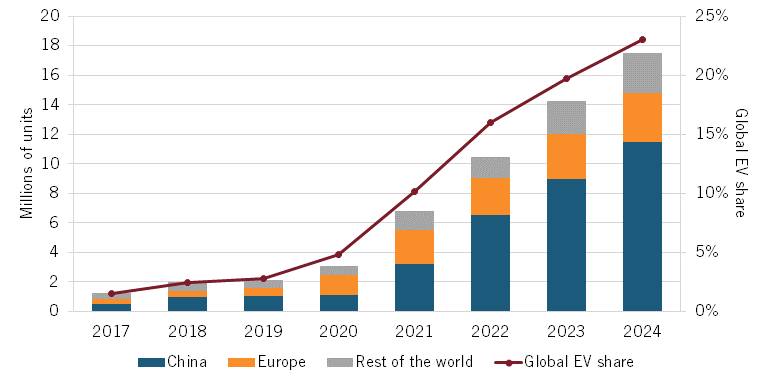
For over a decade, Western capital markets and automotive executives operated under a comfortable assumption: China’s meteoric rise in the electric vehicle sector was predominantly an artifact of state-backed subsidies, cheap industrial labor, and environmental cost arbitrage. On July 29, 2024, a definitive report published by the Information Technology and Innovation Foundation (ITIF) dismantled this narrative, delivering an authoritative empirical verdict that is sending shockwaves through global boardrooms.
The ITIF assessment reveals that Chinese enterprises are no longer merely efficient scale-manufacturers; they have seized the global technological frontier across the entire energy storage and EV capability matrix. China currently accounts for nearly two-thirds of global EV production and commands over 70% of the world's battery manufacturing capacity. Crucially, this dominance is increasingly underpinned by proprietary IP, advanced material science, software-defined vehicle architectures, and unprecedented manufacturing process innovations.
While Western legacy OEMs struggle to achieve target enterprise ROI on capital expenditure spent retooling internal combustion engine (ICE) production lines, Chinese conglomerates have built a vertically integrated ecosystem. By aligning raw material refining, electrochemical synthesis, software design, and final vehicle assembly within tightly integrated domestic hubs, China has established an institutional learning curve that compounds its technological advantage every quarter.
Engineering Breakthroughs: Structural Integration and Chemistry Evolution
At the core of China's technological acceleration are radical innovations in physical pack engineering and electrochemical science that directly attack energy density limitations, thermal runaways, and bill-of-materials (BOM) overhead.
1. Structural Battery Architecture (CTP 3.0, CTB, and CTC)
Traditional EV design relied on modular battery construction: individual cells were assembled into modules, which were then mounted inside a structural battery pack. This approach sacrificed valuable spatial volume and added unnecessary dead weight. Chinese engineering pioneers bypassed this iteration entirely:
- CATL’s Qilin Battery (CTP 3.0): By eliminating intermediate modular housing, Contemporary Amperex Technology Co., Limited (CATL) achieved a volume utilization efficiency exceeding 72%. Utilizing high-nickel NMC chemistries, this architecture delivers energy densities up to 255 Wh/kg, enabling real-world vehicle ranges exceeding 1,000 kilometers on a single charge.
- BYD’s Cell-to-Body (CTB) and Blade Architecture: BYD integrated long, structural LFP "Blade" cells directly into the chassis floorpan. The battery pack doubles as a structural stiffness element, increasing vehicle torsional rigidity to levels surpassing luxury sports cars while dramatically reducing assembly complexity and manufacturing footprint.
2. Next-Generation Electrochemical Chemistries
Western research institutions historically focused on high-cost Nickel-Manganese-Cobalt (NMC) formulations, dismissing Lithium Iron Phosphate (LFP) due to lower theoretical energy density. Chinese material scientists systematically re-engineered LFP through micro-doping, synthetic carbon coating, and advanced electrolyte additives, elevating LFP from a low-cost, low-range compromise into the dominant global cell chemistry.
Furthermore, China is spearheading the commercialization of Sodium-ion (Na-ion) battery technologies. Companies like HiNa Battery and CATL are scaling zero-lithium sodium-ion cells for mass production. Operating with abundant, low-cost sodium precursors, these cells offer exceptional cold-weather thermal performance and low risk of thermal runaway, creating a robust shield against volatile global lithium supply shocks.
Brutal Domestic Competition and the 18-Month Product Cycle
The catalytic engine driving China’s rapid pace of innovation is a hyper-competitive, highly liquid domestic market where over 100 active brands engage in continuous product iteration. This industrial environment operates on business logic vastly different from the multi-year planning horizons of Detroit, Stuttgart, or Tokyo.
The standard product development lifecycle for a legacy Western automotive platform spans 48 to 60 months. In contrast, Chinese tech-centric OEMs—including BYD, Geely, NIO, XPeng, and consumer electronics juggernauts like Xiaomi and Huawei (via its Harmony Intelligent Mobility Alliance)—have compressed full-vehicle development cycles to 18 to 24 months.
"Chinese automotive platforms are updated with the cadence of consumer software, rather than legacy hardware," notes a senior capital allocation strategist tracking Asian industrial equities. "Vehicle hardware is designed around high-performance computing, cloud software integration, and modular battery swaps. Western legacy brands are competing against a structural cycle time deficit that capital expenditure alone cannot close."
This rapid iteration cycle allows Chinese firms to deploy cutting-edge driver assistance systems (ADAS), 800-volt high-silicon carbide (SiC) ultra-fast charging architectures, and high-efficiency heat pump thermal management systems into mass-market vehicles years ahead of global competitors. Weak players are swiftly eliminated through domestic consolidation, leaving the survivors hyper-optimized for global export expansion.
Quantitative Benchmark: China vs. Western EV Ecosystems
To quantify the technical and financial divide documented in the ITIF briefing, the following metrics compare top-tier Chinese battery and EV developers against traditional Western baselines as of mid-2024:
| Performance & Engineering Metric | Chinese OEM / Tier-1 Standard (CATL, BYD, Geely) | Western Legacy OEM Baseline (US / EU Average) | Strategic / Financial Impact |
|---|---|---|---|
| Volumetric Integration Efficiency (Pack Level) | 65% – 72% (Cell-to-Pack / Cell-to-Body) | 40% – 50% (Traditional Modular Packs) | Higher Wh/L, reduced pack weight, maximized interior cabin volume. |
| LFP Cell Energy Density | 190 – 210 Wh/kg | 140 – 160 Wh/kg (Historically standard) | Dramatically reduces reliance on expensive, volatile cobalt and nickel. |
| Vehicle Development Cycle | 18 – 24 Months | 48 – 60 Months | 2.5x faster time-to-market; rapid integration of software and silicon. |
| Battery Pack Production Cost | $75 – $95 / kWh (LFP pack level) | $125 – $150 / kWh (Blended average) | 30%–40% cost reduction per vehicle pack; superior gross margin resilience. |
| Fast-Charging Capability (Architecture) | 800V SiC (4C to 5C multiplier; 10–80% in 10–12 min) | 400V Standard (40–50 min full fast-charge curve) | Eliminates charging friction; drives higher consumer adoption velocity. |
Industry & Market Implications: Capital Flows, Tariff Walls, and Valuation Shockwaves
The findings of the ITIF report underscore a profound shift in global market dynamics, triggering major shifts in corporate strategy, trade policy, and institutional equity valuations.
1. Valuation Compression and Asset Impairments for Legacy Automakers
As Chinese EV exporters gain market share across Europe, Southeast Asia, and Latin America, traditional automakers face severe gross margin compression. Legacy OEMs operating with elevated structural labor overhead and legacy supply chains are being forced to write off stranded ICE assets early. Valuation multiples for traditional auto stocks remain depressed as institutional investors reprice the enterprise risk associated with delayed EV platform rollouts.
2. The Escalation of Protectionist Trade Policy
To mitigate the flood of highly competitive Chinese imports, Western regulators are turning to aggressive trade protectionism:
- United States: Imposed 100% tariffs on Chinese EVs under Section 301, complemented by strict FEOC (Foreign Entity of Concern) provisions within the Inflation Reduction Act (IRA) designed to block Chinese battery materials from receiving consumer tax credits.
- European Union: Finalized anti-subsidy countervailing duties ranging up to 37.6% on top of existing 10% import tariffs, seeking to prevent a structural collapse of Europe's industrial auto base.
3. "Licensing & Localization" Strategy Shift
Trade barriers are accelerating strategic alliances. Rather than spending tens of billions on high-risk in-house development, Western automakers are moving toward licensing Chinese IP. Examples include Ford’s partnership to license CATL battery technology in Michigan, and Stellantis acquiring a major stake in China’s Leapmotor to manage global export rights outside China. Chinese firms, in turn, are building massive localized factories in Hungary, Mexico, Brazil, and Turkey to bypass regional trade tariffs.
Frequently Asked Questions (People Also Ask)
Is China’s EV innovation organic, or is it solely driven by government subsidies?
While early state subsidies (such as consumer purchase tax exemptions, infrastructure grants, and the "Ten Cities, Thousand Vehicles" program initiated in 2009) laid the groundwork, the current wave of innovation is predominantly market-driven. Brutal competition among dozens of private firms forced companies to innovate in material science, thermal management, software integration, and structural design. Today, China leads in international patent filings related to EV software, battery management systems (BMS), and cell manufacturing automation.
What is a Cell-to-Body (CTB) battery system, and why is it superior?
Cell-to-Body (CTB) technology integrates the battery cells directly into the vehicle structure, making the top shell of the battery pack part of the vehicle cabin floor. This eliminates structural redundant layers, increases vehicle space utilization by up to 66%, improves structural torsional rigidity, and significantly cuts structural vehicle mass, directly enhancing vehicle energy efficiency and driving dynamics.
How do Chinese sodium-ion batteries compare to traditional lithium-ion batteries?
Sodium-ion batteries use abundant sodium salts instead of expensive lithium, cobalt, and nickel, reducing raw material procurement costs by up to 30%. While sodium-ion cells currently offer lower gravimetric energy density (approx. 150-160 Wh/kg) than high-nickel lithium cells, they excel in low-temperature environments (retaining over 80% capacity at -20°C), offer superior thermal safety, and support higher C-rate fast charging. They are ideally suited for urban commuters, static energy storage systems (ESS), and lower-cost vehicles.
Can Western tariffs stop the expansion of Chinese EV companies?
Tariffs can delay market penetration in specific jurisdictions like the United States and Northern Europe, but they rarely alter long-term structural cost advantages. Chinese firms are actively mitigating trade protectionism by expanding their manufacturing footprint globally in tariff-neutral or preferential trade nations (e.g., Southeast Asia, Central Europe, Latin America) and licensing their superior IP to Western OEMs who need advanced technology to comply with domestic emission mandates.
Future Outlook (2025–2030): The Solid-State Frontier and Global Grid Dynamics
As the electric vehicle sector enters its next phase of growth, China shows no signs of relinquishing its technology leadership. The next industrial battleground centers on All-Solid-State Batteries (ASSB), which replace liquid electrolytes with solid ceramics or polymers to deliver step-function improvements in energy density (>500 Wh/kg) and safety.
In early 2024, Beijing backed the formation of the China All-Solid-State Battery Collaborative Innovation Platform (CASOB), bringing together government agencies, academic research centers, top battery suppliers (CATL, BYD/FinDreams), and state-owned OEMs. This targeted alliance aims to establish a complete solid-state supply chain by 2030, leveraging the same coordinated capital scaling that made China dominant in LFP and CTP technologies.
For global institutional investors, corporate strategy boards, and policymakers, the conclusions of the ITIF July 2024 analysis are unambiguous: China’s EV and battery industry is no longer a low-cost manufacturing platform—it is the global baseline for technical innovation, operational efficiency, and supply chain scalability. Global leadership in the energy transition will not be determined by trade protectionism, but by the speed at which competing capital markets can innovate, iterate, and deploy technology at scale.