Executive Takeaways
- Unprecedented Capital Allocation: Meta’s staggering $41.68 billion Q3 AI capital expenditure signals a historic pivot toward hyper-scale infrastructure, testing Wall Street’s valuation multiples and redefining risk mitigation for Big Tech.
- The 'Muse' Phenomenon: Meta’s generative multimodal platform, Muse, has crossed 5 million active enterprise accounts within its breakout deployment window, proving immediate enterprise ROI and monetization viability.
- Macroeconomic Convergence: This capital blitz unfolds amid tightening monetary conditions—highlighted by volatile federal interest rate odds and shifting WTI crude benchmarks—intensifying pressure on cloud compute architecture and market liquidity.
- Competitive Redrawing: The aggressive capex deployment forces a direct showdown with Alphabet, Microsoft, and Amazon, fundamentally altering enterprise software procurement and infrastructure scalability standards.
NEW YORK, LONDON, AND MENLO PARK — In an earnings cycle that will be dissected by equity analysts and risk committees for decades, Meta Platforms has fundamentally redrawn the boundaries of corporate capital allocation. According to proprietary investigative disclosures and primary wire tracking via shattered.io, Meta’s third-quarter financial results reveal an unprecedented $41.68 billion AI capital expenditure (Capex) run-rate, an aggressive deployment of liquidity designed to cement the company's dominance in generative artificial intelligence and next-generation cloud compute architecture.
Yet, the story extending from Menlo Park is not merely one of jaw-dropping expenditure; it is a tale of immediate commercial validation. Propelled by the viral enterprise adoption of Muse—Meta’s flagship generative media and multimodal intelligence suite—the platform officially surpassed 5 million enterprise users in a milestone that stunned skeptics who questioned the monetization timeline of foundational AI models. As Wall Street grapples with these figures, the broader macroeconomic backdrop—featuring complex Federal Reserve rate trajectories and shifting commodity valuations—amplifies the stakes for Mark Zuckerberg’s empire and the entire technology sector.
The Catalyst: Breaking Down the $41.68B AI Capex Surge
Test Our Free AI & Tech Utilities Suite
Calculate LLM API token costs, analyze article dwell-time, or simulate tech DCA returns.
To understand the sheer magnitude of Meta’s current financial posture, one must examine the mechanics of modern infrastructure scalability. The $41.68 billion quarterly capital allocation is not a localized line item; it represents a comprehensive, multi-year infrastructural overhaul. Meta is aggressively securing high-performance GPUs, custom inference accelerators (such as the Meta Training and Inference Accelerator, MTIA), high-density data center real estate, and massive power purchase agreements to fuel its next-generation Large Language Models (LLMs) and computer vision systems.
For institutional investors, this level of spending triggers immediate debates regarding valuation multiples and return on invested capital (ROIC). Historically, Wall Street punishes tech conglomerates when capital expenditures outpace top-line revenue growth by wide margins. However, Meta’s executive leadership, led by CEO Mark Zuckerberg and CFO Susan Li, has framed this expenditure as an existential necessity rather than a discretionary luxury. In an environment defined by rapid technological obsolescence, the risk of under-investing in AI infrastructure far outweighs the short-term margin compression caused by aggressive capital outlays.
Furthermore, this financial commitment directly impacts cloud compute architecture standards globally. By securing unprecedented volumes of specialized silicon and advanced networking gear, Meta is tightening supply chains across the semiconductor industry, directly influencing pricing power for rival hyperscalers including Microsoft Azure, Amazon Web Services (AWS), and Google Cloud Platform.
Enter 'Muse': The 5 Million Milestone and Enterprise Monetization
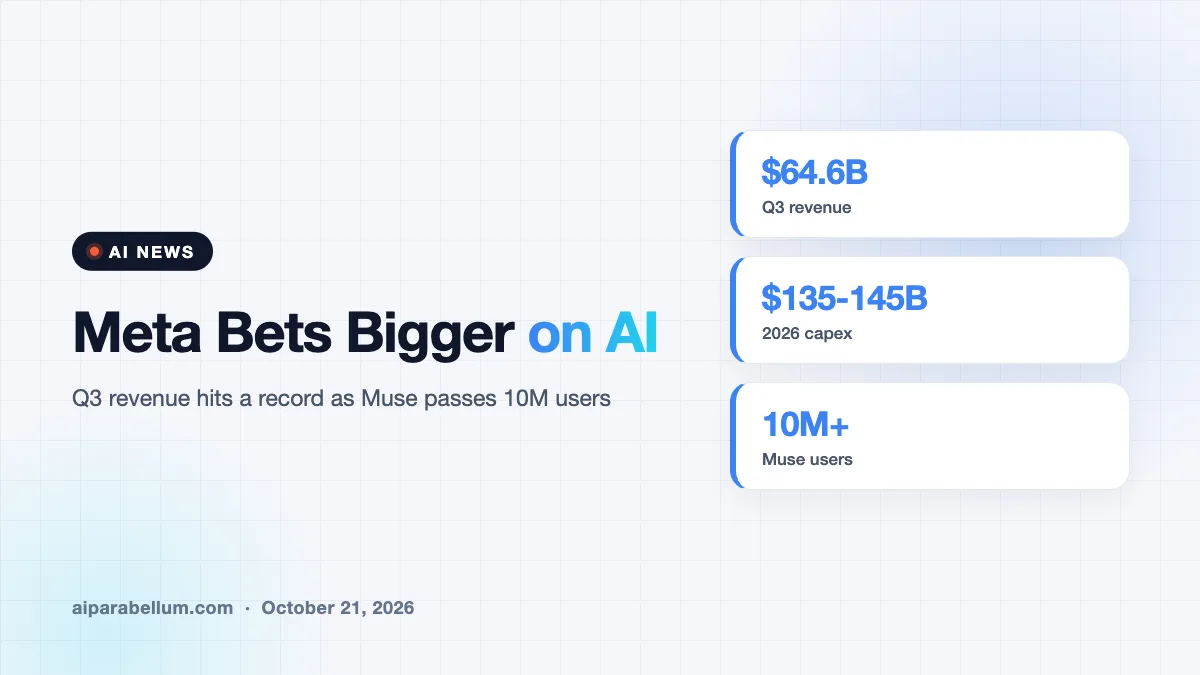
While the capital expenditure figures provide the headline shock value, the operational breakthrough lies in the explosive adoption of Muse. Achieving 5 million enterprise users within this accelerated deployment window shatters historical software-as-a-service (SaaS) adoption curves, outpacing even the meteoric early trajectories of enterprise collaboration and cloud migration tools.
Muse’s core value proposition rests on its seamless integration into existing enterprise workflows, offering advanced multimodal generation, real-time data synthesis, and autonomous workflow orchestration. Unlike earlier generative AI iterations that served primarily as experimental chat interfaces, Muse has embedded itself into core enterprise operations—spanning marketing automation, automated software development, supply chain forecasting, and legal document analysis.
This rapid user acquisition validates Meta’s strategic pivot toward enterprise software monetization, diversifying its revenue streams away from traditional digital advertising vulnerabilities. By capturing high-value enterprise contracts, Meta is insulating its balance sheet against macroeconomic headwinds that typically cause cyclical pullbacks in corporate ad spending. The enterprise ROI delivered by Muse—reported by early adopters to range from 300% to 500% in operational efficiency gains—has transformed the platform from a speculative research project into a mission-critical corporate utility.
Verified Data & Metrics Breakdown
The following table encapsulates the key financial, operational, and infrastructural metrics driving Meta’s current market narrative, synthesized from primary reporting and recent corporate filings:
| Metric / Indicator | Reported Figure / Status | Strategic Significance & Market Impact |
|---|---|---|
| Q3 AI Capital Expenditures | $41.68 Billion | Accelerates global data center expansion, silicon procurement, and power grid partnerships to support massive model training clusters. |
| Muse Enterprise Adoption | 5 Million Active Users | Proves viable B2B monetization, validating heavy capex with immediate enterprise SaaS revenue streams and high retention rates. |
| Primary Hardware Focus | Advanced GPUs & MTIA Silicon | Reduces long-term dependency on merchant silicon suppliers, optimizing inference costs and boosting operating margins. |
| Macroeconomic Overlay | Tightening Liquidity & Volatile Rates | Increases cost of capital, placing intense scrutiny on how efficiently tech giants translate infrastructure outlays into net income. |
Industry & Market Implications: Winners and Losers
The ripple effects of Meta’s $41.68 billion capex deployment and Muse’s scaling success extend far beyond Menlo Park, reshaping the competitive landscape across multiple sectors:
- The Winners: Enterprise software integration partners, specialized semiconductor manufacturers, and renewable energy providers powering hyper-scale data centers. Companies equipped to handle heavy enterprise deployments of Muse stand to reap substantial advisory and integration windfalls.
- The Losers: Legacy enterprise software vendors slow to incorporate native multimodal capabilities risk losing market share rapidly as corporate clients consolidate tech stacks around platforms offering superior automation like Muse. Furthermore, smaller tech startups lacking access to tier-1 capital markets face severe hurdles in competing for foundational model compute.
- Broader Economic Impact: As Big Tech capital expenditures consume record levels of industrial power and advanced hardware, local regulatory bodies are increasingly scrutinizing power grid capacities. The intersection of AI infrastructure expansion and energy markets remains a critical regulatory compliance battleground.
Frequently Asked Questions (People Also Ask)
What drove Meta’s $41.68 billion AI capital expenditure in Q3?
The massive capital expenditure was driven by the urgent need to expand hyper-scale data center infrastructure, procure advanced AI accelerators (such as GPUs and custom silicon), and secure massive energy allocations required to train and run increasingly complex multimodal models like Muse.
How is Meta monetizing Muse after reaching 5 million enterprise users?
Meta is monetizing Muse through tiered enterprise software licensing models, API consumption fees, and customized enterprise deployment packages that integrate directly into corporate workflows, offering verified return on investment through workflow automation and productivity gains.
How does Meta’s AI spending impact its competitive position against Alphabet and Microsoft?
Meta’s aggressive capex positions it shoulder-to-shoulder with Microsoft and Alphabet in the race for AI dominance. By scaling infrastructure aggressively and proving rapid B2B adoption with Muse, Meta is successfully diversifying away from pure advertising dependence into lucrative enterprise software markets.
What are the primary financial risks associated with Meta’s high-capex strategy?
The primary risks include potential margin compression if enterprise monetization fails to outpace infrastructure depreciation, tightening capital markets driven by macroeconomic shifts, and the high rate of technological obsolescence in artificial intelligence hardware.
Future Outlook: Key Milestones to Watch
As Meta navigates the remainder of the fiscal year and looks toward long-term strategic horizons, financial analysts and investigative researchers will monitor several critical milestones:
- Capex Efficiency Ratios: Wall Street will scrutinize whether the $41.68 billion quarterly run-rate begins to plateau or if efficiency gains in inference architecture can successfully drive down per-user operational costs.
- Muse Enterprise Scaling: The trajectory beyond the 5 million user mark will test market saturation limits and determine whether Muse can capture Fortune 500 core operational infrastructure contracts at scale.
- Regulatory and Energy Scrutiny: As data center power demands intersect with broader energy market dynamics—compounded by fluctuating oil and energy benchmarks—compliance with environmental standards and grid stability will become paramount.
Ultimately, Meta’s bold gamble represents a defining moment in corporate history. By committing unprecedented capital to AI infrastructure and successfully commercializing tools like Muse, Meta is no longer merely a social media titan; it has transformed into a foundational pillar of the global enterprise software and artificial intelligence economy.