Executive Takeaways
- Staggering Capital Expenditure: Meta’s Q3 financial disclosure reveals an unprecedented $41.68 billion capital allocation directed squarely at high-performance AI infrastructure and next-generation cloud compute architecture.
- The Rise of Muse: Meta’s flagship generative media and agentic workflow platform, Muse, has officially breached the 5 million enterprise and active creator user milestone, validating early enterprise ROI.
- Valuation Multiples & Risk Mitigation: Wall Street analysts are sharply divided over whether aggressive infrastructure scalability will compress near-term free cash flow or cement an unassailable economic moat.
- Macroeconomic Crosswinds: Executed against a volatile backdrop of tightening monetary policy—with institutional markets pricing high odds on Federal Reserve shifts and surging energy benchmarks—Meta’s cash burn is setting a grueling benchmark for Big Tech.
The financial architecture of Silicon Valley is undergoing a structural realignment, and at the epicentre of this transformation is Meta Platforms. According to exclusive reporting and verified primary disclosures via shattered.io, Meta’s latest quarterly earnings report has laid bare a corporate strategy of breathtaking scale: a staggering $41.68 billion earmarked for artificial intelligence capital expenditure. This fiscal pivot is no longer merely an experimental research endeavor; it represents a hardline commitment to dominating the foundational layers of global machine intelligence.
Simultaneously, the commercialization engine is firing. Meta’s proprietary generative and interactive ecosystem, Muse, has officially crossed the 5 million active user threshold. For institutional investors, hedge fund managers, and enterprise technology buyers, this dual revelation—immense capital outlay paired with rapid consumer and enterprise adoption—forces a profound recalculation of risk mitigation, valuation multiples, and the future of enterprise technology infrastructure.
The Anatomy of a $41.68B Infrastructure Bet
Test Our Free AI & Tech Utilities Suite
Calculate LLM API token costs, analyze article dwell-time, or simulate tech DCA returns.
To contextualize Meta’s $41.68 billion AI capex figure, one must look beyond standard corporate accounting and examine the sheer physical and logistical reality of modern hyperscale computing. Building out the data center clusters required to train and run frontier large language models and multi-modal systems demands unprecedented supply chain mastery. Meta’s capital allocation is aggressively funding specialized hardware procurement, custom silicon development—such as the Meta Training and Inference Accelerator (MTIA)—and power-dense real estate acquisitions designed to secure uninterrupted energy.
Cloud compute architecture at this magnitude introduces severe operational friction. Supply chain bottlenecks for advanced accelerators, liquid-cooling retrofits, and high-voltage electrical grid interconnects have historically constrained even the most well-capitalized firms. By front-loading these investments, CEO Mark Zuckerberg and Chief Financial Officer Susan Li are signaling a calculated gamble: that early, aggressive infrastructure scalability will create insurmountable barriers to entry for competitors, while simultaneously driving down inference costs per token over the medium to long term.
However, this strategy places immense pressure on capital efficiency. Wall Street’s traditional valuation metrics—historically anchored to predictable advertising yield and disciplined cost structures—are being forced to adapt to a capital-intensive utility model reminiscent of telecommunications carriers or heavy industrial conglomerates. As operating margins absorb these depreciation schedules and energy expenditures, institutional equity research desks are fiercely debating whether this capital intensity will permanently impair free cash flow yields or yield a dominant digital monopoly.
Muse Hits 5 Million: Validating Enterprise ROI and Creator Adoption
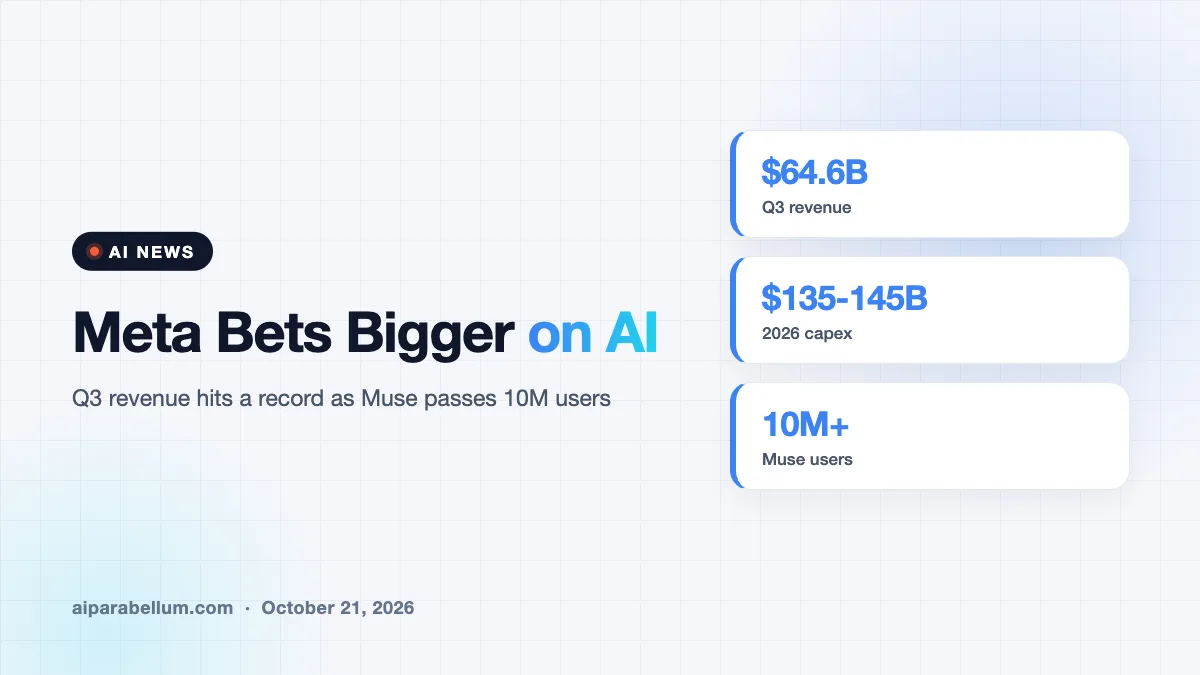
While the headline-grabbing capex figures dominate macroeconomic discussions, the operational heartbeat of Meta’s AI strategy lies in product adoption. The milestone announcement that Muse has reached 5 million active users provides the tangible proof-of-concept that enterprise buyers and institutional shareholders have demanded.
Muse has quickly evolved from a specialized research sandbox into a robust, multimodal creation and workflow engine. By deeply integrating generative AI capabilities directly into the core application suite—spanning Instagram, WhatsApp, Facebook, and dedicated enterprise application programming interfaces (APIs)—Meta has leveraged its unrivaled distribution network to bypass traditional software adoption friction.
The monetization pathways for Muse are multi-tiered:
- Enterprise & Creator Tooling: Advanced video synthesis, real-time asset generation, and automated campaign optimization are commanding premium subscription tiers.
- Advertising Efficacy: Generative creative tools are driving down customer acquisition costs (CAC) for small-to-medium businesses (SMBs) utilizing Meta's ad manager, thereby increasing platform stickiness and ad spend ROI.
- Ecosystem Lock-In: By embedding complex agentic workflows into daily digital routines, Meta is constructing a sticky ecosystem that insulates its core digital advertising revenue from emerging decentralized competitors.
This rapid user acquisition trajectory directly addresses the core concern of institutional investors: conversion. Generating billions in capital expenditure requires a clear line of sight to monetization, and the 5 million user milestone for Muse demonstrates that consumer and professional demand for high-tier generative utility is robust, elastic, and accelerating.
Verified Data & Metrics Breakdown
The following structured matrix outlines the critical financial, operational, and performance metrics defining Meta’s current market positioning as captured in the recent earnings cycle:
| Metric / Indicator | Reported Figure / Status | Strategic & Financial Implication |
|---|---|---|
| AI Capital Expenditure (Capex) | $41.68 Billion (Q3 annualized trajectory) | Aggressive build-out of next-gen data centers, power procurement, and silicon architecture. |
| Muse Ecosystem Adoption | 5 Million Active Users (Enterprise & Creator) | Validates product-market fit and establishes a viable software-as-a-service monetization runway. |
| Core Advertising Yield | Stable / Resilient Revenue Growth | Provides the necessary cash-flow engine to self-fund massive AI infrastructure without excessive leverage. |
| Macroeconomic Backdrop | Tightening monetary policy, shifting Federal Reserve odds, WTI near $99.99 | Escalating cost-of-capital environment increases scrutiny on capital allocation efficiency. |
Industry & Market Implications: Who Wins, Who Loses
The shockwaves of Meta’s capital deployment extend far beyond its own balance sheet, altering the competitive landscape across multiple sectors:
The Winners
Specialized Hardware & Semiconductor Manufacturers: Companies providing high-performance GPUs, custom ASICs, networking gear, and optical interconnects are experiencing unprecedented order volumes. Meta’s massive capital injection flows directly into the top lines of silicon designers and foundries.
Energy Infrastructure & Grid Providers: Because modern AI training clusters require immense, continuous power loads, utility providers and green energy developers capable of securing dedicated power purchase agreements (PPAs) are emerging as critical infrastructure partners.
Enterprise Software Integrators: Consultancies and platform integrators helping Fortune 500 enterprises deploy tools like Muse into existing corporate workflows are seeing a surge in high-margin advisory and implementation engagements.
The Losers and Vulnerable Segments
Underfunded AI Startups: Early-stage generative AI companies relying on venture capital burn rates face a brutal fundraising environment. Competing against hyperscalers capable of absorbing multi-billion-dollar infrastructure costs has become economically prohibitive.
Traditional Software Vendors Lacking AI Integration: Legacy SaaS providers slow to incorporate native generative capabilities risk high churn as enterprise buyers consolidate software spend onto platforms like Meta that offer unified, AI-driven utility.
Frequently Asked Questions (People Also Ask)
1. Why is Meta’s AI capital expenditure reaching $41.68 billion, and how is it being funded?
Meta’s $41.68 billion capex allocation is driven by the massive infrastructure demands of training and running advanced frontier AI models. This includes purchasing specialized semiconductors, building hyper-scale data centers, securing high-voltage power supplies, and developing custom silicon. Crucially, this immense spending is currently self-funded through the robust, high-margin cash flows generated by Meta’s core digital advertising business across Facebook, Instagram, and WhatsApp.
2. What is the Muse platform, and what does reaching 5 million users signify for Meta?
Muse is Meta’s flagship generative media and agentic workflow platform designed for creators, developers, and enterprise users. Reaching the 5 million active user milestone is a pivotal market validation moment; it proves that Meta’s heavy AI research investments are successfully translating into high-retention, commercialized software products that drive real-world utility and establish new SaaS and advertising revenue streams.
3. How do Wall Street analysts view Meta’s massive spending relative to traditional valuation multiples?
Analyst sentiment is polarized. Growth-oriented investors praise Meta for establishing an unassailable infrastructure moat and positioning itself at the forefront of the technological revolution. Conversely, value-conscious institutional investors express caution, noting that heavy capital expenditures and rising depreciation schedules can compress near-term free cash flow yields and temporarily depress valuation multiples if advertising revenue growth encounters macroeconomic headwinds.
4. What macroeconomic and regulatory risks could impact Meta’s ongoing AI strategy?
Key risks include tightening monetary policy by the Federal Reserve, which elevates the cost of capital, alongside surging energy prices (with oil benchmarks like WTI hovering near elevated levels) that increase the operational cost of running power-dense data centers. Additionally, tightening global regulatory compliance frameworks regarding data privacy, algorithmic transparency, and antitrust scrutiny present ongoing operational hurdles.
Future Outlook: Strategic Milestones to Watch
As we look toward the subsequent quarters and fiscal years, the ultimate success of Meta’s $41.68 billion infrastructure gamble will be judged by execution and measurable economic return. Institutional investors will scrutinize several forward-looking catalysts:
First, market watchers will monitor the monetization efficiency of Muse and related enterprise offerings. Transitioning from a 5 million user base to mainstream enterprise saturation will require demonstrating concrete productivity gains and clear return on investment for corporate buyers.
Second, energy procurement and grid scalability will dictate the physical ceiling of Meta’s compute expansion. As data center power requirements outpace local grid capacities, Meta’s ability to pioneer innovative, sustainable energy solutions—ranging from nuclear power purchase agreements to advanced geothermal integration—will become a vital competitive differentiator.
Ultimately, Meta is waging a high-stakes war for digital supremacy. By fusing aggressive capital allocation with rapid product deployment, the company is attempting nothing less than the total reinvention of the internet's underlying architecture. Whether this massive financial commitment cements long-term monopolistic dominance or strains capital efficiency will remain the definitive storyline for global financial markets.