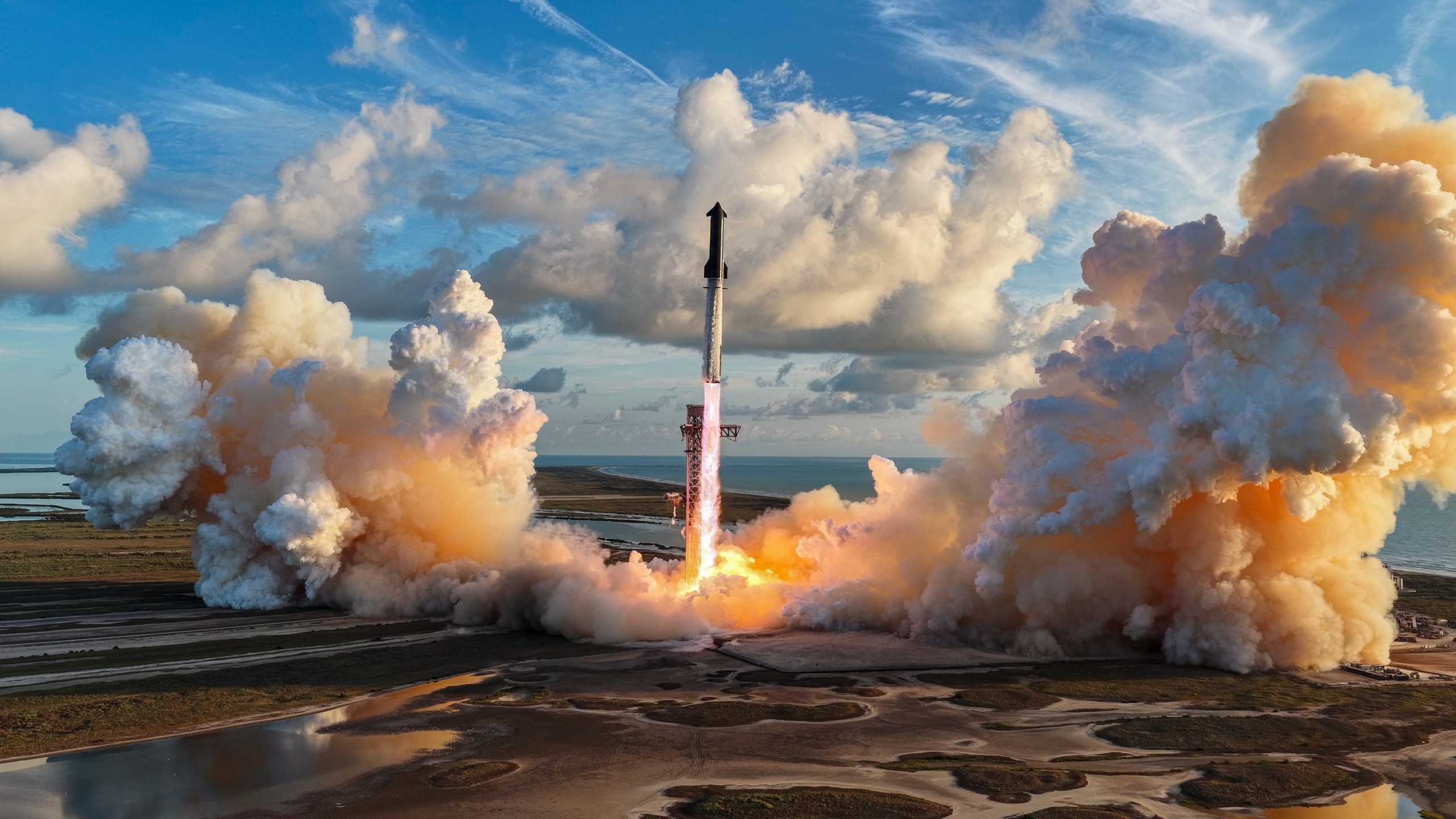
TOKYO — In a calculated bid to cement its standing as an indispensable power in global space exploration, Japan is preparing to execute one of the most technically ambitious planetary science endeavors in modern history. The Japan Aerospace Exploration Agency (JAXA), working alongside a consortium of international partners and domestic defense contractors, is finalizing launch readiness for the Martian Moons eXploration (MMX) mission. The flagship spacecraft is engineered to voyage to the Martian system, perform precision proximity operations around its moons, deploy a joint European rover, and return pristine surface samples from Phobos back to Earth.
The mission represents far more than an astrophysical inquiry into planetary origins. It is a high-stakes demonstration of sovereign aerospace infrastructure, high-margin deep-space logistics, and dual-use technological capability. Coming on the heels of JAXA’s successful Hayabusa and Hayabusa2 missions—which successfully returned regolith from near-Earth asteroids Itokawa and Ryugu—MMX elevates Japan’s strategic footprint into the Martian gravity well, effectively beating competing space powers to the first definitive sample return from the outer terrestrial planets.
Executive Takeaways
- First-Mover Sample Advantage: JAXA’s MMX mission aims to bring back the first-ever physical surface samples from Phobos, offering unprecedented planetary defense, geological, and atmospheric insights while outpacing parallel sample-return timelines proposed by NASA and the China National Space Administration (CNSA).
- Commercial & Defense Industrial Base: Led industrially by Mitsubishi Heavy Industries (MHI) and NEC Corporation, the mission showcases Japan's next-generation H3 launch infrastructure and advances dual-use satellite, autonomous edge computing, and guidance systems.
- Multilateral Risk Mitigation: Strategic capital and hardware contributions from the French National Centre for Space Studies (CNES), the German Aerospace Center (DLR), and NASA dilute capital expenditure while securing international scientific and commercial IP rights.
- Logistical Benchmark for the Space Economy: By perfecting gravity-assist maneuvers, low-gravity landing systems, and autonomous sample-containment chains, MMX establishes foundational architecture for prospective cislunar and deep-space mining ventures.
The Scientific Architecture: Phobos, Deimos, and the Martian Paradigm Shift
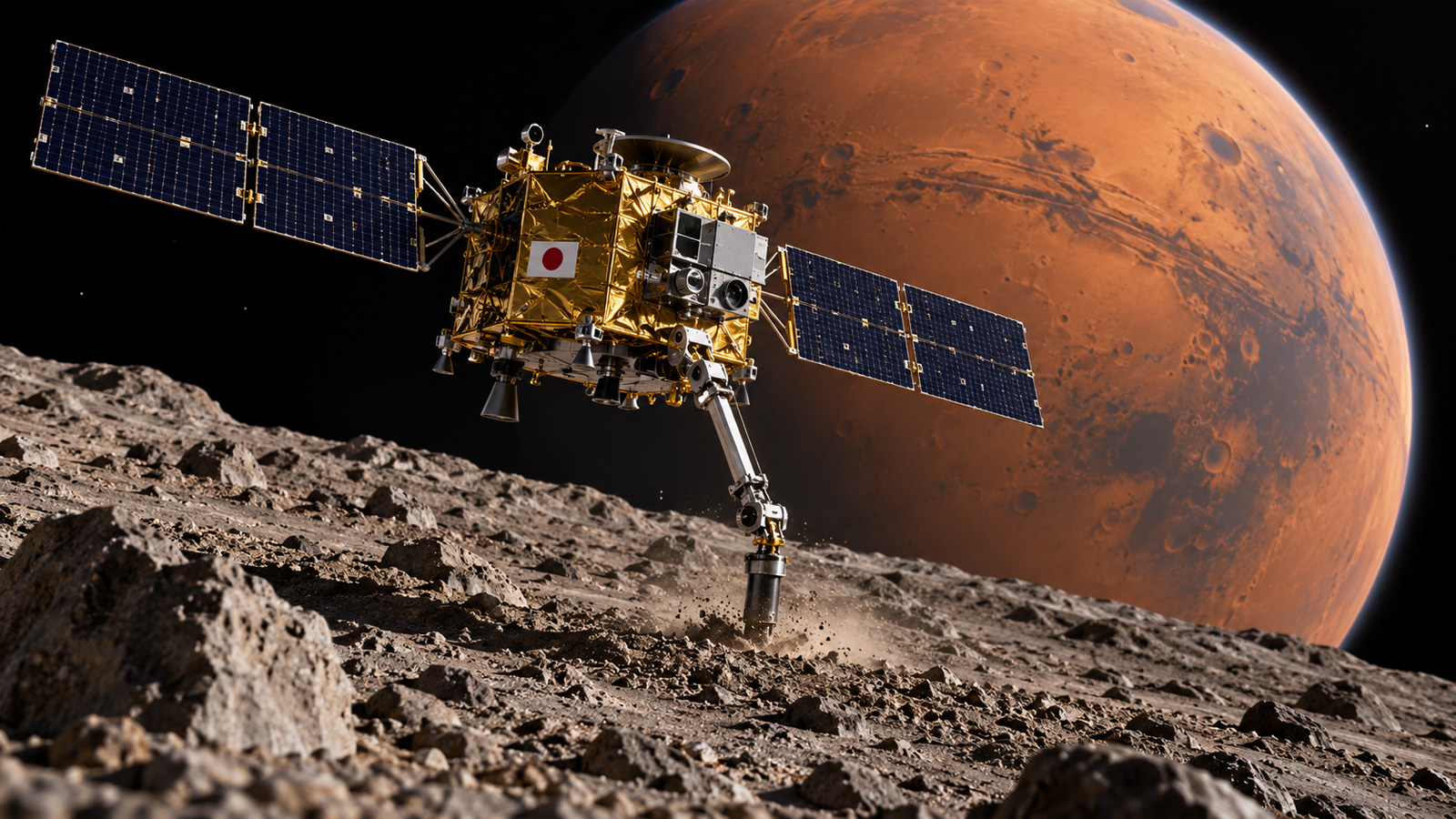
At the core of the MMX enterprise lies a fundamental debate in planetary science: the origin of Mars’ two inner satellites, Phobos and Deimos. Planetary scientists remain divided between two primary models. The first posits that the moons are captured primitive asteroids—dynamic carbonaceous chondrites ensnared by Mars’ gravitational field during the solar system's early formation. The second hypothesis asserts they are the coalesced debris of a catastrophic impact between a protoplanet and primitive Mars, meaning their material composition contains crucial remnants of the early Martian crust and mantle.
By collecting a minimum of 10 grams of regolith—and drilling down to a depth of at least two centimeters below the radiation-weathered surface layer—MMX will yield definitive chemical and isotopic data. The presence of atmospheric escape signatures within the Phobos soil could also reveal billions of years of Mars' hydrological evolution.
To execute this extraction, JAXA designed a multi-tiered sampling apparatus combining a pneumatic transfer system with a coring mechanism. Unlike traditional robotic landers, the MMX spacecraft must navigate the hyper-dynamic, highly irregular gravitational field of Phobos—which possesses less than 0.001g of Earth's gravity. Precision navigation relies on complex autonomous landing algorithms, lidars, and optical velocity sensors capable of conducting real-time hazard avoidance without human intervention from Earth, where communications experience a 10- to 20-minute latency gap.
The Industrial Assembly: Global Capital & Hardware Integration
While JAXA maintains primary command architecture, the project utilizes an international supply chain designed to optimize technical redundancy and mitigate operational capital allocation risk:
- CNES & DLR (The IDEFIX Rover): France and Germany have co-developed "IDEFIX," a 29-kilogram micro-rover integrated into the main propulsion bus. Dropped onto Phobos months prior to the primary lander's touchdown, IDEFIX will conduct low-velocity surface mobility tests, directly analyzing regolith physical properties to de-risk the main spacecraft's sampling sequence.
- NASA Payload Instrumentation: The U.S. space agency has integrated two primary sensor suites: MEGANE (a gamma-ray and neutron spectrometer designed to map elemental abundances) and the Pneumatic Sampler mechanism, ensuring back-to-back instrument verification.
- Mitsubishi Heavy Industries & NEC Corp: MHI serves as prime launch provider via its flagship H3 rocket platform, while NEC supplies high-reliability communications systems, central onboard computers, and edge-compute optical units.
Verified Data & Mission Metrics Breakdown
The operational specifications of the MMX program demonstrate the scale, fiscal commitment, and technical requirements governing modern planetary sample-return ventures:
| Specification / Metric | Configuration / Baseline Figure | Strategic & Commercial Value |
|---|---|---|
| Primary Target Body | Phobos (Secondary flybys: Deimos) | In-situ analysis of Martian planetary ejecta and asteroid material. |
| Launch Vehicle | Mitsubishi Heavy Industries H3 Rocket | Validates low-cost heavy-lift commercial launch platform for MHI. |
| Total Spacecraft Launch Mass | ~4,000 kg (Fuel & Module Mass Included) | High thrust-to-mass optimization for complex delta-v orbital maneuvers. |
| Target Regolith Payload | ≥ 10 grams (Cored up to ≥ 2cm deep) | Provides pristine isotopic samples uncorrupted by terrestrial entry. |
| Secondary Surface Payload | IDEFIX Rover (CNES / DLR Co-dev) | Autonomous off-world rover navigation in micro-gravity environments. |
| Estimated Program Budget | ~$350 Million – $450 Million USD equivalent | Demonstrates high cost-efficiency relative to NASA Mars Sample Return. |
| Transit & Return Horizon | Launch: Mid-2020s | Earth Return: Early 2030s | Establishes early market leadership in returned deep-space material. |
The Business Case for Deep-Space Supply Chains & Dual-Use Tech
From an institutional investment and defense perspective, JAXA’s MMX program is a dual-use incubator. The technology stack required to execute a precise, autonomous landing on a tumbling micro-gravity moon directly informs next-generation orbital defense, satellite servicing, and space situational awareness (SSA).
1. Validating the H3 Launch Platform Efficiency
For Japan’s commercial aerospace sector, the launch of MMX aboard the H3 rocket is a pivotal commercial milestone. Designed by MHI to replace the aging H-IIA, the H3 features simplified engine architectures, 3D-printed component fabrication, and streamlined ground operations intended to reduce launch costs by nearly 50%. Demonstrating the H3's capacity to throw heavy payloads into interplanetary transit vectors provides MHI with crucial market leverage to compete against SpaceX’s Falcon 9 and Vulcan Centauri in the global satellite launch market.
2. Edge Computing and Autonomous Robotics
The mission’s reliance on real-time optical visual navigation and onboard decision-making frameworks accelerates commercial innovation in edge-compute chips, radiation-hardened memory architectures, and autonomous sensor fusion. Companies providing advanced software and component hardware—ranging from optical sensors to propulsion micro-valves—gain validated flight heritage, elevating their valuation multiples and positioning them to capture defense procurement contracts.
3. Capital Efficiency in Sample-Return Architecture
With NASA’s primary Mars Sample Return (MSR) program currently undergoing budget reviews and redesigns due to multi-billion-dollar cost overruns and protracted timelines, JAXA’s leaner, lower-cost model offers a case study in fiscal discipline. By targeting Mars' moon Phobos—which holds Martian surface ejecta without requiring a costly landing and ascent vehicle execution from Mars' deep gravity well—JAXA achieves significant orbital efficiency at a fraction of the enterprise cost.
Industry & Strategic Implications: Winners and Losers
The execution of the MMX mission alters the geopolitical and commercial risk landscape across the global aerospace economy:
- Winners — Japanese Prime Contractors: MHI, NEC, and IHI Corporation gain high-visibility flight validation for heavy-lift commercial integration, deep-space optical communication networks, and cold-gas attitude control thrusters.
- Winners — Commercial Space Hardware Suppliers: Component vendors specializing in rad-hard sensors, high-density solar arrays, and high-efficiency heat shields will see increased institutional demand from international space agencies imitating JAXA's modular bus design.
- Uncertain — Western Legacy Sample-Return Programs: The high capital expenditures associated with multi-stage surface-to-orbit return architectures face increased scrutiny from legislative appropriators when lower-cost orbital options deliver comparative analytical returns.
- Broader Market Impact — Strategic Resource Exploration: The precision guidance, navigation, and control (GNC) algorithms perfected by JAXA accelerate the technical roadmap for commercial deep-space resource extraction enterprises targeting near-Earth asteroids.
Frequently Asked Questions (People Also Ask)
Why is JAXA prioritizing a sample return from Phobos rather than landing directly on Mars?
Landing on the surface of Mars requires navigating a complex atmosphere and fighting a deep gravity well, demanding massive descent modules and expensive surface-to-orbit ascent vehicles. Phobos features micro-gravity and no atmosphere, dramatically lowering the delta-v (energy) requirements for landing and liftoff. Because Phobos has been bombarded by meteorite impacts on Mars for billions of years, its surface soil contains blasted-off fragments of early Martian regolith, enabling scientists to study Martian history without the cost and risk of landing on Mars itself.
How does the MMX mission utilize the new Mitsubishi Heavy Industries H3 rocket?
The MMX mission serves as a flagship high-orbit payload demonstration for the H3 rocket, Japan’s next-generation heavy-lift launch vehicle developed by MHI. Using advanced booster configurations and low-cost Liquid Hydrogen/Liquid Oxygen LE-9 engines, the H3 provides the requisite velocity to place the 4-ton MMX spacecraft onto a Trans-Mars Injection trajectory while validating the rocket's commercial competitiveness for international satellite operators.
What makes the joint European IDEFIX rover critical to the mission’s overall success?
Developed jointly by France's CNES and Germany's DLR, the IDEFIX rover is deployed ahead of the main lander to conduct a low-risk reconnaissance of the Phobos regolith. By analyzing wheel traction, surface dust behavior, and thermal properties, IDEFIX transmits real-time telemetry back to JAXA engineers, allowing them to optimize the landing sequence, thruster firings, and sampling depth parameters for the primary spacecraft.
What key insights are expected from the physical samples brought back to Earth?
Laboratory analysis of the returned regolith using high-resolution mass spectrometers and synchrotrons will definitively solve the mystery of whether Phobos is an ancient captured asteroid or a remnant of a giant collision with Mars. Additionally, identifying organic compounds, volatile water trace molecules, and Martian atmospheric isotopes locked inside the sample will provide a critical historical baseline for planetary habitability and past water dynamics on Mars.
Future Outlook: Strategic Milestones to Watch
As the MMX spacecraft moves closer to its launch integration, the aerospace industry and scientific community will monitor several critical milestones:
1. Systems Integration & Environmental Testing: Final thermal-vacuum chamber and electromagnetic compatibility testing at JAXA’s Tsukuba Space Center will validate the complete payload stack under simulated interplanetary conditions.
2. Launch & Trans-Mars Injection: The flawless operation of the H3 launch system will be vital. A successful departure vector validates Japan’s independent space launch capability for deep-space science and commercial satcom missions.
3. Orbital Insertion and Proximity Operations: Upon reaching Mars, MMX will transition from a Martian orbital path into Quasi-Satellite Orbits (QSOs) around Phobos—a mathematically delicate dynamic requiring continuous, ultra-precise trajectory corrections.
4. Rover Deployment & Landing Phase: The operational success of the IDEFIX micro-rover will serve as the final green light for JAXA's surface touchdown and automated regolith extraction sequence.
If executed according to schedule, the MMX return capsule will streak through Earth’s atmosphere in the early 2030s, delivering pristine sample materials to global laboratories. In doing so, Japan will not only answer fundamental questions about the birth of our planetary system, but also solidify its position as an indispensible hub in the emerging multi-trillion-dollar off-world economy.