EXECUTIVE TAKEAWAYS
- Accelerating Atmospheric Drag: Heightened solar activity from Solar Cycle 25 has expanded Earth's upper atmosphere, accelerating Hubble’s orbital decay and bringing potential uncontrolled re-entry timelines into the late 2020s or early 2030s.
- Paradigm Shift in Procurement: NASA is leveraging Request for Information (RFI) frameworks to pivot from costly government-led servicing missions to high-efficiency, commercial In-Space Servicing, Assembly, and Manufacturing (ISAM) architectures.
- Private Capital Integration: Venture-backed and private equity-funded entities—led by Jared Isaacman’s Polaris Program in collaboration with SpaceX—are offering low-cost or privately financed mission concepts to re-boost the observatory.
- Market Validation for Orbital Logistics: A successful commercial mission will de-risk servicing technologies, unlocking high-margin enterprise markets in satellite life extension, active debris removal, and defense-focused space domain awareness.
The Atmospheric Clock Ticks: Inside Hubble’s Orbital Mechanics
Test Our Free AI & Tech Utilities Suite
Calculate LLM API token costs, analyze article dwell-time, or simulate tech DCA returns.
Positioned approximately 515 kilometers above Earth’s surface, the Hubble Space Telescope (HST) is suffering from an unyielding force of orbital physics: upper atmospheric drag. Launched in 1990 aboard Space Shuttle Discovery (STS-31) at an initial altitude of 615 kilometers, the 11-ton observatory has steadily surrendered gravitational altitude over its 34-year operational tenure. The retirement of the Space Shuttle fleet in 2011 severed NASA’s direct physical pipeline to the telescope, leaving it without dedicated propulsion capabilities or onboard thrusters to adjust its trajectory.
The urgency surrounding Hubble’s orbital trajectory has intensified due to Solar Cycle 25. Stronger-than-expected solar activity radiates extreme ultraviolet energy, heating Earth’s thermosphere and causing atmospheric gas layers to expand outward into Low Earth Orbit (LEO). This atmospheric swelling significantly increases the drag coefficient ($C_d$) exerted on Hubble’s wide solar arrays and main chassis. Without an external re-boost, orbital dynamicists project that Hubble could experience an atmospheric re-entry window between 2028 and 2034, resulting in structural breakup and potential land-falling debris hazard.
For NASA’s Astrophysics Division, losing Hubble premature to total scientific instrument failure represents an asset degradation issue. While the James Webb Space Telescope (JWST) captures infrared wavelengths across deep space, Hubble remains humanity’s primary instrument for high-resolution ultraviolet and optical astronomy. The complementary science produced by simultaneous JWST and Hubble observations creates unique data synergies across multi-messenger astronomy—a capability that civil space infrastructure cannot duplicate without substantial capital expenditures.
The Commercial Pivot: Re-engineering Government Procurement Models

Historically, servicing Hubble was a capital-intensive endeavor. Across five Space Shuttle servicing missions (STS-61, STS-82, STS-103, STS-109, and STS-125), NASA spent billions in cumulative mission architecture, specialized astronaut EVA training, and dedicated shuttle launch ops. The final servicing mission in 2009 alone cost an estimated $1.1 billion. In an era of tightly constrained civil space budgets, replicating such a mission under traditional Cost-Plus contracting models is financially unfeasible.
To overcome this capital barrier, NASA issued an Request for Information (RFI) seeking commercial concepts to re-boost the telescope’s orbit using private spacecraft architectures at minimal or zero cost to the federal government. This strategy mirrors NASA’s Commercial Resupply Services (CRS) and Commercial Crew Program (CCP) models, shifting financial risk, operational ownership, and capital deployment responsibilities onto private enterprise.
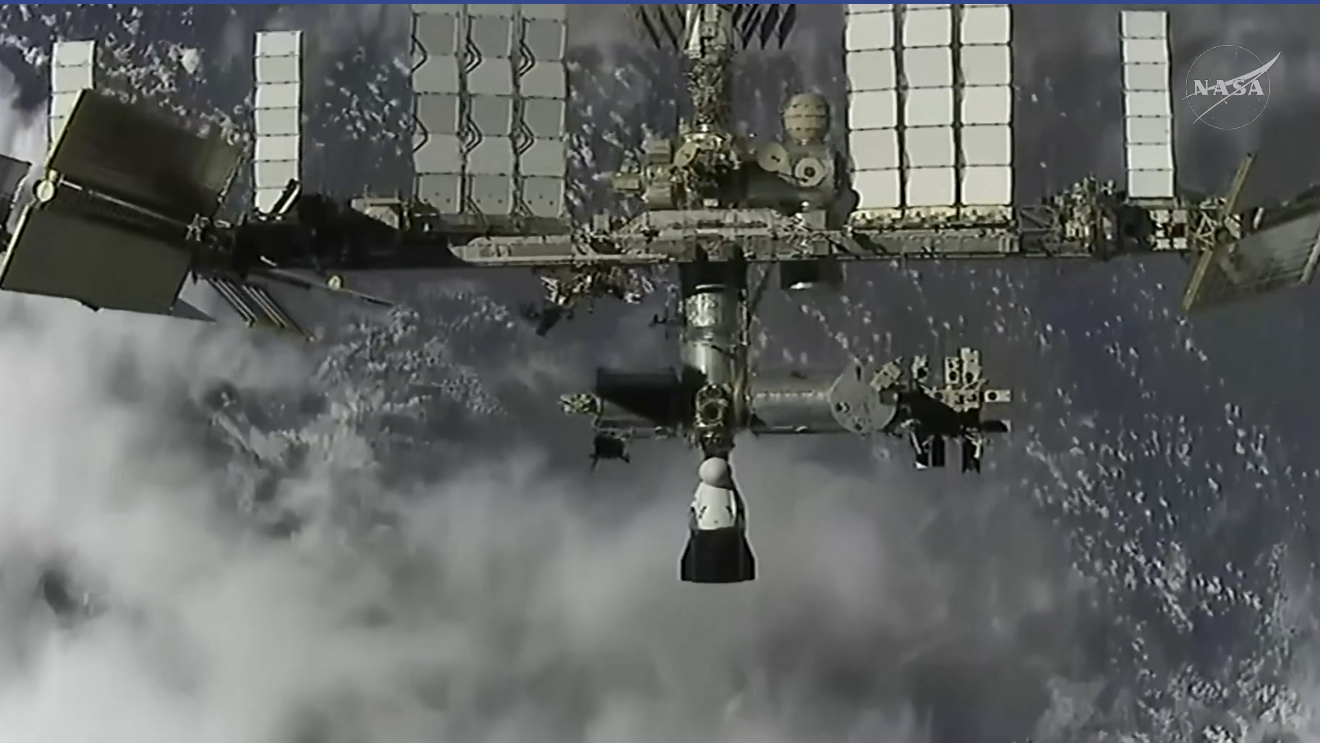
Leading the commercial charge is the Polaris Program—a private spaceflight initiative funded by billionaire entrepreneur Jared Isaacman—in technical partnership with SpaceX. In late 2022, NASA and SpaceX initiated a joint, un-funded Feasibility Study to evaluate modifying a SpaceX Crew Dragon spacecraft for an autonomous or crewed rendezvous, docking, and re-boost operation. Under this framework, commercial capital funds the primary development, while NASA provides operational telemetry, heritage engineering access, and risk assurance monitoring.
Engineering Constraints: Plumes, Gyros, and Unstandardized Docking
Interfacing a modern commercial spacecraft with a 1980s-era space observatory presents structural, mechanical, and guidance control challenges. Unlike modern satellites designed under standard modular interfaces, Hubble was built to be serviced by human hands wearing Space Shuttle EVA gloves. It lacks a standardized universal docking adapter, relying instead on a specialized Soft Capture Mechanism (SCM) installed during STS-125 on its aft shroud, alongside legacy latching points designed for the Shuttle’s Remote Manipulator System.
Key Operational Challenges for Commercial Servicing Vehicles:
- Propellant Plume Contamination: Standard hydrazine or hypergolic reaction control system (RCS) thrusters output chemical exhaust that can coat Hubble’s highly sensitive primary and secondary optical mirrors, damaging its light-gathering mirrors. Commercial vehicles must utilize hyper-pure cold-gas, electric propulsion, or strictly angled thruster vectoring.
- Attitude Determination and Control (ADCS): Hubble currently operates on a reduced set of control gyroscopes to maintain fine pointing stability. Any physical contact or pushing force during an orbital boost maneuver risks triggering structural loads beyond the tolerance of its aging momentum wheels and solar array gimbals.
- Relative Navigation (RelNav) without Beacon Transponders: Servicing vehicles must execute rendezvous maneuvers using passive optical sensors, LiDAR, and computer-vision algorithms without relying on active modern transponders on the target craft.
Comparative Analysis of Proposed Commercial Interventions
The emerging In-Space Servicing, Assembly, and Manufacturing (ISAM) ecosystem presents multiple distinct operational paths to re-boosting Hubble. The table below outlines the core metrics, risks, and financial implications across competing mission architectures.
| Mission Concept | Primary Architecture | Estimated Cost / Funding Model | Primary Technical Risk | Expected Lifetime Extension |
|---|---|---|---|---|
| Crewed SpaceX Dragon (Polaris) | Direct docking via modified trunk/SCM; crewed EVA assistance if required. | Privately Funded (Polaris / Isaacman) Zero-cost to NASA. | Crew safety risks; plume contamination on optics during dynamic maneuvering. | +15 to 20 Years (Boosts altitude back to ~600 km). |
| Autonomous Robotic Servicer (e.g., Astroscale / SpaceLogistics) | Uncrewed robotic tug latches onto Soft Capture Mechanism (SCM). | Fixed-Price Commercial Service Contract ($100M – $250M). | Robotic grapple failure; complex autonomous relative navigation. | +10 to 15 Years (Dependent on tug fuel capacity). |
| Attached Propulsion Pod (Impulse Space / Starfish) | Small, high-efficiency secondary stage remains permanently docked to act as an external ADCS/thruster unit. | Venture Capital / NASA Milestone Grants ($50M – $120M). | Long-term dynamic load balancing; potential control loop interference with HST gyros. | +8 to 12 Years. |
Market and Investment Dynamics: Scaling the In-Space Economy
NASA’s strategic decision to leverage commercial capabilities for Hubble serves as a catalytic event for the broader space domain market. By creating a high-profile target for operational validation, NASA is effectively anchoring demand for the nascent ISAM sector. Venture capital and private equity firms are closely evaluating how these servicing capabilities convert into scalable, recurring revenue models.
The enterprise ROI for satellite servicing extends far beyond astronomical preservation. The global space sector currently hosts hundreds of legacy geosynchronous communications satellites and high-value LEO national security assets that face operational decommissioning simply due to station-keeping fuel exhaustion, rather than component failure. Demonstrating autonomous rendezvous, soft capture, and trajectory alteration on a delicate platform like Hubble establishes clear technological validity. This de-risking allows operators like Intelsat, SES, and defense entities (such as the U.S. Space Force) to write long-term life-extension contracts, enhancing capital efficiency and raising long-term valuation multiples for space infrastructure companies.
Conversely, failure to establish commercial servicing standards presents downside risks. A high-profile anomaly during a private rendezvous with Hubble—such as an accidental collision or plume degradation of the telescope's main aperture—could trigger strict regulatory frameworks from the FAA, FCC, and international space traffic management regulatory bodies, stifling venture capital deployments across the sector.
Frequently Asked Questions (People Also Ask)
Why can't NASA simply use the Space Launch System (SLS) or Orion to fix Hubble?
The Space Launch System (SLS) rocket and Orion spacecraft were engineered for deep-space and lunar missions under the Artemis program. They lack the dedicated robotics systems, payload bay configurations, and specialized airlocks required for LEO servicing ops. Furthermore, the marginal cost of an SLS launch exceeds $2 billion, making it economically unviable compared to commercial LEO launch vehicles.
Is Hubble still producing relevant scientific data alongside the James Webb Space Telescope?
Yes. Hubble operates primarily in the optical and ultraviolet spectra, whereas the James Webb Space Telescope operates in the infrared domain. These complementary capabilities allow astronomers to analyze phenomena across wavelengths—such as tracking atmospheric composition on exoplanets or observing distant supernova energetic outputs simultaneously across ultraviolet and infrared spectra.
How much will a commercial Hubble re-boost mission cost the U.S. taxpayer?
Under current feasibility studies and RFI proposals, NASA aims for zero-to-minimal direct infrastructure costs. Private concepts, like the Polaris-SpaceX proposal, are structured as privately funded technical demonstrations. If NASA transitions to an uncrewed commercial procurement contract, it will likely use a fixed-price milestone model, capping taxpayer exposure to a fraction of traditional shuttle-era costs.
What happens if NASA decides not to boost Hubble’s orbit?
If no intervention occurs, atmospheric drag will degrade Hubble's altitude. As it descends below 400 kilometers, safe science operations will become unviable due to high orbital drift rates and thermal variations. Eventually, NASA would be forced to conduct a targeted, controlled de-orbit using a commercial propulsive module to force the spacecraft into a safe ocean impact zone, preventing an unguided, dangerous re-entry over populated landmasses.
Future Outlook: Critical Milestones and Decision Gates (2025–2030)
The trajectory of Hubble's rescue mission will hinge on several near-term technical and policy milestones over the coming 18 to 36 months:
- NASA Technical Review Completion: NASA’s Engineering and Safety Center (NESC) must finalize internal safety reviews of the Polaris/SpaceX joint study, specifically validating dynamic load limits on Hubble's structure during thruster burns.
- Solar Maximum Peak Monitoring (2024–2026): Orbital tracking data gathered during the peak of Solar Cycle 25 will determine the precise rate of altitude degradation, establishing a hard operational deadline for execution.
- Contracting and Regulatory Authorization: NASA will determine whether to issue a sole-source operational grant to a private team or launch a competitive commercial acquisition program under FAR (Federal Acquisition Regulation) guidelines.
- Mission Execution Window: If approved, target launch windows for a commercial rendezvous mission are expected between 2026 and 2028, lifting Hubble back above 600 kilometers and extending its operational lifecycle well into the 2040s.
NASA's strategy for saving Hubble represents a test case for modern space economics: replacing government-funded mission models with agile, venture-backed commercial execution. The outcome will shape not only the future of deep-space optical science, but also the commercial ecosystem of in-space logistics for decades to come.