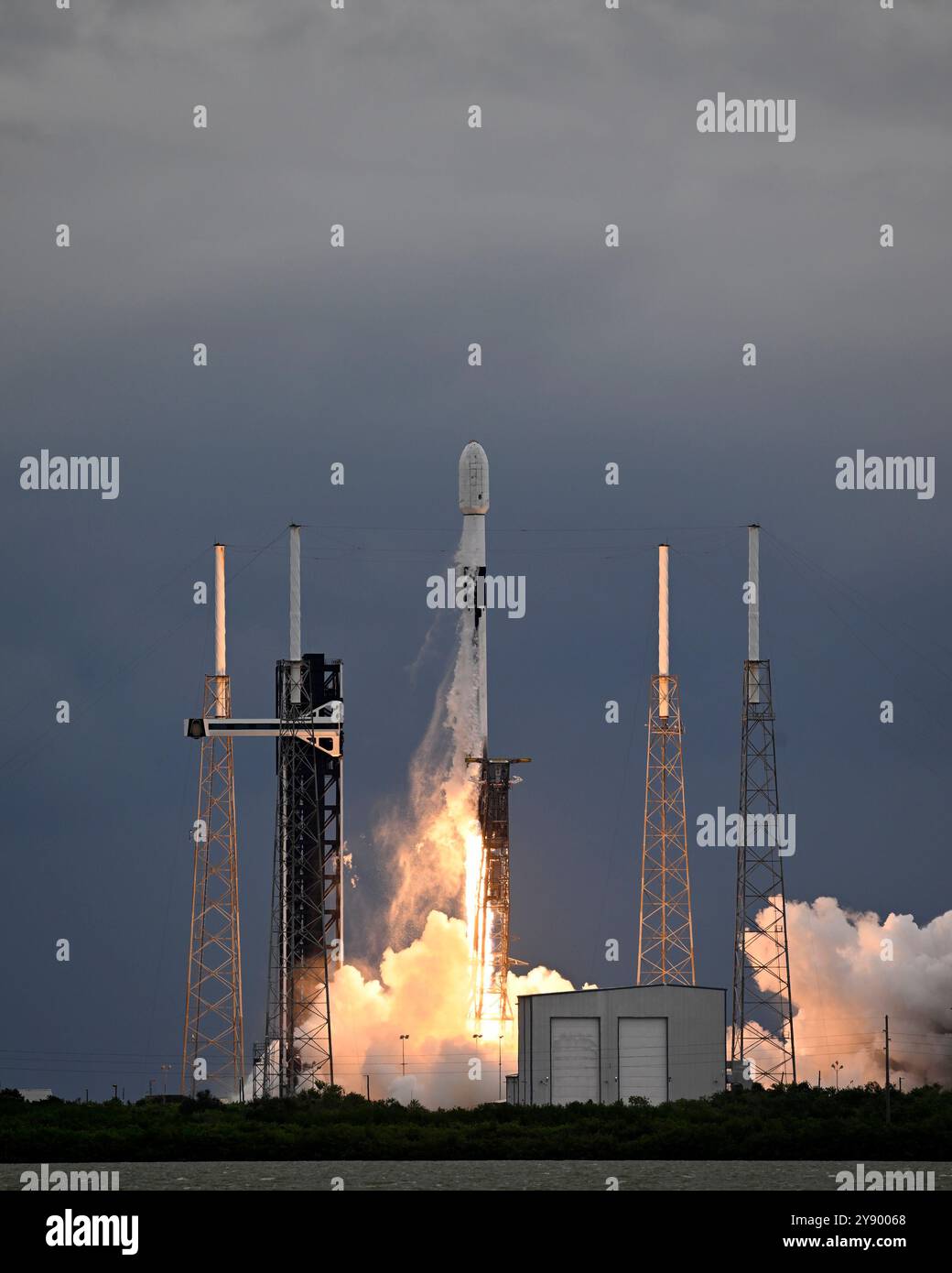
WASHINGTON — As October drew to a close, SpaceX quietly achieved a milestone that once belonged exclusively to sovereign space programs and defense contracting cartels: the 700th successful liftoff of its workhorse Falcon 9 rocket. For an industry accustomed to decade-long development cycles and catastrophic capital allocation failures, the achievement represents far more than a numerical triumph. It is a masterclass in infrastructure scalability, iterative engineering, and the ruthless execution of enterprise ROI.
Yet, behind the celebratory static of the webcasts lies a far more profound financial and geopolitical narrative. By normalizing orbital access at a cadence that outpaces legacy aerospace competitors combined, Elon Musk’s private enterprise has permanently altered the valuation multiples of the global defense and telecommunications sectors. As institutional investors evaluate risk mitigation strategies in an increasingly contested low-Earth orbit (LEO), the Falcon 9’s 700-launch benchmark serves as a stark reminder: the old guard is no longer competing against a rival company, but against a completely redesigned economic engine.
Executive Takeaways
Test Our Free AI & Tech Utilities Suite
Calculate LLM API token costs, analyze article dwell-time, or simulate tech DCA returns.
- Unprecedented Cadence: SpaceX closed October by pushing its cumulative Falcon 9 launch count to 700, cementing the vehicle as the most prolific medium-to-heavy lift rocket in human history.
- Market Liquidity & Capital Efficiency: Reusable first-stage boosters have driven marginal launch costs down to levels that traditional aerospace conglomerates—reliant on cost-plus government contracting models—cannot replicate.
- Strategic Moat for Starlink: The majority of these 700 flights directly serve internal deployment needs, building out a high-margin cloud compute architecture and global broadband infrastructure.
- Regulatory Compliance & Risk: As orbital congestion intensifies, regulatory compliance regarding space debris management and frequency allocation remains the primary friction point for future scaling.
The Catalytic Evolution of a Workhorse
To understand the magnitude of the 700th launch, one must contextualize the graveyard of capital that preceded the Falcon 9. For decades, institutional aerospace operated under a paradigm of bespoke manufacturing. Every rocket was treated like a luxury yacht, built by hand, priced in the hundreds of millions of dollars, and discarded into the ocean after a single use. The financial risks were absorbed by taxpayers through cost-plus government procurement frameworks, insulating legacy primes from market realities.
When SpaceX introduced the Falcon 9, the initial market response was skeptical. Wall Street analysts questioned the capital allocation strategy of pouring billions into vertical landing technologies. However, the iteration cycle proved decisive. By treating orbital rocketry more like commercial aviation—focusing on rapid turnaround, standardized hardware, and relentless software optimization—SpaceX transformed launch services from a high-risk gamble into predictable, high-frequency infrastructure.
The acceleration has been exponential. While the first 100 launches took nearly a decade to accumulate due to developmental hurdles, regulatory hurdles, and technological refinements, the final stretches toward the 700-launch milestone have been achieved in mere months. This operational tempo provides SpaceX with a nearly insurmountable data advantage. Every flight yields terabytes of telemetry data, driving continuous improvements in structural margins, engine performance, and guidance algorithms.
Verified Data & Metrics Breakdown
| Metric / Milestone | Falcon 1 Era (Historical) | Falcon 9 Early Phase (2010) | Falcon 9 Mature Phase (Current) |
|---|---|---|---|
| Cumulative Launches | 5 flights | 1st Launch (2010) | 700th Milestone Reached |
| First-Stage Recovery | None (Expendable) | Experimental / R&D | Routine (Multi-flight reuse record >20) |
| Payload to LEO (Capacity) | ~420 kg | ~10,400 kg | Up to 22,800 kg (Expendable profile) |
| Launch Cadence | Sporadic (2006–2009) | 2–3 per year | Multiple per week |
Industry & Market Implications: Who Wins, Who Loses
The economic shockwaves generated by SpaceX’s launch dominance extend far beyond the aerospace sector, deeply impacting global telecommunications, defense prime contractors, and venture capital deployment strategies.
The Winners
- Global Enterprise Connectivity Providers: Companies requiring resilient, low-latency backhaul are leveraging the LEO ecosystem built out almost entirely by Falcon 9 rockets.
- Commercial Satellite Operators: Smaller Earth-observation and communications startups now have reliable, predictable access to space without facing multi-year launch queues.
- SpaceX’s Financial Valuation: With a secure revenue stream from commercial payloads, NASA resupply contracts, and military national security space launches (NSSL), SpaceX commands a private valuation that rivals major publicly traded defense institutions.
The Losers
- Legacy Aerospace Primes: European and domestic competitors who relied on traditional heavy-lift vehicles face severe pricing pressures, often requiring government bailouts or strategic restructurings to remain viable.
- Traditional GEO Satellite Manufacturers: The shift toward decentralized, high-throughput LEO constellations has compressed the addressable market for multi-ton geostationary communication satellites.
Frequently Asked Questions (People Also Ask)
1. Why is the 700th Falcon 9 launch significant for financial markets?
The milestone underscores extreme operational reliability and cost efficiency. By proving that a single rocket design can fly 700 times with an exceptionally high success rate, SpaceX validates its reuse economic model. This creates intense competitive pressure on traditional aerospace companies, forcing defense budgets and commercial capital to reallocate toward reusable architectures.
2. How does Falcon 9 reusability impact SpaceX’s profit margins?
First-stage booster reuse drastically reduces the marginal cost of manufacturing new hardware, which is historically the most capital-intensive component of a launch vehicle. While refurbishment costs exist, they are a fraction of building a brand-new rocket, allowing SpaceX to maintain aggressive pricing while capturing high profit margins per mission.
3. What role does Starlink play in the frequency of Falcon 9 launches?
Starlink is the primary internal customer for Falcon 9. A significant percentage of the 700 launches have been dedicated to lofting batches of internet-beaming satellites into low-Earth orbit. This symbiotic relationship ensures that SpaceX maintains its aggressive launch cadence even during lulls in commercial or government customer demand.
4. Are there regulatory hurdles threatening the continuation of this launch cadence?
Yes. As the volume of orbital traffic increases, regulatory compliance regarding orbital debris mitigation, spectrum interference, and environmental impact statements at launch sites (such as Cape Canaveral and Starbase) faces heightened scrutiny from bodies like the FAA, FCC, and international agencies.
Future Outlook: What Comes Next?
Even as the 700th Falcon 9 mission enters the history books, industry eyes are already shifting toward the horizon. The medium-term strategic imperative for SpaceX involves gradually transitioning its primary payload capacity from the Falcon 9 ecosystem to Starship—its fully reusable, next-generation super-heavy lift vehicle.
For financial markets and enterprise strategists, the lesson of the Falcon 9’s 700 flights is clear: operational tempo and engineering agility win over legacy bureaucratic caution. As SpaceX works toward higher cadence milestones and deeper interplanetary ambitions, the burden of proof remains heavily on global competitors to prove they can adapt to a permanently altered economic reality.