Executive Takeaways
- The Optical Mechanism: The dramatic "space jellyfish" (or twilight phenomenon) occurs when a high-altitude rocket plume ascends into sunlit mesospheric vacuum conditions while ground observers remain shrouded in pre-dawn or post-sunset darkness, illuminating expanding exhaust gases across hundreds of kilometers.
- Cadence-Driven Visibility: Exponential growth in commercial satellite constellation deployments—dominated by SpaceX’s Falcon 9 launch architecture and emerging heavy-lift platforms—has converted a once-rare atmospheric anomaly into a frequent global event.
- Capital Allocation & Infrastructure: The phenomenon highlights the rapid scaling of Low Earth Orbit (LEO) telecommunications, where private enterprises and defense primes are pouring billions into orbital infrastructure, driving high enterprise ROI and market liquidity across aerospace supply chains.
- Environmental & Defense Scrutiny: Beyond aesthetic capture, atmospheric scientists and space domain awareness (SDA) networks are rigorously analyzing plume dynamics to assess stratospheric moisture accumulation, upper-atmosphere chemistry, and infrared early-warning signature signatures.
1. The Atmospheric Physics of the High-Altitude Plume
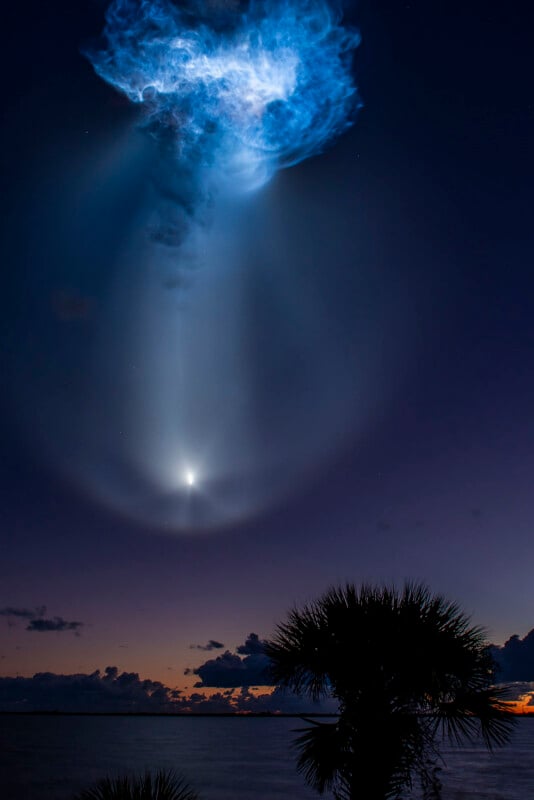
In the quiet hours preceding dawn or immediately following dusk, astrophotographers and casual observers along coastal launch corridors frequently document one of the modern era’s most striking visual phenomena: the "space jellyfish." The spectacle appears as an incandescent, bulbous head with trailing, undulating tendrils that drift silently across the upper atmosphere. While social media channels often react with viral speculation, the phenomenon is grounded in precise atmospheric physics, fluid dynamics, and optical geometry.
Scientifically recognized as a high-altitude twilight phenomenon, the effect requires a strict confluence of geometric conditions between the launch vehicle, the Sun, and the ground-based observer. When a launch vehicle—such as SpaceX’s Falcon 9, United Launch Alliance’s Vulcan Centaur, or NASA’s Space Launch System (SLS)—ascends past the stratosphere into the mesosphere (roughly 80 to 100 kilometers above sea level), ambient air pressure drops to fractions of a millibar. At this altitude, exhaust gases ejected from rocket nozzles no longer face atmospheric containment; they expand omnidirectionally into the near-vacuum at supersonic velocities.
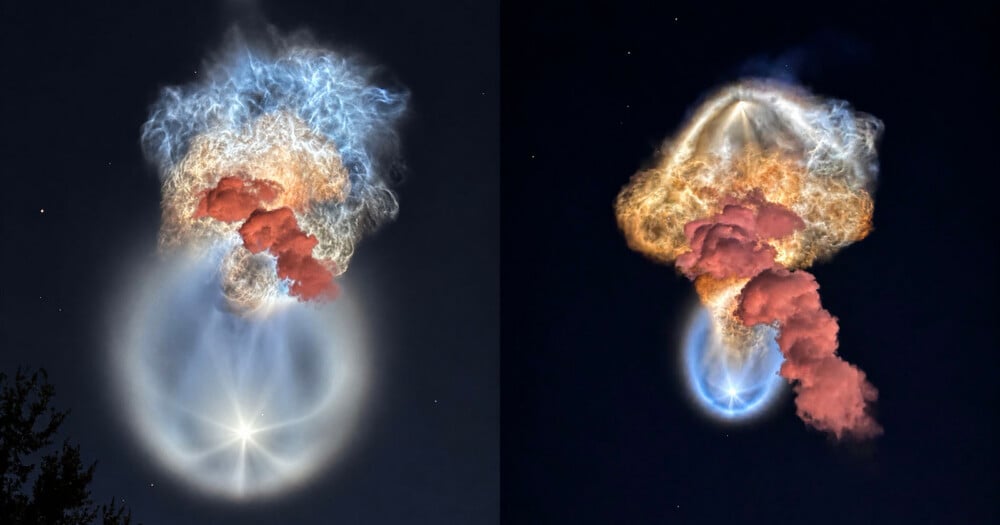
Simultaneously, while the launch pad and ground observers remain cast in Earth's shadow (below the local horizon line), the rocket at 100 kilometers altitude transcends the planet's shadow line into direct sunlight. The expanding plume—comprising water vapor, carbon dioxide, unburnt hydrocarbons, and trace combustion particulates—instantly freezes into microscopic ice crystals. These ice particulates scatter solar radiation via Rayleigh and Mie scattering, projecting luminous, bioluminescent-like blue, iridescent silver, and deep crimson hues back down to Earth against a dark night sky.
Figure 1: High-altitude solar scattering creates the characteristic wide-diameter expansion of cryogenic exhaust gases in near-vacuum mesospheric conditions.
2. Commercial Launch Expansion & The Megaconstellation Engine
The sudden rise in space jellyfish sightings across Florida’s Space Coast, Southern California, and launch zones in Vandenberg, Japan, and Kazakhstan is directly correlated with the commercialization of Low Earth Orbit. Over the past decade, global orbital launch attempts have expanded dramatically, transforming from an institutional government domain into a high-throughput commercial enterprise.
At the center of this operational scaling is the deployment of mega-constellations. Broadband enterprises like SpaceX’s Starlink, Amazon’s Project Kuiper, and defense-backed dual-use networks require unprecedented launch density to maintain orbital capacity and infrastructure scalability. To achieve low latency and global enterprise bandwidth, operators must continuously replenish orbital shells composed of thousands of active satellites operating at operational lifespans of five to seven years.
This relentless manifest cadence has fundamentally altered launch logistics. What was once a monthly or quarterly aerospace event has evolved into an almost daily operational schedule. Consequently, launch trajectories regularly intersect the tight 30-to-60-minute post-sunset or pre-dawn "twilight window," drastically increasing the mathematical probability that launch plumes will be illuminated for ground-based observers and commercial tracking networks.
Verified Technical & Operational Metrics
To understand the environmental conditions, physical scales, and commercial vectors behind high-altitude plume optics, the table below delineates the key parameters governing the space jellyfish phenomenon:
| Parameter / Metric | Low Altitude (0 – 30 km) | Stratospheric Phase (30 – 60 km) | Mesospheric Plume ("Jellyfish" Zone) (60 – 120 km) |
|---|---|---|---|
3. Enterprise ROI, Defense Tracking, and Environmental Implication Analysis
While the imagery captured by astrophotographers provides significant public relations value and viral engagement for launch providers, the underlying mechanics of high-altitude plumes carry deep implications for capital markets, national defense, and environmental regulation.
Capital Allocation and Enterprise Valuation
The operational maturity demonstrated by high-cadence launch architectures directly impacts enterprise valuation multiples across the space economy. Reliable access to orbit reduces risk premiums for space hardware, enabling venture capital and private equity firms to execute aggressive capital deployment strategies in downstream markets—including Earth observation, satellite IoT, space-based cloud compute architecture, and orbital logistics. Higher launch frequency yields superior enterprise ROI by accelerating the time-to-revenue for satellite operators, who can deploy, monetize, and continuously upgrade in-space assets.
Space Domain Awareness (SDA) & Early Warning Systems
For defense primes and military intelligence organizations, high-altitude exhaust plumes represent critical data points in missile defense and space domain awareness. Infrared early-warning satellites and land-based optical arrays track plume signatures to differentiate between standard commercial satellite deployments, ballistic trajectories, and hypersonic glide vehicles. Modern algorithms analyze the exact optical expansion rate and chemical spectral lines of space jellyfish events to refine automated threat detection systems and mitigate operational intelligence risks in contested orbital regimes.
Stratospheric Science & Regulatory Scrutiny
As commercial launch manifest schedules double year-over-year, environmental regulators and atmospheric scientists are closely monitoring the long-term impact of rocket exhaust on the upper atmosphere. The deposition of water vapor, black carbon, and alumina particles directly into the mesosphere and stratosphere alters ambient chemical balances. While water vapor at ground level is harmless, injecting megatons of moisture into dry mesospheric layers can induce persistent noctilucent cloud formation and potentially accelerate stratospheric ozone depletion processes.
Consequently, regulatory bodies such as the Federal Aviation Administration (FAA) and international aerospace agencies are faced with balancing commercial innovation with environmental compliance. Future licensing frameworks may require launch operators to submit detailed environmental impact assessments regarding upper-atmosphere plume composition, incentivizing the industry to shift toward cleaner-burning propellants like liquid methane (methalox) and hydrolox architectures.
Frequently Asked Questions (People Also Ask)
What causes the 'space jellyfish' visual effect during a rocket launch?
The space jellyfish effect is created by a combination of atmospheric physics and solar geometry known as the twilight phenomenon. When a rocket reaches extreme altitudes (60 to 100+ kilometers), low atmospheric pressure allows its exhaust gases to expand into a massive plume. If the launch occurs during pre-dawn or post-sunset hours, the ground remains dark while the rocket high overhead is illuminated by direct sunlight. Sunlight reflects off freezing water vapor and ice crystals in the exhaust, creating a glowing, bioluminescent jellyfish-like shape.
Why are space jellyfish sightings becoming much more common?
Space jellyfish sightings are increasing due to the exponential growth in global rocket launch cadences driven by commercial satellite deployment. Companies like SpaceX, along with other global commercial launch providers, execute orbital launches at unprecedented frequencies to build out massive low-Earth orbit broadband constellations (such as Starlink). Because these frequent launches regularly coincide with twilight windows (just before sunrise or after sunset), the visual conditions necessary to trigger the phenomenon occur far more often than in previous decades.
Does the rocket exhaust plume pose environmental or atmospheric hazards?
While visually harmless to observers on the ground, high-altitude rocket exhaust is receiving increased scientific scrutiny. Rockets deposit water vapor, black carbon, alumina particulates, and unburnt hydrocarbons directly into the stratosphere and mesosphere. At these extreme altitudes, these compounds persist longer than at sea level and can contribute to noctilucent cloud formation and local ozone depletion. Environmental regulatory bodies are evaluating these atmospheric footprints to ensure high launch frequencies maintain environmental compliance and long-term orbital sustainability.
How far away can a space jellyfish plume be seen?
Because the plume expands at altitudes exceeding 80 kilometers above Earth's surface, a space jellyfish can be seen across vast geographic distances. Under ideal optical conditions with clear skies, observers located up to 300 to 500 miles (480 to 800 kilometers) away from the launch site or flight path can clearly view the luminous plume drifting across the twilight sky.
4. Future Outlook: Advanced Propellants and Orbital Architecture Scalability
Looking ahead, the optical and visual characteristics of high-altitude space plumes will undergo a strategic transformation as the launch industry pivots toward next-generation propulsion systems. The transition from legacy RP-1 (refined kerosene) propellants to liquid methane (methalox)—utilizing engines like SpaceX’s Raptor, Blue Origin’s BE-4, and Relativity Space's Aeon—significantly reduces soot and black carbon particulates in rocket exhaust. Methalox combustion yields cleaner water vapor and carbon dioxide exhaust, which alters the light scattering spectrum and produces distinct, translucent visual structures in mesospheric conditions.
Concurrently, the scale of orbital operations will expand as super-heavy-lift vehicles enter operational maturity. As payload capabilities double, individual launch events will deploy larger propellant volumes into the upper atmosphere, generating mesospheric plumes capable of spanning thousands of square kilometers. For institutional investors, defense analysts, and atmospheric scientists, monitoring these illuminated cosmic structures provides valuable insights into the rapid expansion of global orbital infrastructure and the evolving dynamics of the commercial space ecosystem.