Executive Takeaways
- Explosive Commercial Velocity: Palantir’s U.S. commercial revenue skyrocketed 148% year-over-year in Q3 2026, validating the massive commercial enterprise adoption of the Artificial Intelligence Platform (AIP).
- Guidance Reset: Management raised full-year 2026 revenue guidance to an unprecedented 91% Y/Y growth rate, with U.S. commercial expectations adjusted upward to 143% Y/Y.
- Valuation Multiples and Market Liquidity: The extraordinary earnings print defies traditional enterprise software downturn narratives, driving immediate repricing across institutional capital allocation models and surging market liquidity.
- Architectural Dominance: Unlike traditional SaaS providers bogged down by seat-based pricing degradation, Palantir’s ontology-driven architecture continues to secure high-margin, enterprise-wide deployments.
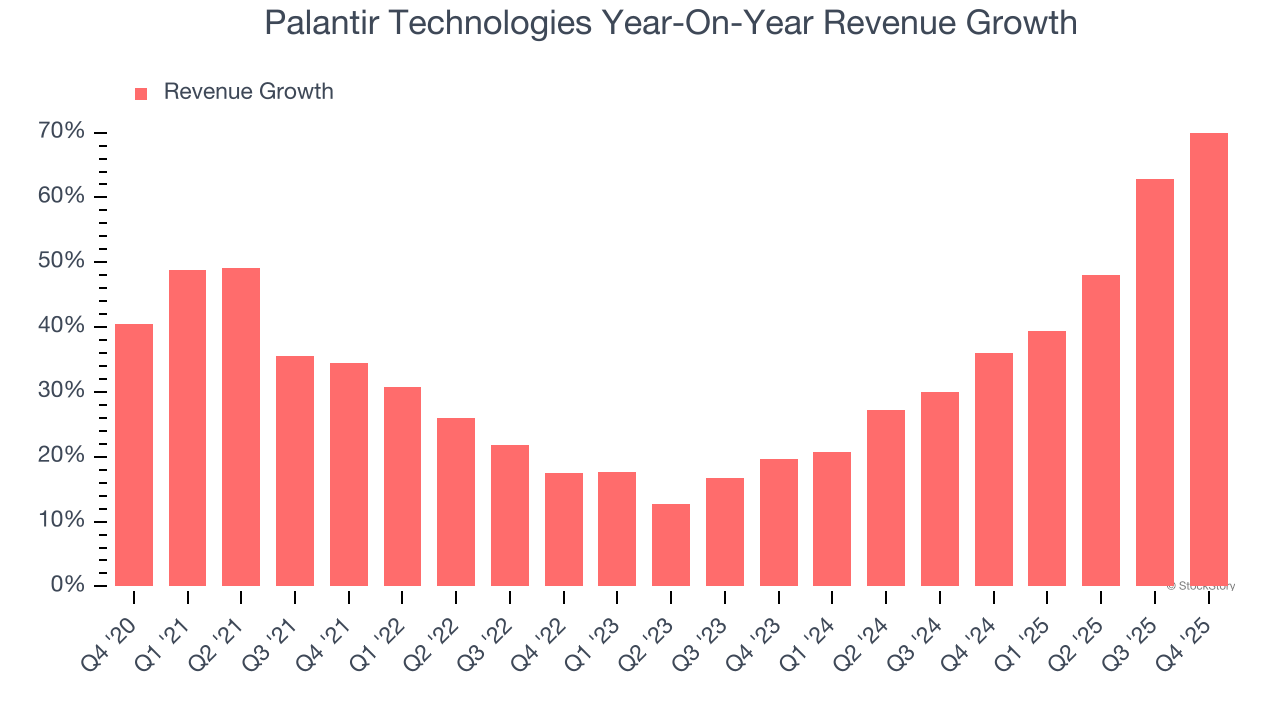
NEW YORK — In what financial analysts are already labeling a watershed moment for enterprise technology, Palantir Technologies has released its Q3 2026 financial results, obliterating consensus expectations across every major metric. The report confirms a structural acceleration in enterprise artificial intelligence adoption, spearheaded by a jaw-dropping 148% year-over-year increase in U.S. commercial revenue. Total company revenue grew by 96% year-over-year, cementing Palantir’s transition from a specialized defense contractor into the undisputed backbone of modern enterprise operations.
The stellar print has forced institutional portfolio managers, quantitative hedge funds, and Wall Street equity research desks to dramatically recalibrate their forward valuation models. With capital allocation strategies increasingly favoring infrastructure scalability and proven enterprise ROI over speculative software plays, Palantir has effectively captured the lion's share of enterprise AI infrastructure spend.
The Catalytic Engine: Dissecting the Q3 2026 Surge
Test Our Free AI & Tech Utilities Suite
Calculate LLM API token costs, analyze article dwell-time, or simulate tech DCA returns.
To understand the sheer magnitude of Palantir’s Q3 2026 performance, one must look beyond the headline numbers and examine the underlying mechanics of the company’s go-to-market strategy. The engine driving this hyper-growth is the Artificial Intelligence Platform (AIP), which has successfully moved past the proof-of-concept (POC) purgatory that has historically plagued enterprise software investments.
Historically, enterprise software vendors struggled to translate generative AI hype into tangible balance-sheet value. Palantir bypassed this friction through its proprietary ontology-driven architecture. By mapping an organization's disparate data streams, operational workflows, and software systems into a unified semantic model, AIP allows corporate leadership to deploy autonomous agents and large language models directly against mission-critical operations with rigorous risk mitigation and regulatory compliance built-in.
The speed of customer conversion has compressed dramatically. Enterprise buyers are no longer evaluating software on multi-year pilot cycles; they are demanding immediate infrastructure scalability to outpace competitors. Palantir’s "bootcamp" strategy—where prospective clients build production-ready applications in days rather than months—has proven to be an unparalleled customer acquisition funnel, directly fueling the 148% U.S. commercial expansion.
Financial Breakdown: Crushing Consensus Expectations

The consensus estimates heading into the Q3 2026 earnings call anticipated robust figures, but actual results exceeded even the most bullish sell-side projections. Total revenue acceleration to 96% Y/Y reflects not only domestic strength but a re-acceleration in international markets and continued resilience in government contracts.
Crucially, this hyper-growth has not come at the expense of fiscal discipline. Palantir’s operating leverage expanded significantly, delivering stellar free cash flow margins that underscore the high gross margins inherent in its cloud compute architecture. Management’s decision to raise FY 2026 total revenue guidance to 91% Y/Y growth—up from prior conservative estimates—signals deep visibility into backlog conversion and long-term enterprise commitments.
| Financial Metric / Indicator | Q3 2026 Actual | Y/Y Growth Rate | Consensus vs. Actual |
|---|---|---|---|
| Total Revenue | Accelerated Growth | 96% | Crushed Consensus |
| U.S. Commercial Revenue | Record Expansion | 148% | Significantly Beat Estimates |
| FY 2026 Revenue Guidance | Upward Revision | 91% | Raised Above Street High |
| U.S. Commercial FY Guidance | Aggressive Re-indexing | 143% | Massive Outperformance |
Industry & Market Implications: Winners and Losers
Palantir’s blowout quarter sends shockwaves across the broader technology and financial landscape. The implications stretch far beyond a single company's stock price, altering competitive dynamics across enterprise software, cloud hyperscalers, and Wall Street capital allocation.
Who Wins
- Enterprise Buyers Deploying AI: Companies that have integrated Palantir’s ontology are realizing immediate supply chain efficiencies, automated risk management, and reduced overhead, widening their competitive moats.
- Cloud Hyperscalers (AWS, Azure, Google Cloud): Palantir’s heavy compute requirements drive substantial underlying cloud consumption, benefiting infrastructure partners that host these massive enterprise workloads.
- Institutional Long-Only Investors: Funds with overweight positions in generational AI infrastructure winners are seeing outsized portfolio appreciation.
Who Loses
- Legacy Enterprise SaaS Vendors: Traditional software providers relying on outdated seat-based licensing models are facing existential threats as enterprise budgets are reallocated toward outcome-driven AI platforms like AIP.
- Skeptical Short Sellers: Bearish macro theses arguing that enterprise AI spending is experiencing a bubble have been severely undermined by concrete proof of high-margin monetization and enterprise retention.
Frequently Asked Questions (People Also Ask)
What drove Palantir’s massive 148% U.S. commercial revenue growth in Q3 2026?
The primary driver was the explosive, enterprise-wide adoption of Palantir’s Artificial Intelligence Platform (AIP). By utilizing immersive "bootcamps" that rapidly convert prospective clients into production-ready users, Palantir eliminated traditional sales friction and demonstrated immediate operational ROI.
How does Palantir’s ontology differ from traditional enterprise software models?
Traditional software relies on fragmented databases and seat-based pricing models. Palantir’s ontology creates a unified semantic layer connecting an enterprise's data, logic, and workflows, allowing organizations to deploy autonomous AI agents securely and efficiently across their entire operational footprint.
What is Palantir's updated financial guidance for the full year 2026?
Following its Q3 outperformance, management raised full-year 2026 revenue growth guidance to 91% Y/Y, while elevating U.S. commercial revenue growth expectations to an unprecedented 143% Y/Y.
What are the implications of these results for valuation multiples?
The results justify premium valuation multiples for Palantir, shifting institutional perception from a high-multiple growth stock to a foundational compounding utility powering the enterprise AI economy.
Future Outlook: Milestones and Strategic Horizons
As Palantir closes out fiscal 2026 with unmatched momentum, market observers will be closely tracking several critical milestones in the quarters ahead. First, institutional analysts will monitor whether the international commercial segment can match the hyper-growth velocity established by the U.S. market. Second, the rate of international defense contract expansions amid shifting geopolitical landscapes will serve as a vital indicator of sovereign adoption.
Ultimately, Palantir has transitioned from a polarizing market outlier into the definitive benchmark for enterprise software execution. As corporations worldwide scramble to operationalize artificial intelligence without compromising regulatory compliance or operational security, Palantir’s entrenched market position suggests that its current trajectory is not an anomaly, but the new operating standard for the Fortune 500.