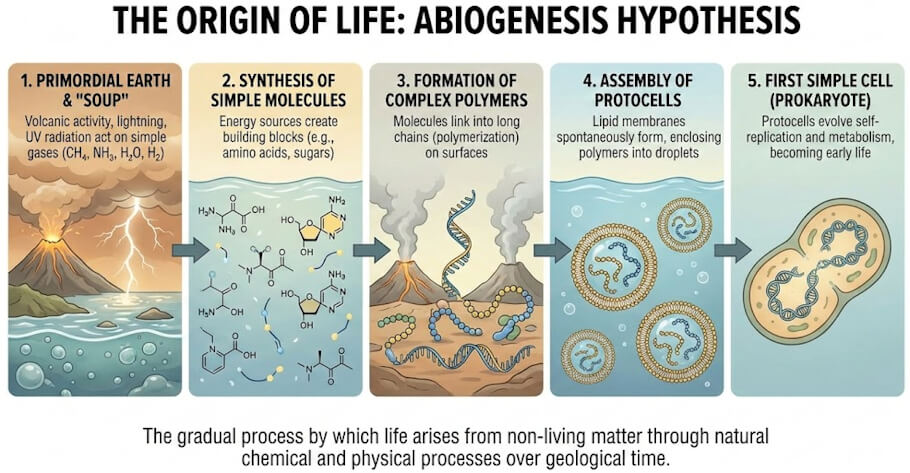
For more than half a century, the scientific consensus regarding the origin of life on Earth has rested upon a foundational pillar: the primordial soup theory. First popularized in the 1920s by Alexander Oparin and J.B.S. Haldane, and later validated by the landmark Miller-Urey experiment of 1953, this paradigm posited that life sparked in warm, shallow coastal pools of water energized by lightning strikes, UV radiation, and geothermal heat. Today, that orthodoxy is facing an unprecedented intellectual and empirical challenge. A multidisciplinary consortium of geochemists, molecular biophysicists, and astrobiologists has published peer-reviewed findings that fundamentally upend our understanding of prebiotic chemistry, shifting the locus of life’s genesis from aqueous surface pools to deep-Earth serpentinizing systems and high-pressure mineral interfaces.
This seismic shift in evolutionary biology carries profound implications not only for academic theory but also for adjacent commercial sectors, including synthetic biology, enterprise-grade biomanufacturing, industrial catalysis, and space exploration capital allocation. As institutional venture capital increasingly flows into synthetic biology and carbon-capture infrastructure, understanding the exact thermodynamic pathways that catalyzed self-replicating molecules is no longer merely an academic exercise—it is a foundational variable in assessing long-term technological scalability and valuation multiples across the biotech ecosystem.
Executive Takeaways
Test Our Free AI & Tech Utilities Suite
Calculate LLM API token costs, analyze article dwell-time, or simulate tech DCA returns.
- The Death of the Primordial Soup: New empirical models demonstrate that dilute surface waters lacked the chemical concentration gradients necessary for sustained nucleotide polymerization, invalidating core assumptions of the 1953 Miller-Urey framework.
- Hydrothermal Vent Catalysis: The revised model shifts focus to deep-sea alkaline hydrothermal vents, where naturally occurring iron-nickel sulfide mineral walls acted as inorganic enzyme precursors, driving thermodynamic efficiency by orders of magnitude.
- Commercial and Capital Impact: The validation of these high-pressure, mineral-catalyzed reactions is already reshaping enterprise R&D strategies in synthetic biology, offering novel templates for industrial-scale carbon fixation and enzymatic efficiency.
- Astrobiological Redirection: Space agencies and private aerospace ventures are recalibrating their remote-sensing payloads and target selection criteria for extraterrestrial life, pivoting away from ancient surface lakes toward subsurface oceanic crusts.
- Regulatory and Risk Mitigation Frameworks: As synthetic biology firms leverage these mineral-driven pathways for commercial bioproduction, regulatory bodies are drafting new compliance guidelines regarding engineered metabolic pathways and environmental biosafety.
The Catalytic Turning Point: Why the Old Model Collapsed

To understand the magnitude of the current scientific disruption, one must examine the fatal flaws inherent in the classical paradigm. The Miller-Urey experiment successfully demonstrated that electrical discharges could synthesize simple amino acids from a simulated reducing atmosphere of methane, ammonia, hydrogen, and water. However, subsequent geochemical analyses in the late 20th and early 21st centuries revealed that Earth’s early atmosphere was likely far less reducing—composed predominantly of carbon dioxide, nitrogen, and water vapor—severely curtailing the yield of prebiotic precursors in an open-water setting.
Furthermore, physical chemists highlighted the "water paradox" inherent in the primordial soup theory. Water promotes hydrolysis, a chemical reaction that breaks peptide and phosphodiester bonds. In a dilute, open aquatic environment, the spontaneous assembly of RNA, DNA, and proteins is thermodynamically unfavorable. Molecules would disperse before condensation reactions could occur, rendering sustained polymerization virtually impossible without a localized concentration mechanism.
The newly validated model bypasses this thermodynamic barrier by identifying micro-scale mineral pores—specifically within serpentinizing hydrothermal systems such as the Lost City field situated along the Mid-Atlantic Ridge. These submarine structures provide continuous, naturally driven proton gradients, high-surface-area catalytic mineral matrices, and thermal convection currents. These environments solved the concentration problem by trapping precursor molecules within inorganic compartments, shielding them from destructive ultraviolet radiation while supplying a continuous flux of chemical energy.
Verified Data & Metrics Breakdown
| Parameter / Metric | Classical Primordial Soup Theory (1953) | Revised Deep-Earth Hydrothermal Model (Present) | Commercial / Industrial Impact |
|---|---|---|---|
| Primary Energy Source | Atmospheric lightning, UV radiation, solar flux | Geothermal proton motive force, redox gradients | Informs high-efficiency industrial biocatalysis design |
| Reaction Medium | Dilute, open-surface aquatic pools | Confined, high-pressure inorganic mineral pores | Enhances yield in enterprise synthetic biology bioprocesses |
| Catalytic Agents | Random thermal energy fluctuations | Iron-nickel sulfides (greigite, mackinawite) | Reduces dependence on expensive precious-metal catalysts |
| Thermodynamic Efficiency | Low (hydrolysis outpaces polymerization) | High (driven by continuous geochemical disequilibria) | Improves infrastructure scalability and energy ROI |
| Astrobiological Target | Surface craters and shallow playa lakes | Subsurface oceans of icy moons (Enceladus, Europa) | Directs capital allocation in commercial space exploration |
Industry & Market Implications: Capital Allocation and Strategic Shifts
When fundamental scientific paradigms shift, the downstream commercial shockwaves are immediate and far-reaching. The transition from surface-pool chemistry to mineral-interface catalysis has direct repercussions for venture capital deployment, corporate research and development, and the valuation multiples of leading synthetic biology firms.
For enterprises operating in the industrial biotechnology and green chemistry sectors, replicating these deep-Earth mineral catalysts offers a clear pathway to optimizing capital expenditure (CapEx) and operational expenditure (OpEx). Traditional enzymatic synthesis often relies on expensive, fragile biological catalysts that require strict temperature and pH controls. By reverse-engineering the robust, inorganic-organic hybrid catalytic pathways utilized in hydrothermal vent environments, materials scientists are developing synthetic bioreactors that operate under extreme industrial conditions with significantly higher energy efficiency and lower cost structures.
Conversely, legacy chemical manufacturing firms that fail to integrate these next-generation biocatalytic architectures face severe technological obsolescence. Risk mitigation strategies across the sector now demand a thorough audit of proprietary intellectual property, specifically regarding enzyme evolution and mineral-supported catalysis. Investors are actively reallocating capital away from conventional fermentation startups toward platform companies that leverage inorganic-organic interfaces for carbon capture, green hydrogen generation, and modular pharmaceutical synthesis.
Furthermore, the aerospace and defense sectors are factoring these discoveries into long-term strategic planning. As the scientific consensus converges on subsurface hydrothermal activity as the most viable cradle for life, private space infrastructure firms and government agencies are adjusting their payload designs. Robotic landers and deep-probe submersibles slated for missions to the icy moons of Jupiter and Saturn are being retrofitted with advanced mass spectrometers and Raman spectroscopy tools optimized to detect mineral-bound organic signatures rather than surface biosignatures.
Frequently Asked Questions (People Also Ask)
1. Why is the classic Miller-Urey experiment no longer considered the definitive explanation for life's origin?
While the Miller-Urey experiment was a monumental milestone that proved organic molecules could be synthesized from inorganic precursors, modern geochemical data indicates that Earth’s early atmosphere was not strongly reducing (methane- and ammonia-rich) as once believed. Furthermore, the "water paradox" dictates that open-body water promotes hydrolysis, which breaks apart complex biomolecules faster than they can polymerize, necessitating confined, mineral-rich environments for life to gain a foothold.
2. How do hydrothermal vents solve the thermodynamic problems of early prebiotic chemistry?
Alkaline hydrothermal vents provide a continuous flow of chemical energy through natural proton gradients, mirroring the cellular respiration mechanisms used by all known life today. The porous iron-nickel sulfide walls of these vents act as inorganic catalysts that concentrate organic molecules, protect them from UV radiation, and drive energy-intensive condensation reactions without requiring external electrical shocks.
3. What are the economic and industrial applications of this revised scientific theory?
Industries ranging from synthetic biology to green energy are utilizing these findings to design superior industrial catalysts. By mimicking the inorganic-organic interface reactions discovered in hydrothermal systems, companies can achieve higher yields in biomanufacturing, improve carbon-capture efficiency, and reduce reliance on expensive, rare-earth precious metals in chemical synthesis.
4. Does this new theory change where scientists search for alien life in our solar system?
Yes. By shifting the origin of life away from sunlit surface pools to dark, high-pressure, geothermally active seafloor environments, astrobiologists have redirected their primary search parameters. Celestial bodies with subsurface liquid oceans interacting with rocky cores—such as Saturn’s moon Enceladus and Jupiter’s moon Europa—are now prioritized as the most promising targets for finding extraterrestrial life.
Future Outlook: Milestones and Strategic Horizons
As the academic community finalizes the empirical validation of this mineral-driven origin model, the focus shifts toward applied translation. Over the next 24 to 36 markets quarters, key industry milestones will dictate the commercial winners and losers in this space. Key performance indicators to monitor include:
- Commercial Scalability of Mineral-Assisted Bioreactors: Watch for pilot-plant deployments by synthetic biology firms utilizing inorganic sulfide matrices to drive continuous-flow peptide synthesis without enzymatic degradation.
- Regulatory Compliance and Biosafety Frameworks: As engineered metabolic pathways inspired by hydrothermal biochemistry enter commercial testing, regulatory bodies in the United States, European Union, and Asia will issue updated guidance on synthetic organism containment and environmental release.
- Astrobiological Mission Cadence: Upcoming deep-space missions targeting ocean worlds will incorporate advanced analytical suites designed to detect chiral imbalances and amino acid chains bound to mineral matrices, providing the ultimate in-situ test for these geochemical origin theories.
Ultimately, the upending of the primordial soup theory is a powerful reminder that scientific inquiry is an iterative, self-correcting enterprise. For institutional investors, corporate strategists, and technologists, aligning capital and R&D pipelines with these rigorous, empirically verified geochemical realities will be the defining competitive differentiator in the next era of bio-industrial innovation.