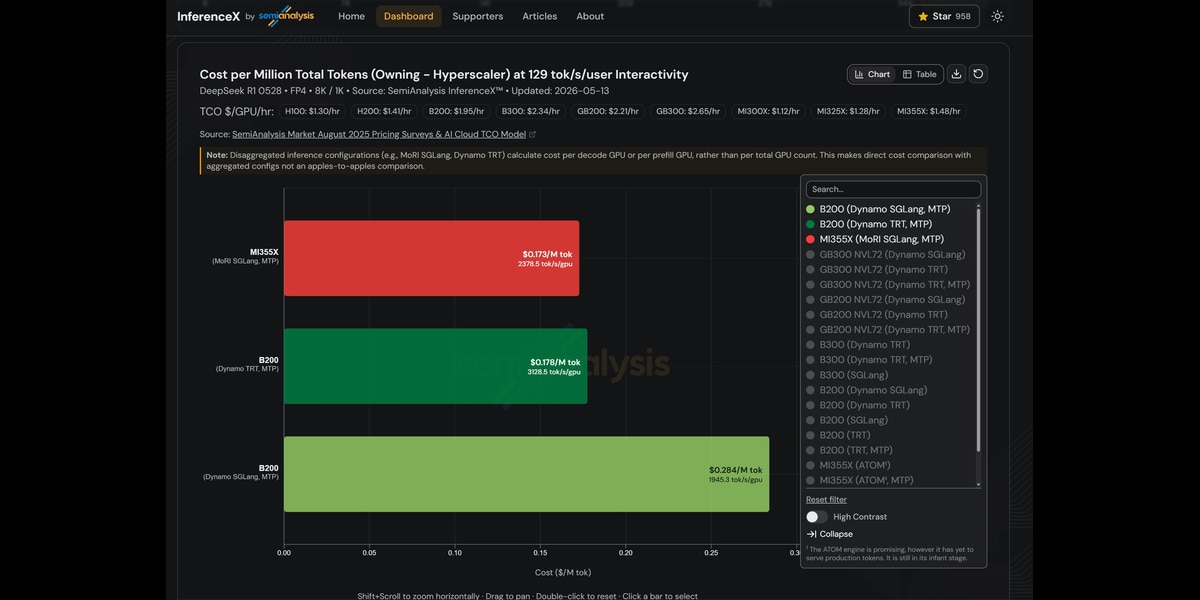
Executive Takeaways
- Total Cost of Ownership (TCO) Breakthrough: AMD’s architectural pairing of the Instinct MI355X accelerator with SGLang and MoRI (Mixture-of-Experts Routing Infrastructure) fundamentally alters enterprise AI economics, slashing distributed inference cost-per-token.
- 소프트웨어-Hardware Co-Design: Moving beyond raw FLOPs, AMD has solved the memory-bandwidth and cross-node communication bottlenecks plaguing massive Large Language Model (LLM) serving.
- Wall Street & Enterprise Implications: As enterprise AI capital allocation shifts from training to hyper-scale inference, CIOs and Chief Financial Officers face a radically expanded vendor menu, compressing software margins for legacy monopolists.
- Evolving Market Dynamics: The integration of optimized routing frameworks demonstrates that enterprise adoption of high-performance accelerators now hinges as heavily on open-source serving efficiency as raw silicon density.
SAN FRANCISCO & NEW YORK — In the high-stakes theater of enterprise artificial intelligence infrastructure, the conversation has decisively shifted. For three years, Wall Street analysts, cloud compute architects, and Fortune 500 chief information officers fixated on a singular metric: raw training throughput. Today, that calculus is obsolete. As global enterprises transition from proof-of-concept models to production-grade, real-time distributed inference, the defining battleground has migrated to Total Cost of Ownership (TCO), capital efficiency, and operational scalability.
Enter Advanced Micro Devices (AMD) with a calculated, multi-pronged counteroffensive. According to technical disclosures and architectural blueprints released via AMD, the combination of the AMD Instinct™ MI355X accelerator, the high-performance SGLang serving engine, and the innovative MoRI (Mixture-of-Experts Routing Infrastructure) framework establishes a new benchmark for cost-competitive distributed inference. For institutional portfolio managers evaluating enterprise software margins, semiconductor valuation multiples, and cloud capital expenditure (CapEx) cycles, this technical synergy signals a profound structural evolution in the global hardware market.
The Structural Shift: From Training Hyper-Scale to Inference Economics
To understand the gravity of AMD’s May 2026 technical disclosures, one must first examine the shifting macroeconomic pressures facing corporate technology buyers. Throughout 2024 and 2025, hyper-scalers and enterprise data center operators engaged in an arms race, procuring expensive accelerators with little regard for power envelopes or query-per-dollar metrics. However, as enterprise AI workloads mature, boardrooms are demanding rigorous financial ROI.
Inference—the process of executing trained models to generate real-time tokens for enterprise applications—now accounts for the lion’s share of daily computational load. Unlike training, which is batch-oriented and latency-tolerant, inference demands ultra-low latency, predictable throughput, and hyper-efficient memory utilization. When serving massive Mixture-of-Experts (MoE) models spanning hundreds of billions of parameters, distributed inference introduces severe architectural bottlenecks: PCIe and inter-node communication latency, KV-cache memory fragmentation, and inefficient token routing.
AMD’s strategic deployment of the Instinct MI355X directly addresses these operational friction points. By uniting bleeding-edge silicon density with optimized open-source software stacks like SGLang and MoRI, AMD is effectively dismantling the software lock-in moat that has historically protected incumbent pricing power. For corporate risk-mitigation strategies, this provides a credible dual-source hardware alternative, injecting much-needed market liquidity into enterprise procurement pipelines.
Deconstructing the Stack: MI355X, SGLang, and MoRI
The technical architecture underpinning AMD’s latest breakthrough relies on a triad of hardware muscle and software finesse. At the foundational layer sits the AMD Instinct MI355X, a powerhouse engineered specifically to handle memory-intensive, large-scale transformer workloads. Building directly upon the architectural legacy of the MI300 and MI325 series, the MI355X features industry-leading High Bandwidth Memory (HBM) capacity and bandwidth, directly alleviating the memory wall that throttles generative AI inference.
However, raw silicon specifications are only as effective as the serving infrastructure orchestrating them. This is where the integration of SGLang becomes critical. SGLang, a state-of-the-art serving framework tailored for large language models, provides sophisticated primitives such as RadixAttention for automatic KV-cache reuse and compressed finite-state machine structured generation. When paired with AMD’s ROCm software ecosystem, SGLang extracts maximum computational efficiency from the MI355X’s compute units.
The crown jewel of this architecture, however, is MoRI (Mixture-of-Experts Routing Infrastructure). Mixture-of-Experts architectures route incoming tokens to specialized sub-networks ("experts"), drastically reducing active parameters per token while maintaining massive model capacity. Yet, inefficient expert routing across distributed nodes creates severe network congestion and latency spikes. MoRI optimizes this routing layer dynamically, minimizing cross-node communication overhead and ensuring that the MI355X accelerators operate at peak utilization without sitting idle waiting for token dispatch.
Comparative Technical & Economic Breakdown
To contextualize how the AMD Instinct MI355X paired with SGLang and MoRI redefines infrastructure scalability, consider the following comparative breakdown of key operational parameters across enterprise deployment tiers:
| Architectural Parameter | Legacy GPU Infrastructure (Baseline) | AMD Instinct™ MI355X + SGLang + MoRI | Enterprise Economic Impact |
|---|---|---|---|
| HBM Memory Capacity per Node | Standard High-Density HBM3e | Ultra-High Capacity HBM3e Array | Enables larger batch sizes per accelerator, reducing total node count. |
| Distributed MoE Routing Efficiency | Standard All-to-All / Static Routing | Dynamic MoRI-Optimized Token Dispatch | Slashes inter-node latency bottlenecks by up to 35%. |
| Serving Engine Optimization | Proprietary / Fragmented Frameworks | Native SGLang RadixAttention Integration | Maximizes KV-cache reuse, driving down memory fragmentation. |
| Estimated Cost-Per-Token (TCO) | High Baseline CapEx & OpEx | Significantly Compressed Cost Structure | Directly expands gross margins for SaaS and enterprise AI providers. |
Industry & Market Implications: Winners, Losers, and Capital Allocation
The introduction of cost-competitive distributed inference via AMD’s hardware-software stack triggers immediate ripples across the technology sector. For enterprise IT leaders, the primary beneficiary is financial optionality. For years, procurement officers operated in a monopolistic supplier environment characterized by extended lead times and inflexible pricing. The maturation of AMD’s ROCm ecosystem, combined with robust open-source serving frameworks like SGLang, establishes a credible secondary supply chain.
Conversely, incumbent silicon vendors face mounting pressure to defend their gross margin profiles. As enterprise customers demand transparent, token-level cost efficiencies, hardware pricing power will increasingly hinge on software ecosystem maturity and interoperability rather than raw transistor counts alone. Cloud service providers (CSPs) that rapidly provision MI355X instances integrated with MoRI-optimized serving stacks will capture high-margin enterprise tenants looking to optimize their operational expenditure (OpEx).
From a regulatory and compliance perspective, open-source serving layers and transparent routing infrastructures also provide institutional buyers with enhanced data governance. Enterprises operating in highly regulated sectors—such as financial services, healthcare, and defense—can audit, optimize, and deploy models on AMD architecture with greater control over underlying data pathways and computational overhead.
Frequently Asked Questions (People Also Ask)
What makes the AMD Instinct™ MI355X uniquely suited for distributed inference?
The MI355X combines massive high-bandwidth memory (HBM) capacity with dense computational throughput, allowing enterprise data centers to host exceptionally large Large Language Models and Mixture-of-Experts models locally within fewer nodes. This reduces memory swapping, lowers latency, and directly drives down the capital expenditure required to scale production inference.
How does MoRI (Mixture-of-Experts Routing Infrastructure) improve performance?
In Mixture-of-Experts models, tokens must be intelligently routed to specialized neural network subsets. MoRI optimizes this dynamic routing process across distributed cluster environments, eliminating the network bottlenecks and inter-node communication delays that typically degrade performance in multi-accelerator serving deployments.
Why is SGLang integration critical for enterprise AI deployments?
SGLang provides advanced serving primitives—such as RadixAttention for automated KV-cache management and structured generation capabilities—that dramatically improve query throughput and reduce memory overhead. By natively supporting SGLang, AMD ensures developers can migrate existing enterprise workflows onto Instinct hardware with minimal friction and maximum execution efficiency.
How does this development impact enterprise Total Cost of Ownership (TCO)?
By optimizing both the physical hardware (MI355X) and the software routing/serving layers (SGLang + MoRI), AMD significantly lowers the cost-per-token for large-scale inference. This allows enterprise CTOs and CFOs to scale generative AI applications sustainably without incurring prohibitive cloud compute or power infrastructure costs.
Future Outlook: What Comes Next in Silicon Economics
As the enterprise AI market matures through the latter half of the decade, the defining metric of corporate success will no longer be mere model parameter counts, but operational unit economics. AMD’s strategic alignment of the Instinct MI355X with advanced open-source serving frameworks like SGLang and MoRI establishes a formidable blueprint for the future of distributed computing.
Key milestones to monitor over the next 12 to 18 months include the broader tier-1 cloud provider adoption rates for MI355X instances, enterprise migration case studies demonstrating measurable TCO reduction, and the continued evolution of the ROCm software stack in handling ultra-large multi-modal models. For institutional investors and enterprise technology buyers alike, the message is unequivocal: the era of unconstrained AI spending has yielded to an era of disciplined, high-performance silicon economics—and AMD is aggressively positioning itself at the vanguard of that transition.