Executive Takeaways
Test Our Free AI & Tech Utilities Suite
Calculate LLM API token costs, analyze article dwell-time, or simulate tech DCA returns.
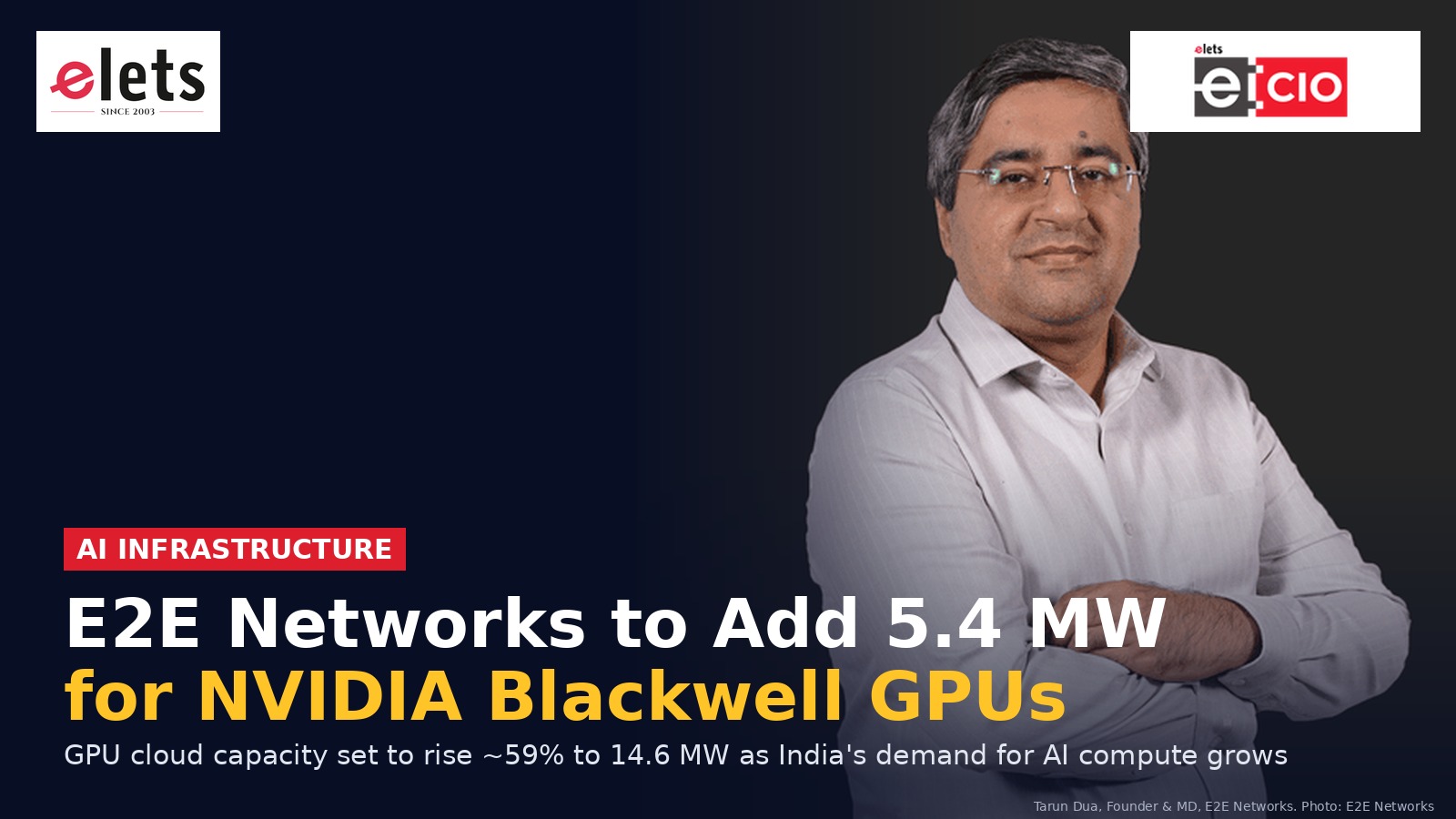
- Capacity Surge: E2E Networks has officially announced an expansion of 5.4 Megawatts (MW) of dedicated NVIDIA Blackwell GPU infrastructure, bringing its total operational AI-centric datacenter capacity from 9.2 MW to 14.6 MW—a massive 58.7% capacity jump.
- Architectural Paradigm Shift: The deployment transitions E2E’s cloud compute architecture into high-density liquid-cooled environments capable of supporting power draws in excess of 100 kW per rack, setting a new benchmark for hyper-dense infrastructure in emerging markets.
- Strategic Enterprise Positioning: By securing priority access to NVIDIA’s next-generation Blackwell architecture (GB200/B200 systems), E2E Networks directly challenges global public cloud hyperscalers across South Asia, capturing critical market share in sovereign AI training and low-latency enterprise inferencing.
- Capital Allocation & Valuation Dynamics: This multi-million-dollar capital expenditure program enhances E2E's long-term enterprise Return on Invested Capital (ROIC) while driving structural re-ratings in its equity valuation multiples, reflecting a shift from standard web hosting to high-margin accelerated cloud compute.
The Catalytic Event: Scaling Sovereign Accelerated Compute
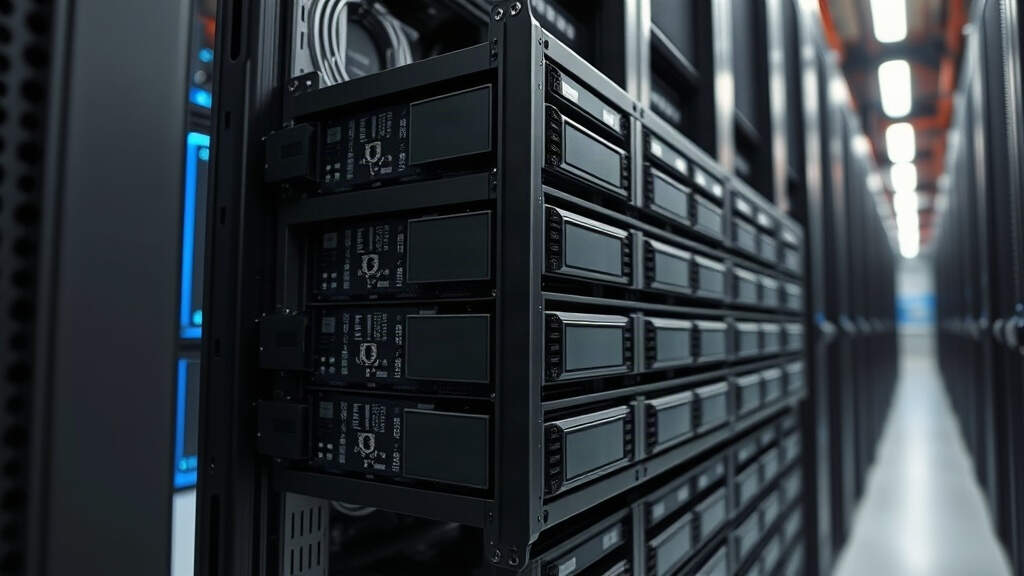
In a watershed moment for sovereign cloud compute architecture, Indian cloud infrastructure pioneer E2E Networks (NSE: E2E) has committed to adding 5.4 Megawatts (MW) of cutting-edge NVIDIA Blackwell GPU capacity. The expansion, revealed in industry filings, pushes the firm's total dedicated artificial intelligence footprint to an impressive 14.6 MW. This high-capital strategy highlights the escalating race to build regional compute clusters that can handle large language model (LLM) training and complex generative AI inference workloads without relying solely on Western public cloud monoliths.
The addition of 5.4 MW dedicated exclusively to NVIDIA’s latest Blackwell platform represents much more than a routine capacity upgrade. It marks a fundamental pivot in high-performance computing (HPC) deployment models across South Asia. As global demand for AI compute outstrips silicon supply, cloud infrastructure providers are forced to balance aggressive capital allocation against technical execution risks. E2E Networks' strategic alignment with NVIDIA ensures early-mover access to the world’s most sought-after silicon, effectively repositioning the company from a domestic cloud vendor into a high-tier global compute provider.
From an operational perspective, integrating 5.4 MW of Blackwell chips requires complete re-engineering of traditional datacenter facilities. Blackwell’s underlying architecture—engineered for trillion-parameter scale models—demands unprecedented energy densities, ultra-fast networking interconnects, and advanced liquid cooling topologies. By committing to this buildout, E2E Networks is establishing a sovereign compute reserve that caters directly to local technology giants, high-growth startups, and government-backed AI research initiatives seeking data localization and cost-effective compute performance.
Deconstructing the Architecture: The Engineering of 5.4 MW of Blackwell Silicon
To understand the magnitude of E2E Networks' expansion, one must evaluate the raw physical and computational metrics of the NVIDIA Blackwell platform. Unlike previous GPU generations, such as the Hopper (H100/H200) series, the Blackwell architecture (including the B200 and GB200 NVL72 rack-scale systems) operates at power consumption thresholds that challenge legacy datacenter capabilities. A single GB200 NVL72 cabinet can consume up to 120 kW of continuous electrical power, generating massive thermal loads that make standard forced-air cooling completely obsolete.
Integrating 5.4 MW of Blackwell capacity implies a systematic migration to Direct-to-Chip (D2C) liquid cooling infrastructure. Water-to-coolant heat exchangers, closed-loop fluid circulation, and specialized facility water loops are required to maintain operating temperatures across thousands of tightly packed GPU dies. This shift drastically alters the facility's Power Usage Effectiveness (PUE) target, allowing E2E to achieve operational PUE ratios below 1.25 despite the intense power density. Such physical scaling optimizes long-term operational expenditure (OpEx), directly improving EBITDA margins per megawatt of active compute.
Technical Infrastructure Metric Breakdown
| Infrastructure Metric | Pre-Expansion Baseline | Post-Expansion Architecture | Delta / Strategic Shift |
|---|---|---|---|
| Total AI Power Allocation | 9.2 Megawatts (MW) | 14.6 Megawatts (MW) | +58.7% Capacity Increase |
| Primary GPU Architecture | NVIDIA Hopper (H100/H200) / Ampere | NVIDIA Blackwell (B200/GB200 Ecosystem) | Next-Gen Architecture Acceleration |
| Rack Power Density Limits | 30 kW – 40 kW per rack | 80 kW – 120+ kW per rack | 3x Density Threshold Scaling |
| Cooling Methodology | Hybrid Air / In-Row Precision Cooling | Direct-to-Chip (D2C) Liquid Cooling | Lower Facilities PUE (< 1.25 Target) |
| Interconnect Infrastructure | InfiniBand Quantum-2 (400Gb/s) | NVLink 5 (1.8TB/s) + Quantum-X800 | Massively Reduced Cross-Node Latency |
| Target Workload Envelope | Mid-Scale LLM Fine-Tuning & Inference | Trillion-Parameter Foundation Model Training | Tier-1 Enterprise Sovereign Compute |
Furthermore, the high throughput of these multi-megawatt Blackwell clusters relies on advanced networking fabrics. Operating at 1.8 TB/s of bidirectional bandwidth per GPU via fifth-generation NVLink interfaces, combined with NVIDIA Quantum-X800 InfiniBand networking, E2E's cluster eliminates multi-node communication bottlenecks. For enterprise clients training multi-modal foundation models, this translates directly to reduced training duration, lower overall job failure rates, and maximized return on enterprise AI investment.
Capital Allocation, Financial Engineering, and Market Valuation Dynamics
From an enterprise capital management perspective, deploying 5.4 MW of Blackwell architecture represents a highly strategic asset placement. Megawatt-scale GPU compute deployments require significant upfront capital outlays for hardware acquisition, mechanical/electrical/plumbing (MEP) infrastructure, and high-voltage grid upgrades. However, the unit economics of accelerated cloud computing yield significantly higher revenue realization per square foot compared to standard bare-metal or CPU-based cloud environments.
In terms of equity market dynamics, investors increasingly view cloud infrastructure providers through the lens of EV/EBITDA multiples and revenue yields per megawatt. Standard datacenter colocation yields fixed, long-term contractual revenues with moderate gross margins. In contrast, cloud providers offering fully managed, specialized GPU instances command premium pricing, achieving gross margins that often exceed 60% when capacity utilization remains above 85%.
E2E Networks’ targeted expansion signals to capital markets that it is successfully transitioning its business mix toward high-margin enterprise AI services. By securing early Blackwell allocation, the company enhances its enterprise valuation multiples, securing higher pricing power relative to generic compute hosting. Additionally, localized sovereign compute pricing offers a compelling value proposition to enterprise customers: reduced exposure to foreign currency fluctuations (such as foreign-exchange volatility when paying USD-denominated public cloud invoices) and optimized Total Cost of Ownership (TCO) for regional enterprise deployments.
Industry & Market Implications: Who Wins and Who Loses?
The arrival of 5.4 MW of NVIDIA Blackwell capacity in regional markets alters the competitive landscape for public cloud providers, enterprise IT departments, and sovereign AI initiatives alike.
The Winners:
- Regional Enterprise & AI Startups: Local developers gain access to cutting-edge AI infrastructure at localized pricing structures, bypassing international latency pipelines and foreign exchange risks.
- E2E Networks Shareholders: The firm secures a high-margin revenue runway, cementing its position as a key partner in NVIDIA’s sovereign cloud partner ecosystem and improving long-term earnings per share (EPS) visibility.
- Data Localization & Regulatory Compliance Advocates: Enterprises subject to strict regulatory regimes—such as financial institutions, health networks, and government agencies—can now run heavy compute operations locally without violating data sovereignty statutes (such as India’s DPDP Act).
The Losers / Entities at Risk:
- Legacy Tier-3 Datacenter Operators: Datacenters incapable of supporting high-density liquid cooling setups risk accelerated obsolescence as high-value enterprise workloads migrate to specialized AI-ready facilities.
- Traditional Systems Integrators & IT Distributors: Legacy IT vendors relying on slow, physical server integration sales face shrinking market share as enterprise clients pivot toward flexible, cloud-native GPU instances.
- High-Cost Global Public Cloud Hyperscalers: Incumbents charging high egress fees and premium USD-based compute rates face churn as regional enterprises migrate baseline training workloads to cost-efficient sovereign cloud alternatives.
Frequently Asked Questions (People Also Ask)
1. What is the significance of E2E Networks adding 5.4 MW of NVIDIA Blackwell capacity?
The addition of 5.4 MW dedicated to NVIDIA’s Blackwell architecture increases E2E Networks' total AI infrastructure capacity by 58.7%, bringing it to 14.6 MW. This expansion grants regional enterprises, researchers, and tech firms early access to next-generation AI hardware optimized for training multi-trillion parameter foundation models locally, boosting data sovereignty and reducing latency.
2. How does NVIDIA Blackwell differ technically from previous GPU architectures in cloud datacenters?
NVIDIA Blackwell GPUs (such as the B200 and GB200 series) deliver up to 30x faster inference performance and significantly higher energy efficiency compared to the previous Hopper architecture. However, they operate at extreme power densities—often exceeding 100 kW per server rack—requiring datacenters to implement Direct-to-Chip (D2C) liquid cooling rather than traditional air cooling systems.
3. How does this infrastructure expansion impact E2E Networks' enterprise ROI and market valuation?
Deploying specialized, high-demand Blackwell clusters enables E2E Networks to capture premium compute rates and generate higher revenue per megawatt. This shift toward high-margin accelerated cloud compute improves its enterprise Return on Invested Capital (ROIC) and supports higher valuation multiples compared to legacy hosting and colocation providers.
4. Why is sovereign cloud compute crucial for modern enterprise AI strategies?
Sovereign cloud compute ensures that sensitive corporate data, healthcare records, and national datasets are trained and processed within local geographic and legal boundaries. This mitigates geopolitical supply chain risks, ensures full compliance with local data protection regulations, and protects organizations from global FX risk associated with USD-billed public cloud services.
Future Outlook: Strategic Milestones and Execution Risks
Looking ahead over the next 12 to 24 months, the successful operational execution of E2E Networks' 5.4 MW expansion will serve as a key industry benchmark. Key milestones to monitor include the physical deployment timeline of the liquid-cooled facility systems, grid interconnection schedules, and the pre-commitment booking rate among enterprise AI customers. As the global AI race shifts focus from basic model training to deep real-time inferencing across global supply chains, secure access to high-density, low-latency compute will dictate commercial success.
However, risk mitigation remains essential. Key challenges include managing potential power grid constraints, maintaining high hardware utilization rates to offset capital amortization, and retaining specialized site reliability engineering talent capable of maintaining complex liquid-cooled systems. If E2E Networks effectively executes this expansion, it will solidify its standing as a core infrastructure pillar in the global AI supply chain, establishing a sustainable blueprint for sovereign, high-density cloud computing.