WASHINGTON & REDMOND, Wash. — The temporal compression of digital warfare reached a critical inflection point today. As cyber adversaries increasingly weaponize generative algorithms to automate reconnaissance, craft hyper-personalized phishing campaigns, and execute zero-day exploit chains in milliseconds, human-led security operations centers (SOCs) are facing an existential bottleneck. Traditional security information and event management (SIEM) tools, while robust for historical analysis, are proving fundamentally too slow to counter modern, machine-speed incursions.
Into this escalating arms race steps a major strategic realignment from enterprise software titan Microsoft. On May 12, 2026, the company officially unveiled its new multi-model agentic security system, helmed by Taesoo Kim, Vice President of Agentic Security. According to benchmark disclosures released concurrently with the announcement, Microsoft’s proprietary architecture has decisively topped the industry's most rigorous adversarial evaluation frameworks. For enterprise boards, Chief Information Security Officers (CISOs), and institutional investors, this deployment signals a profound structural shift: the transition from reactive, human-tethered defense mechanisms to proactive, autonomous cybernetic triage.
Executive Takeaways
- Autonomous Multi-Model Architecture: Led by VP Taesoo Kim, Microsoft’s new system coordinates multiple specialized AI models to reason, hunt, and remediate threats simultaneously at machine speed.
- Benchmark Dominance: The agentic framework has shattered previous ceilings, securing the top position on leading industry security benchmarks published on May 12, 2026.
- Macro Enterprise ROI: Designed to radically compress Mean Time to Detect (MTTD) and Mean Time to Respond (MTTR), directly mitigating massive downstream financial liabilities from enterprise data breaches.
- Strategic Competitive Dynamics: Arriving amid a hyper-competitive landscape—punctuated by concurrent industry shifts such as the May 15, 2026 retirement of competing LLM instances like Grok—this launch fortifies Microsoft’s cloud-compute and security valuation multiples.
The Catalytic Shift: Why Traditional SOCs Are Reaching Their Breaking Point
Test Our Free AI & Tech Utilities Suite
Calculate LLM API token costs, analyze article dwell-time, or simulate tech DCA returns.
To understand the profound significance of Microsoft’s agentic security breakthrough, one must examine the macro-economic and technical realities currently punishing global enterprise security budgets. Modern cloud compute architecture has rendered legacy perimeters obsolete. With remote workforces, multi-cloud deployments, and sprawling IoT ecosystems, the corporate attack surface has expanded exponentially.
Concurrently, cybercriminal syndicates and state-sponsored APT (Advanced Persistent Threat) groups have industrialized artificial intelligence. They no longer rely solely on human operators to scan networks, discover misconfigurations, or write malicious payloads. Autonomous malware strains and LLM-assisted social engineering can now pivot through corporate networks within minutes of initial compromise. Against this velocity, human security analysts are overwhelmed by alert fatigue, false positives, and the sheer volume of telemetry generated by enterprise networks.
Taesoo Kim and his engineering teams at Microsoft recognized that solving this dilemma required moving beyond simple copilot models that merely suggest remediation steps to human operators. True defense at AI speed demands agentic workflows—systems capable of autonomous reasoning, hypothesis generation, tool invocation, and recursive problem-solving without mandatory human intervention at every microscopic decision node.
Deconstructing the Multi-Model Agentic Security Framework
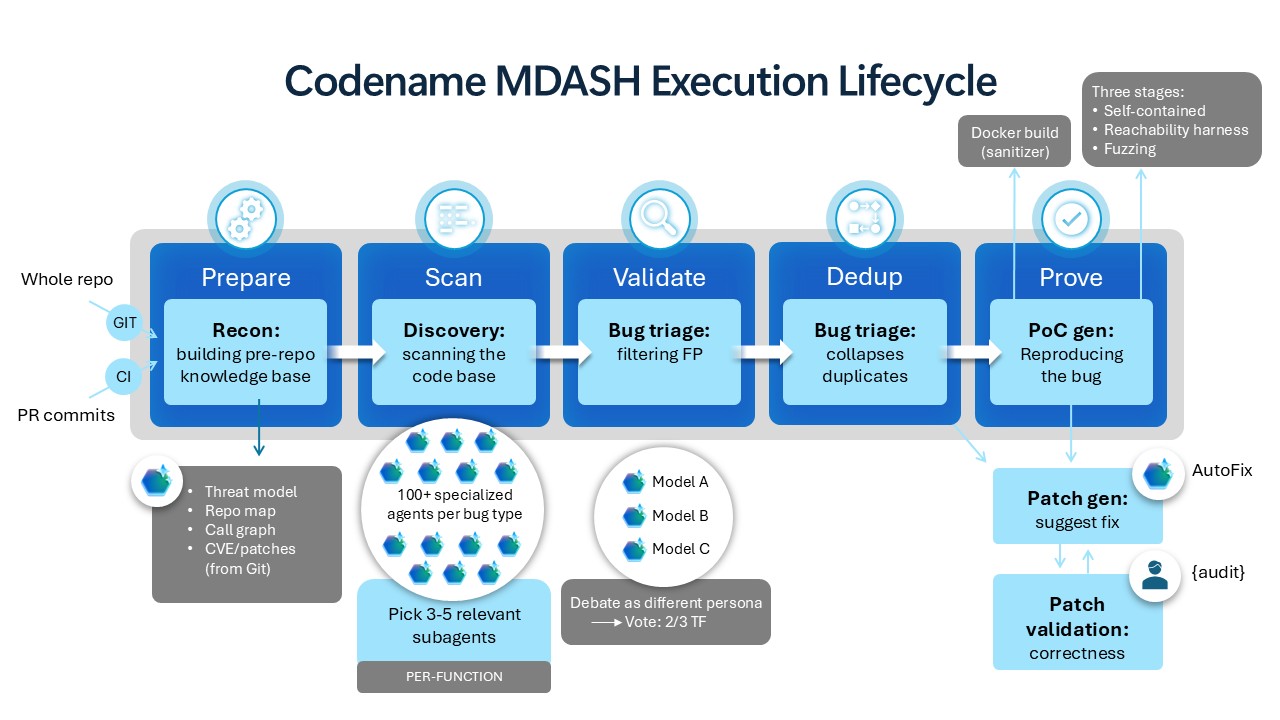
Microsoft’s newly unveiled system breaks away from monolithic AI security applications by deploying a collaborative orchestra of specialized models. In this multi-model paradigm, distinct neural networks are assigned granular operational roles:
- The Orchestrator Model: Acts as the cognitive core, continuously ingesting telemetry streams from Azure Sentinel, Microsoft Defender, and third-party security telemetry to maintain a unified situational graph.
- The Specialist Threat Hunters: Trained explicitly on historical adversary tactics, techniques, and procedures (TTPs), these localized models proactively scan deep memory and endpoint logs for anomalous behavioral anomalies.
- The Verification & Safety Enclave: A deterministic validation layer that cross-references proposed automated containment actions against corporate compliance frameworks, zero-trust policies, and operational continuity protocols before executing remediation.
By decoupling these tasks across a distributed multi-model framework, Microsoft has successfully mitigated the hallucination risks that traditionally plague single large language models deployed in high-stakes operational environments. When tested against standardized adversarial simulation suites, this agentic architecture demonstrated an unprecedented capability to intercept multi-stage cyber attacks before lateral movement could be established.
Verified Data & Technical Metrics Breakdown
Rigorous third-party evaluation is the gold standard for enterprise software adoption. The following matrix outlines the core performance metrics, operational timelines, and foundational architectural pillars associated with Microsoft’s May 2026 security rollout.
| Metric / Parameter | Legacy SOC Paradigm | Microsoft Agentic Security System |
|---|---|---|
| Announcement Date | Historical baseline (Pre-2026) | May 12, 2026 |
| Leadership | Human-led analyst teams | Taesoo Kim, VP Agentic Security |
| Benchmark Performance | Variable / High alert fatigue | Top-ranked across leading industry benchmarks |
| Operational Speed | Minutes to hours (MTTR bottleneck) | Milliseconds to seconds (Machine speed) |
| Model Architecture | Single-purpose heuristics / Static rules | Collaborative multi-model agentic framework |
Industry & Market Implications: Capital Allocation and Competitive Landscape
The commercial ramifications of Microsoft’s technological leap extend far beyond technical cybersecurity metrics. In the enterprise software sector, security has transitioned from an operational expense (OpEx) line item to a core driver of corporate valuation and market liquidity. Enterprises suffering catastrophic data breaches face immediate equity sell-offs, regulatory fines, and permanent brand erosion.
By integrating autonomous agentic security natively into its cloud and enterprise productivity ecosystem, Microsoft is fundamentally altering the competitive dynamics against pure-play cybersecurity vendors and cloud rivals like Amazon Web Services (AWS) and Google Cloud Platform (GCP). For corporate boards evaluating IT spend, the promise of reducing operational expenditure associated with ballooning SOC staffing costs—while simultaneously decreasing risk exposure—provides a compelling enterprise ROI thesis.
Furthermore, this release arrives during a period of intense volatility across the broader generative AI ecosystem. Notably, industry adjustments—such as the scheduled retirement of competing language models like Grok on May 15, 2026—highlight the rapid consolidation occurring within the artificial intelligence market. As weaker or less scalable model architectures are pruned from the market, enterprise buyers are consolidating their capital allocation around heavily capitalized platform providers capable of delivering proven, audited, and benchmark-leading reliability.
Frequently Asked Questions (People Also Ask)
Frequently Asked Questions
What is a multi-model agentic security system?
Unlike traditional single AI models or static scripts, a multi-model agentic security system employs a cooperative network of specialized artificial intelligence models. These models possess autonomous reasoning capabilities ("agency") to investigate, hypothesize, and execute threat remediation workflows across enterprise infrastructure without constant human prompting.
How does Microsoft’s new system impact enterprise ROI and security budgets?
By dramatically compressing Mean Time to Detect (MTTD) and Mean Time to Respond (MTTR), the system reduces the human hours required for routine incident triage. This mitigates severe financial liabilities associated with data breaches and optimizes labor allocation within corporate Security Operations Centers (SOCs).
What benchmarks did Microsoft top, and why do they matter?
Microsoft’s agentic security framework achieved the top ranking on leading industry adversarial evaluation benchmarks as of May 12, 2026. These benchmarks simulate complex, multi-stage cyberattacks, providing enterprise CISOs with objective proof of system efficacy against sophisticated threat actors.
How does this announcement align with broader tech market trends in May 2026?
The launch coincides with broader market consolidation—exemplified by shifts like the May 15, 2026 Grok model retirement—underscoring a flight to quality. Enterprise buyers are increasingly favoring fully integrated, hyper-scale cloud security ecosystems backed by verified performance metrics over experimental AI deployments.
Future Outlook: What Comes Next in Autonomous Defense
As Microsoft rolls out its multi-model agentic security infrastructure to global enterprise clients throughout the remainder of 2026, industry observers will be monitoring several critical performance milestones. Primary among these is the rate of false-positive reduction under live enterprise workloads and the seamlessness of integration with non-Microsoft cloud environments.
The broader trajectory is unmistakable. The era of manual, dashboard-bound cybersecurity is drawing to a close. With adversaries deploying autonomous agents to probe digital defenses, the survival of modern enterprise architecture depends entirely on matching machine speed with machine intelligence. By setting the benchmark standard on May 12, 2026, Microsoft has firmly established that the future of defense belongs not to faster humans, but to synchronized artificial agents operating with rigorous governance and absolute autonomy.