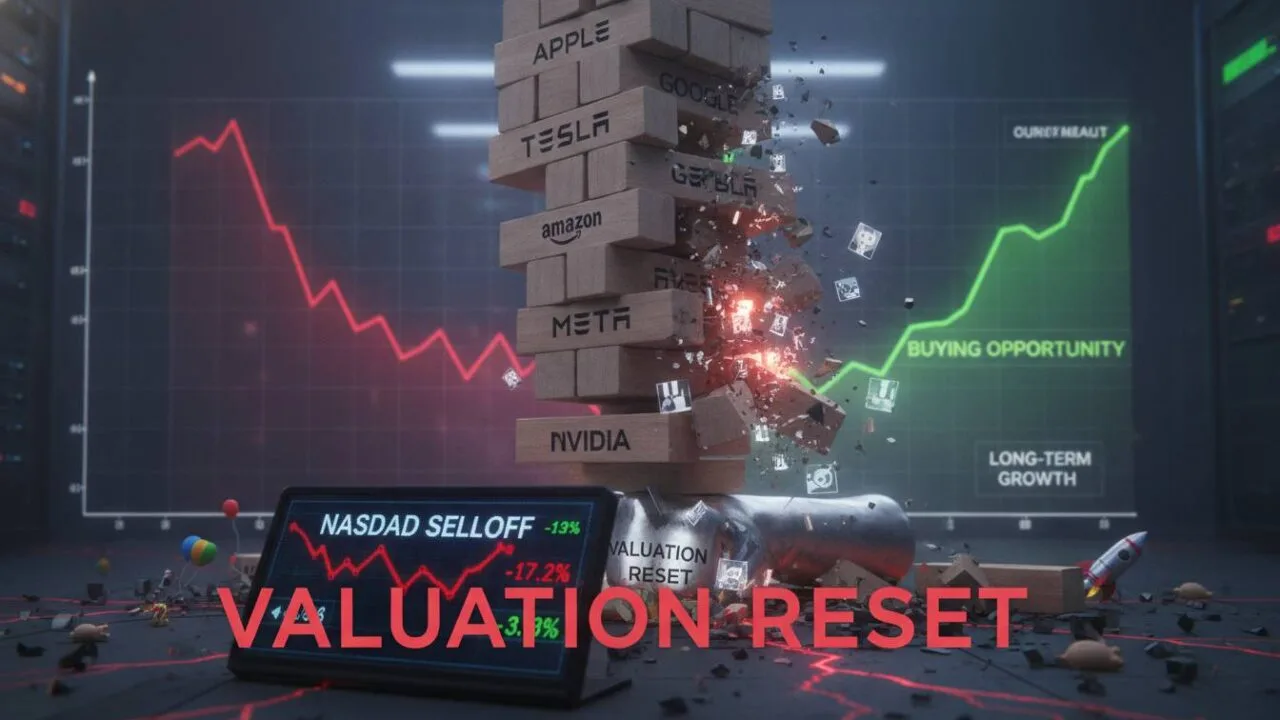
NEW YORK — Wall Street closed out the final trading session of October 2026 nursing deep wounds. A relentless, multi-week liquidation wave across the artificial intelligence sector, semiconductor fabrication plants, and hyper-scaler cloud infrastructure providers culminated in a brutal Friday session. The Nasdaq Composite plummeted, confirming its worst monthly performance since early 2025. What began as a routine portfolio rebalancing at the end of Q3 metastasized into a structural repricing of risk, erasing trillions in market capitalization and forcing institutional allocators to aggressively rethink their capital allocation strategies.
As the closing bell rang on October 30, 2026, senior desks across Lower Manhattan and Mayfair were left dissecting a market environment defined by compressed valuation multiples, surging Treasury yields, and escalating anxieties over enterprise return on investment (ROI). For two years, Wall Street bulls championed the unstoppable momentum of generative AI and cloud compute architecture. Today, that narrative has fractured under the weight of mounting capital expenditure obligations and diminishing near-term revenue visibility.
Executive Takeaways
Test Our Free AI & Tech Utilities Suite
Calculate LLM API token costs, analyze article dwell-time, or simulate tech DCA returns.
- The Worst Month Since 2025: The Nasdaq Composite suffered its steepest monthly decline in over a year, driven by systemic liquidations in mega-cap technology equities and semiconductor leaders.
- The Enterprise ROI Reckoning: Wall Street investors are increasingly punishing corporations that fail to demonstrate immediate, tangible monetization from multi-billion-dollar infrastructure scalability initiatives.
- Valuation Multiples Compression: Forward price-to-earnings (P/E) ratios for elite tech stocks contracted sharply as risk-free yields remained stubbornly elevated, altering long-term risk mitigation models.
- Liquidity Rotation: Institutional capital is actively rotating out of high-beta growth assets and repositioning into defensive sectors, fixed income, and cash-equivalent instruments.
The Catalysts Behind the October Collapse

To understand the anatomy of the October 2026 tech selloff, one must examine the macroeconomic crosscurrents that converged over the past four weeks. Throughout the summer, equity markets traded near all-time highs, propelled by the assumption that central banks would rapidly ease monetary policy. However, sticky inflation prints and resilient employment data through September and October forced the Federal Reserve to signal a more prolonged restrictive stance.
This higher-for-longer interest rate environment fundamentally altered the discount rates applied to future cash flows. High-growth technology companies—whose valuations are heavily predicated on earnings projected far into the future—bore the brunt of the adjustment. As risk-free yields on 10-year and 30-year U.S. Treasury bonds hovered near cyclical peaks, institutional risk mitigation frameworks mandated a reduction in duration risk.
Simultaneously, fundamental cracks began to appear within the tech sector itself. During the late-October corporate earnings cycle, several bellwether cloud providers and enterprise software giants reported record capital expenditures directed toward data center buildouts and advanced silicon procurement. While management teams defended these outlays as essential for maintaining competitive moats in machine learning, institutional shareholders grew increasingly impatient regarding enterprise ROI.
"We are witnessing the end of the blind accumulation phase," says a senior portfolio manager at a global asset management firm overseeing $450 billion in equities. "For three years, the market rewarded any management team that uttered the letters 'A' and 'I' in the same sentence. Today, risk committees are demanding to see concrete margin expansion and accelerated payback periods. The era of funding speculative infrastructure without near-term monetization is over."
The Mechanics of the Liquidation Wave
The speed and ferocity of the October selloff were exacerbated by market structure and derivatives positioning. As key technical support levels on the Nasdaq were breached midway through the month, systematic trend-following strategies, commodity trading advisors (CTAs), and volatility-target funds were forced into mechanical deleveraging.
Options market dynamics further amplified the downside momentum. Heavy open interest in short-dated out-of-the-money puts created a hedging cascade, as market makers selling those options had to aggressively short underlying equities to maintain delta neutrality. This feedback loop turned routine profit-taking into acute intraday liquidity vacuums, particularly during the final hours of trading sessions.
Semiconductor stocks, which served as the vanguard of the 2023–2025 bull run, experienced some of the most volatile swings. Fabless chip designers and equipment manufacturers saw their market valuations battered as supply chain audits revealed potential inventory digestion phases heading into 2027. Investors grew anxious that fab capacity commitments made during peak demand periods might outpace actual end-market absorption, threatening cyclical earnings contractions.
Verified Data & Metrics Breakdown
| Market Index / Asset Class | October 2026 Performance | Trailing 12-Month High | Primary Driver of Movement |
|---|---|---|---|
| Nasdaq Composite | -7.8% (Worst month since early 2025) | Reached in July 2026 | Multi-sector tech liquidation, multiple compression |
| S&P 500 Information Technology | -8.4% | Reached in August 2026 | Enterprise ROI skepticism, high capex concerns |
| PHLX Semiconductor Sector (SOX) | -11.2% | Reached in June 2026 | Inventory normalization fears, hardware spending pause |
| U.S. 10-Year Treasury Yield | Closed at 4.48% | 4.55% (Intra-month peak) | Persistent inflation data, hawkish monetary outlook |
Industry & Market Implications: Winners and Losers
Every major market dislocation creates structural winners and losers, and the October 2026 tech correction is no exception. As capital vacates high-flying growth equities, asset allocators are executing aggressive sector rotation models.
The Losers: High-Beta Growth & Speculative Software
Unprofitable biotechnology firms, early-stage enterprise software-as-a-service (SaaS) providers lacking free cash flow, and hardware suppliers heavily dependent on discretionary consumer upgrade cycles have faced severe capital flight. Without immediate pathways to profitability, these firms find equity financing windows effectively closed, forcing them to rely on dilutive debt financing or emergency cost-cutting measures.
The Winners: Defensive Yield, Energy Infrastructure, and Cash Alternatives
Conversely, capital has found refuge in defensive sectors such as healthcare, consumer staples, and regulated utilities. Furthermore, traditional energy infrastructure providers catering to the power demands of next-generation data centers have demonstrated relative resilience. While pure-play software developers sold off, industrial conglomerates with diversified cash flows and strong balance sheets outperformed the broader market.
Moreover, institutional liquidity has increasingly gravitated toward ultra-short-duration fixed income and money market funds yielding nearly 4.5%. This risk-free yield provides a formidable hurdle rate that growth stocks must clear to justify equity ownership.
Frequently Asked Questions (People Also Ask)
What caused the sharp decline in technology stocks in October 2026?
The October selloff was triggered by a combination of persistent macroeconomic headwinds, including higher-for-longer interest rates set by the Federal Reserve, combined with growing skepticism among institutional investors regarding the short-term enterprise ROI of massive artificial intelligence and cloud infrastructure capital expenditures.
How does the current market correction impact semiconductor manufacturers?
Semiconductor stocks experienced outsized volatility due to concerns over inventory digestion, supply chain normalization, and questions surrounding whether aggressive fab capacity investments will match future demand as corporate IT budgets face tighter scrutiny.
Are institutional investors abandoning technology stocks permanently?
No. Institutional allocators are not abandoning technology, but rather pivoting from passive momentum buying to disciplined, selective fundamental analysis. Companies with robust balance sheets, undeniable pricing power, and proven free cash flow conversion continue to attract strategic accumulation.
What role did interest rates play in the tech sector's worst month in over a year?
Elevated U.S. Treasury yields increased the discount rate applied to future corporate cash flows. Because technology valuations rely heavily on long-term earnings projections, higher risk-free yields mechanically compressed forward valuation multiples across the entire sector.
Future Outlook & Key Milestones to Watch
As Wall Street looks past October and navigates the final two months of 2026, market participants are bracing for heightened volatility. The trajectory of equities through the end of the year will depend heavily on three critical catalysts:
- The November Federal Reserve Meeting: Central bank communications regarding rate cuts or a prolonged restrictive plateau will dictate the direction of bond yields and, by extension, equity valuation multiples.
- Q4 Enterprise IT Budget Reviews: Corporate disclosures regarding fiscal year 2027 technology budgets will reveal whether enterprise spending is truly contracting or simply shifting toward higher-efficiency projects.
- End-of-Year Liquidity and Rebalancing: Institutional window-dressing and tax-loss harvesting through November and December could introduce temporary price dislocations, offering strategic entry points for long-term capital allocators.
Ultimately, the October 2026 tech selloff marks a healthy, albeit painful, transition from speculative exuberance to rigorous fundamental accountability. The era of unchecked equity expansion has given way to an environment where execution, margin resilience, and verifiable enterprise value reign supreme.