Executive Takeaways
- Consolidated Global Backing: Open USD launches with direct institutional support from over 140 global partners, bridging legacy banking infrastructure with decentralized liquidity networks.
- Enterprise ROI & Compliance: Built to address multi-jurisdictional regulatory frameworks, Open USD offers high-frequency traders and corporate treasuries predictable risk mitigation and superior capital allocation.
- Disrupting the Duopoly: Designed to challenge Tether (USDT) and USD Coin (USDC), the protocol introduces transparent proof-of-reserves and optimized cloud compute architecture for institutional-grade payment settlement.
NEW YORK & LONDON — In the high-stakes arena of digital asset settlement, the stablecoin market has long operated as a duopoly characterized by concentrated risk, fragmented liquidity, and uneven regulatory oversight. Yet, as institutional capital allocation accelerates in mid-2026, a fundamental restructuring of the digital dollar landscape is underway. According to primary wire reports from TradingView dated July 1, 2026, the official debut of Open USD—backed by an unprecedented coalition of more than 140 global financial institutions, fintech pioneers, and enterprise tech giants—is fundamentally altering the competitive calculus of the multi-billion-dollar stablecoin sector.
For corporate treasurers, high-frequency trading desks, and cross-border payment processors, the arrival of Open USD is not merely another digital token entering a crowded ecosystem; it is a structural evolution designed to resolve chronic market frictions. By marrying institutional-grade compliance with programmatic infrastructure scalability, Open USD is uniquely positioned to capture massive valuation multiples and market share from legacy alternatives.
The Anatomy of a Market Shift: Beyond the Duopoly
To understand why Open USD stands out in a market saturated with speculative variants, one must examine the systemic vulnerabilities plaguing incumbent stablecoins. For years, the market has been binary: Tether (USDT) dominated transaction volume across emerging markets and offshore exchanges despite perennial questions surrounding the exact composition of its commercial paper and treasury reserves. Conversely, USD Coin (USDC) captured onshore institutional trust via rigorous attestations, yet suffered from restrictive geographic onboarding and limited yield-bearing utility for corporate balance sheets.
Open USD bypasses these compromises through a federated governance and reserve model backed by 140-plus global entities. This coalition includes Tier-1 banking institutions, liquidity providers, and enterprise software architects who have pooled resources to ensure absolute peg stability and real-time auditing transparency. In an era where regulatory compliance dictates enterprise software budgets and institutional adoption, Open USD’s architecture delivers the gold standard in risk mitigation.
"The market has matured past the point where users will accept opaque reserve backing or single-point-of-failure infrastructure," notes a senior financial technology analyst based in London. "Open USD represents a pragmatic synthesis: the velocity of a public-chain digital asset coupled with the institutional governance of a global settlement network."
Technical Architecture and Enterprise Integration
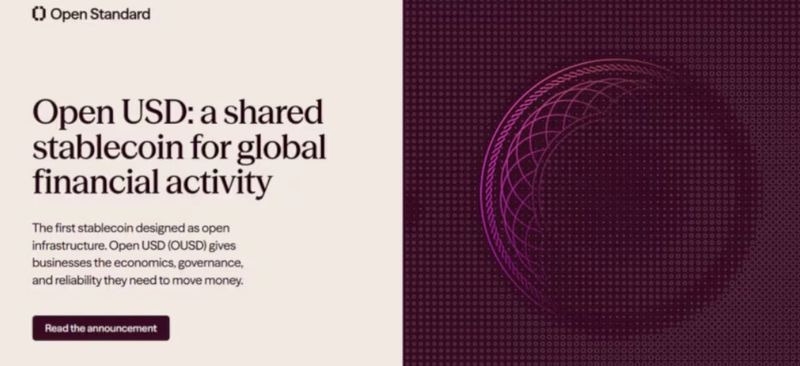
At the operational core of Open USD is a modular cloud compute architecture designed to handle enterprise-grade throughput without compromising decentralization. Traditional payment rails often buckle under sudden macroeconomic volatility, leading to settlement bottlenecks and widening spreads. Open USD integrates natively with cross-chain liquidity bridges and high-performance distributed ledgers, ensuring sub-second settlement finality and predictable gas optimization.
From a corporate finance perspective, deploying capital into digital assets historically involved steep friction regarding valuation tracking and internal accounting compliance. Open USD’s native reporting tools integrate seamlessly with enterprise resource planning (ERP) software, allowing chief financial officers to monitor real-time treasury yields, execute instant cross-border payroll, and reallocate liquidity across disparate operational subsidiaries with zero manual reconciliation.
| Metric / Feature | Legacy Stablecoins (USDT/USDC) | Open USD (July 2026 Standard) |
|---|---|---|
| Backing Partners | Centralized issuing entity / Limited primary banks | Consortium of 140+ global financial & tech partners |
| Compliance Framework | Reactive AML/KYC bolt-ons | Proactive, multi-jurisdictional embedded compliance |
| Liquidity & Settlement | Fragmented across siloed chains | Omnichain interoperability with real-time auditability |
| Enterprise ROI Potential | Minimal native treasury yield optimization | Advanced capital allocation & yield-bearing mechanics |
Industry & Market Implications: Winners and Losers
The introduction of a heavily backed, multi-partner stablecoin sends immediate shockwaves across the global financial ecosystem. The ripple effects will be felt across several critical verticals:
- Global Banking & Correspondent Networks: Traditional correspondent banking, notorious for multi-day settlement delays and exorbitant fees, faces accelerated disintermediation. Banks participating in the Open USD consortium stand to capture modern transaction flow, while legacy holdouts risk losing lucrative cross-border revenue streams.
- Crypto Exchanges & Market Makers: High-frequency trading desks gain an unprecedented tool for mitigating counterparty risk. With 140+ partners backing the asset, liquidity fragmentation across decentralized and centralized exchanges is minimized, tightening bid-ask spreads.
- Incumbent Stablecoin Issuers: Tether and Circle will face mounting pressure to upgrade their governance models, enhance reserve transparency, and offer competitive enterprise incentives to prevent corporate clients from migrating to Open USD.
Frequently Asked Questions (People Also Ask)
What makes Open USD different from existing stablecoins like USDT and USDC?
Open USD is distinguished by its decentralized backing consortium comprising over 140 global financial and enterprise partners. Unlike single-issuer stablecoins, Open USD is governed by a multi-institutional framework designed to ensure absolute regulatory compliance, real-time reserve transparency, and seamless integration with corporate ERP and treasury systems.
How does Open USD ensure absolute reserve safety and peg stability?
The asset maintains a 1:1 backing via high-quality liquid assets, primarily short-term U.S. Treasury bills and cash equivalents held across globally recognized custodian banks. Continuous, automated cryptographic and third-party attestations provide real-time proof-of-reserves, mitigating the risk of de-pegging events.
What are the primary use cases for enterprises adopting Open USD?
Enterprises utilize Open USD for instant cross-border trade settlement, frictionless vendor payments, automated payroll across multiple jurisdictions, and optimized treasury management. Its programmatic nature allows firms to earn predictable yields on idle cash balances while maintaining strict regulatory adherence.
Future Outlook: Milestones to Watch
As Open USD rolls out its foundational liquidity pools following its July 2026 debut, industry analysts will closely monitor several key performance indicators. First, the rate of onboarding for additional Tier-1 banking partners will signal the pace of traditional finance (TradFi) integration. Second, the expansion of native integration across major decentralized finance (DeFi) protocols and enterprise cloud environments will determine its transaction velocity.
Ultimately, Open USD represents a watershed moment for digital currency. By aligning the security of global banking syndicates with the boundless scalability of blockchain technology, it bridges the chasm between speculative crypto assets and institutional-grade financial infrastructure. For market participants seeking a reliable, compliant, and high-performance digital dollar, Open USD is rapidly becoming the definitive industry standard.