
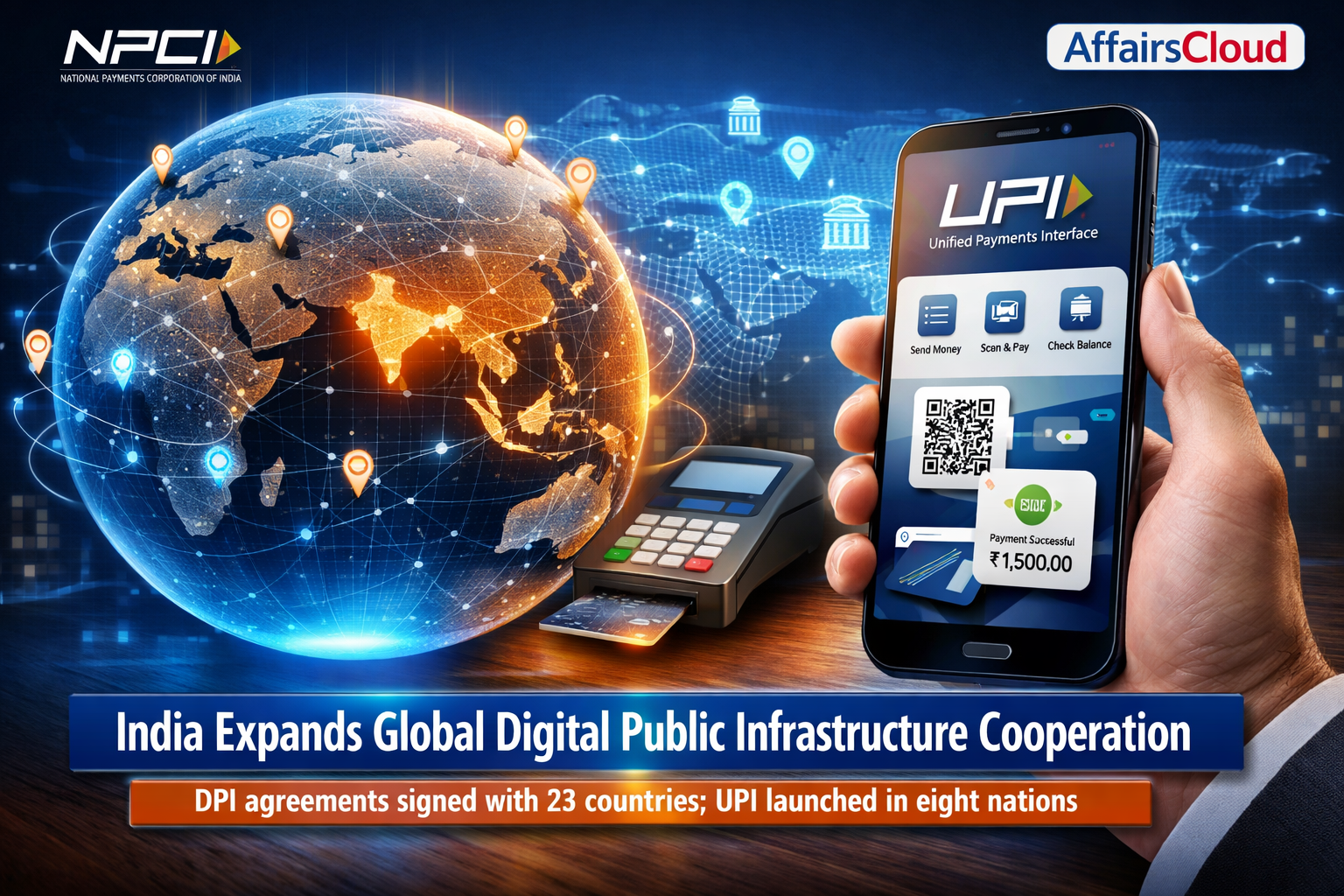
NEW DELHI — In a milestone shift for international monetary architecture, the Indian government confirmed on February 6, 2026, that its Digital Public Infrastructure (DPI) framework has crossed a major geopolitical threshold. India has successfully formalized DPI cooperation agreements with 23 sovereign nations, while its flagship real-time payment network, the Unified Payments Interface (UPI), has officially gone live in eight international markets. This dual rollout marks a defining moment in global fintech, challenging legacy Western-dominated payment rails, altering capital allocation models for emerging economies, and establishing a new playbook for state-backed technological sovereignty.
As state-backed digital infrastructure scales across continents, the implications for enterprise ROI, infrastructure scalability, and international regulatory compliance are profound. For multinational corporations, central banks, and institutional investors, India’s open-source modular stack—encompassing identity verification (Aadhaar), instant payments (UPI), and secure data exchange (Account Aggregator)—is no longer a localized domestic experiment. It is rapidly emerging as the gold standard for developing-world digitization.
Executive Takeaways
- Geographic Reach: India has signed formal DPI cooperation agreements with 23 countries, exporting its modular, low-cost digital governance stack.
- Live Deployments: The Unified Payments Interface (UPI) is now fully operational and live across eight international jurisdictions, facilitating instantaneous cross-border retail transactions.
- Strategic Shift: The export of India's "India Stack" bypasses traditional high-fee card networks (Visa, Mastercard) and SWIFT messaging dependencies, fundamentally altering global payment infrastructure scalability.
- Economic and Capital Impact: Developing economies adopting these interoperable standards reduce transaction friction, slash infrastructure deployment costs, and enhance market liquidity for micro, small, and medium-sized enterprises (MSMEs).
The Strategic Evolution of India's DPI Diplomacy
For over a decade, India's Ministry of Electronics and Information Technology (MeitY), the National Payments Corporation of India (NPCI), and the Reserve Bank of India (RBI) have quietly built and refined a tripartite digital foundation known colloquially as the India Stack. By unbundling identity, payments, and data, India solved critical structural bottlenecks that previously hindered financial inclusion and administrative efficiency.
By early 2026, this domestic triumph evolved into an aggressive, soft-power economic diplomacy engine. The signing of DPI cooperation agreements with 23 nations is not merely a diplomatic gesture; it represents a comprehensive framework for technology transfer, regulatory alignment, and cloud compute architecture cooperation. Developing nations, constrained by fiscal deficits and legacy banking software, find India's open-source, population-scale APIs an attractive alternative to proprietary Western enterprise software solutions.
The operationalization of UPI in eight nations—spanning parts of Southeast Asia, the Middle East, and Europe—demonstrates the technical robustness of the infrastructure. Unlike legacy wire transfers that incur high foreign exchange margins and take days to clear, UPI leverages instant account-to-account (A2A) rails. This real-time settlement capability drastically mitigates counterparty risk and frees up working capital for international traders and migrant workers alike.
Verified Data and Metrics Breakdown
| Metric Category | Status / Milestone (As of Feb 2026) | Strategic Impact |
|---|---|---|
| DPI Cooperation Agreements | 23 Sovereign Nations | Establishes bilateral frameworks for digital identity, data sharing, and foundational tech transfer. |
| UPI International Live Deployments | 8 Countries | Enables instant retail merchant payments and cross-border remittances without traditional intermediary lag. |
| Core Technology Architecture | Open-API, Modular Stack | Ensures high infrastructure scalability and low deployment costs for adopting governments. |
| Target Beneficiaries | Governments, MSMEs, Migrant Workers | Reduces remittance drag, cuts operational friction, and drives financial inclusion. |
Industry & Market Implications: Winners, Losers, and Capital Flows
The widespread adoption of India's DPI and UPI frameworks outside its borders triggers a major realignment of global financial revenue pools. Financial institutions and fintech investors must urgently reassess their risk mitigation models and valuation multiples in light of these shifting dynamics.
The Winners
Emerging Market Governments: Nations adopting the India Stack bypass the multi-year, multi-million-dollar software development cycles typically required to build national payment rails. They gain instant access to battle-tested security protocols and fraud-detection mechanisms.
Cross-Border Merchants and MSMEs: Lower interchange and processing fees directly boost profit margins. By integrating UPI rails, merchants in partner nations can accept payments from Indian tourists and business travelers seamlessly, driving local tourism and retail revenue.
Indian Fintech and Cloud Providers: Domestic technology firms, systems integrators, and cloud compute architecture providers positioned to deploy and maintain these stacks abroad stand to capture substantial enterprise service contracts.
The Losers
Legacy Card Networks and Intermediaries: Traditional card giants (Visa, Mastercard) and legacy cross-border remittance providers face long-term volume erosion. As sovereign nations adopt direct A2A instant payment rails, the rationale for paying 2% to 3% interchange fees on every transaction evaporates.
SWIFT Dependency: While high-value institutional banking still relies heavily on legacy messaging systems, the proliferation of sovereign retail and wholesale real-time payment corridors chips away at the absolute dominance of legacy international messaging networks.
Frequently Asked Questions (People Also Ask)
What exactly is a DPI cooperation agreement signed by India?
A Digital Public Infrastructure (DPI) cooperation agreement is a formal bilateral or multilateral memorandum of understanding where India agrees to share its technological blueprints, open-source codebases (such as MOSIP for identity or modular payment frameworks), and governance models with partner governments. This allows recipient nations to build their own sovereign digital identity, payment, and data-sharing systems without relying on expensive, proprietary Western tech monopolies.
How does UPI operate when it goes live in a foreign country?
When UPI goes live in a foreign jurisdiction, the NPCI partners with the host country’s central bank or designated domestic payment switch. Through Application Programming Interfaces (APIs), users from India can make direct payments at merchant locations abroad, or local citizens can utilize interoperable QR codes linked to supported banking networks, achieving real-time settlement across foreign exchange corridors.
Which countries currently support UPI and India's DPI framework?
While bilateral agreements encompass 23 nations across Africa, Asia, Europe, and Latin America, actual live retail deployment of UPI has successfully launched in eight specific international markets, including nations in Southeast Asia, the Middle East, and Europe, with continuous expansions scheduled throughout the fiscal year.
What are the economic benefits for nations adopting India's digital stack?
Adopting nations experience accelerated financial inclusion, drastically reduced costs for government welfare disbursement (eliminating leakage), lower merchant discount rates (MDR) for small businesses, and streamlined cross-border remittance channels that save billions in cumulative foreign exchange and transfer fees.
Future Outlook: Milestones and Strategic Horizons
As India looks past the February 2026 milestones, the trajectory of its DPI export strategy points toward deeper integration with central bank digital currencies (CBDCs) and multilateral real-time gross settlement (RTGS) linkages. The primary objective for the NPCI and regulatory bodies is to establish regional payment hubs that connect multiple national instant payment systems into a unified, borderless network.
For global investors and financial executives, monitoring the operational stability, regulatory harmonization, and cybersecurity resilience of these 23 partner nations will be paramount. As infrastructure scalability proves out in diverse geopolitical environments, India's digital public infrastructure is no longer just a domestic success story—it is rapidly becoming the foundational operating system for the 21st-century global digital economy.