Special Investigation | Global Macroeconomics & Fixed Income
The Term Premium Reckoning: Why Canada’s Bond Market Is Sending Shocks Through Global Portfolios
Test Our Free AI & Tech Utilities Suite
Calculate LLM API token costs, analyze article dwell-time, or simulate tech DCA returns.
By Eugene Trostin, James Ketcheson, and Antonio Diez de los Rios | Bank of Canada Insights / Global Financial Desk
Published: March 10, 2026 | 12-Minute Read
Executive Takeaways
- Structural Shift: The Canadian term premium has experienced a decisive upward trajectory, breaking years of post-global financial crisis suppression and mirroring broader G10 yield curve dynamics.
- Global Synchronization: Driven by persistent fiscal expansion, escalating sovereign debt issuance, and quantitative tightening (QT), Canadian sovereign debt is demanding higher compensation for duration risk.
- Corporate Fallout: Enterprise ROI, debt refinancing schedules, and corporate capital allocation strategies are being aggressively recalibrated as long-term borrowing costs decouple from central bank policy rates.
- Strategic Risk Mitigation: Institutional asset allocators are forced into complex duration matching, shifting away from long-duration sovereigns toward high-grade credit and infrastructure scalability plays.
Introduction: The Unraveling of the Yield Curve
For over a decade following the 2008 global financial crisis, investors operated in a macroeconomic regime defined by artificially compressed term premiums. Central banks across advanced economies—including the Bank of Canada (BoC), the Federal Reserve, and the European Central Bank—flooded the financial system with liquidity through successive rounds of quantitative easing (QE). This massive balance-sheet expansion absorbed enormous quantities of long-dated sovereign debt, driving yields downward and effectively subsidizing government borrowing costs worldwide.
That era has officially drawn to a close. As detailed in recent research from the Bank of Canada by Eugene Trostin, James Ketcheson, and Antonio Diez de los Rios, the Canadian term premium—the extra yield investors demand for holding long-term bonds instead of rolling over short-term bills��has broken out of its historic slumber. This structural reversal is not an isolated domestic phenomenon; it is a critical node in a synchronized global repricing of sovereign risk.
For corporate treasurers, institutional asset managers, and risk mitigation officers, understanding the anatomy of this rising term premium is no longer an academic exercise. It is an urgent operational necessity that directly impacts debt refinancing schedules, valuation multiples, and cross-border capital allocation.
Catalytic Events and Structural Drivers
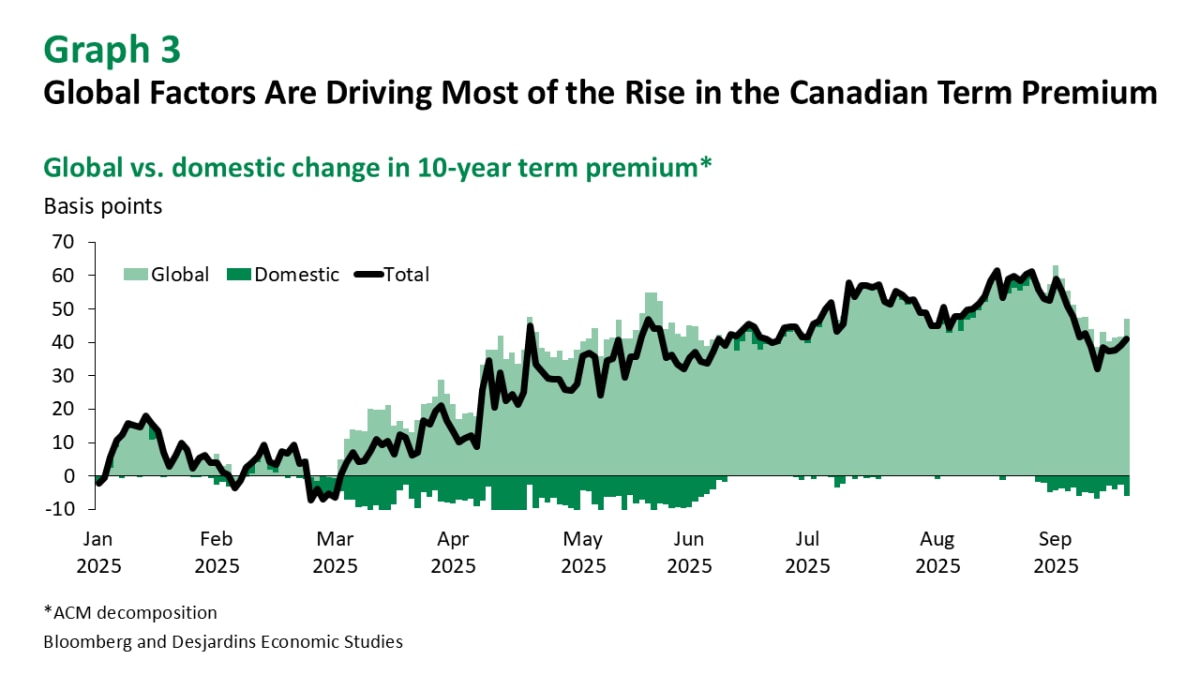
To comprehend the current expansion of the Canadian term premium, one must examine the confluence of fiscal, monetary, and structural pressures that have converged since the pandemic recovery. Unlike the short end of the yield curve, which remains tightly tethered to the Bank of Canada’s policy interest rate, the long end is governed by market sentiment, inflation expectations, and, crucially, supply-and-demand imbalances.
1. Unprecedented Sovereign Debt Issuance
Federal and provincial governments across Canada have sustained elevated fiscal deficits to fund public infrastructure, healthcare modernization, and defense initiatives. This surge in public spending requires massive, continuous issuance of Government of Canada (GoC) bonds. When the marginal supply of sovereign debt outstrips the organic demand from domestic pension funds and insurance companies, clearing the market requires higher yields. Investors demand a liquidity and duration risk premium to absorb this unrelenting wall of paper.
2. The Quantitative Tightening (QT) Paradigm Shift
The Bank of Canada’s balance sheet normalization has eliminated the single largest price-insensitive buyer of long-dated bonds. As maturing GoC holdings roll off the central bank's balance sheet without reinvestment, private sector investors must step in to bridge the gap. Without the artificial anchor of central bank purchases, price discovery has returned to the bond market with a vengeance, pushing the term premium higher toward historical norms.
3. Global Spillover Effects and Term Premia Synchronization
Canada’s bond market does not operate in a vacuum. The Canadian term premium exhibits high beta relative to US Treasury dynamics. As the US federal deficit expands past trillion-dollar milestones and long-term US Treasury yields face upward pressure, Canadian yields are dragged higher. Global investors continuously reallocate capital between North American debt markets based on currency-hedged spreads, ensuring that US term premium expansion is rapidly imported into Canadian financial assets.
Verified Data & Metrics Breakdown
The following comparative matrix illustrates the structural evolution of Canadian sovereign debt metrics against historical benchmarks and global peers, highlighting the scale of term premium expansion.
| Metric / Indicator | Post-GFC Average (2012–2019) | Pandemic Peak (2021–2022) | Current Environment (2026) |
|---|---|---|---|
| 10-Year GoC Term Premium (Est.) | -0.50% to -0.20% | -0.30% to +0.10% | +0.35% to +0.75% |
| 10-Year / 2-Year Yield Spread | +35 bps (Normal) | -60 bps (Inverted) | +25 bps (Steepening) |
| BoC Balance Sheet (% of GDP) | ~4% - 5% | ~25% (Peak QE) | ~8% (Post-QT Normalization) |
| Federal Debt-to-GDP Ratio | ~31% | ~47% | ~43% (Stabilizing with Higher Cost) |
Industry and Market Implications
The ascent of the Canadian term premium ripples across corporate boardrooms, banking balance sheets, and real estate markets. As the risk-free benchmark curve shifts upward, every asset class must be repriced.
Who Wins: Institutional Investors and Cash-Rich Enterprises
- Defined Benefit Pension Funds: Canadian pension plans, long plagued by underfunding risks during the era of negative real yields, can now match long-term liabilities with higher-yielding sovereign and high-grade corporate assets without taking excessive credit risk.
- Commercial Banks and Fixed Income Desks: Trading desks benefit from renewed yield curve steepening and heightened volatility, generating stronger net interest margins and trading revenues compared to the compressed margins of the late 2010s.
Who Loses: Highly Leveraged Corporates and Real Estate Developers
- Capital-Intensive Sectors: Telecommunications, utilities, and infrastructure players that rely heavily on long-term debt issuance face higher hurdle rates. Enterprise ROI calculations must be adjusted upward to justify capital allocation for greenfield projects.
- Commercial Real Estate (CRE): Property developers facing debt maturity walls are forced to refinance at substantially higher capitalization rates, putting downward pressure on property valuations and forcing equity recapitalizations.
Frequently Asked Questions (People Also Ask)
What exactly is a term premium, and why is it rising in Canada?
The term premium is the extra compensation investors demand for holding long-term bonds rather than holding a series of short-term bonds over the same period. It is rising in Canada due to increased federal and provincial bond issuance, the Bank of Canada's ongoing quantitative tightening, and synchronized global yield curve repricing driven by US fiscal pressures.
How does the Canadian term premium affect corporate borrowing costs?
While short-term borrowing costs track the Bank of Canada's policy rate, long-term corporate bond yields are benchmarked directly against Government of Canada bond yields plus a credit spread. As the term premium pushes long-term GoC yields higher, corporate debt issuance becomes more expensive, forcing firms to re-evaluate capital allocation and refinancing strategies.
Are central banks expected to intervene to lower term premiums again?
Central banks generally view term premium normalization as a healthy return to traditional market functioning. Barring severe financial market dysfunction or liquidity crises, major institutions like the Bank of Canada are unlikely to re-engage in large-scale asset purchases (QE) purely to suppress long-term borrowing costs, as doing so would conflict with inflation mandates.
Future Outlook and Strategic Milestones
As we navigate through 2026 and beyond, financial market participants must accept that structurally higher term premiums are the new baseline. The era of cheap, frictionless long-term leverage has been replaced by an environment where asset quality, balance sheet resilience, and capital discipline dictate market winners.
Key milestones to monitor include upcoming federal fiscal updates detailing deficit trajectories, Bank of Canada balance sheet runoff completion dates, and cross-border capital flows between US and Canadian debt instruments. Chief financial officers and institutional portfolio managers who successfully adapt their risk mitigation frameworks to this higher-term-premium reality will safeguard their enterprises against future macro shocks.