Executive Takeaways
- The Cross-Border Feedback Loop: Japan's domestic sovereign debt dynamics directly dictate American borrowing costs, capital allocation, and long-term US Treasury valuations.
- The Great Repatriation Risk: As the Bank of Japan normalizes monetary policy, Japanese institutional investors face immense incentives to repatriate trillions of dollars back to domestic bonds, draining liquidity from US markets.
- Systemic Risk Mitigation: Chief Investment Officers and corporate treasurers must recalibrate their risk management frameworks to account for sudden spikes in global yield correlations.
For decades, Wall Street has treated Tokyo as a predictable secondary actor in global monetary policy—a perpetual laboratory for quantitative easing, negative interest rates, and yield curve control. But as financial markets navigate the shifting macroeconomic landscape of 2026, a fundamental reality is shattering institutional complacency. According to recent analysis by senior economists at the American Enterprise Institute (AEI), spearheaded by Desmond Lachman, if there is one foreign financial ecosystem that holds the power to abruptly upend US financial markets, it is Japan. With an astronomical $8 trillion sovereign bond market sitting at the epicenter of international capital flows, any structural fracture in Japanese debt mechanics reverberates instantly through American corporate balance sheets, mortgage rates, and federal borrowing costs.
To understand why a nation thousands of miles away dictates the cost of capital in New York and Silicon Valley, one must examine the plumbing of global finance. For generations, Japanese institutional investors—including massive pension funds, insurers, and mega-banks—served as the primary shock absorbers for excess global liquidity. Facing an environment of structural deflation and near-zero yields at home, these capital allocators exported trillions of dollars into higher-yielding foreign assets, most notably US Treasuries, agency mortgage-backed securities, and blue-chip corporate debt. This symbiotic relationship kept American borrowing costs artificially suppressed, facilitating robust corporate capital allocation, expansive valuation multiples, and continuous infrastructure scalability across US industries.
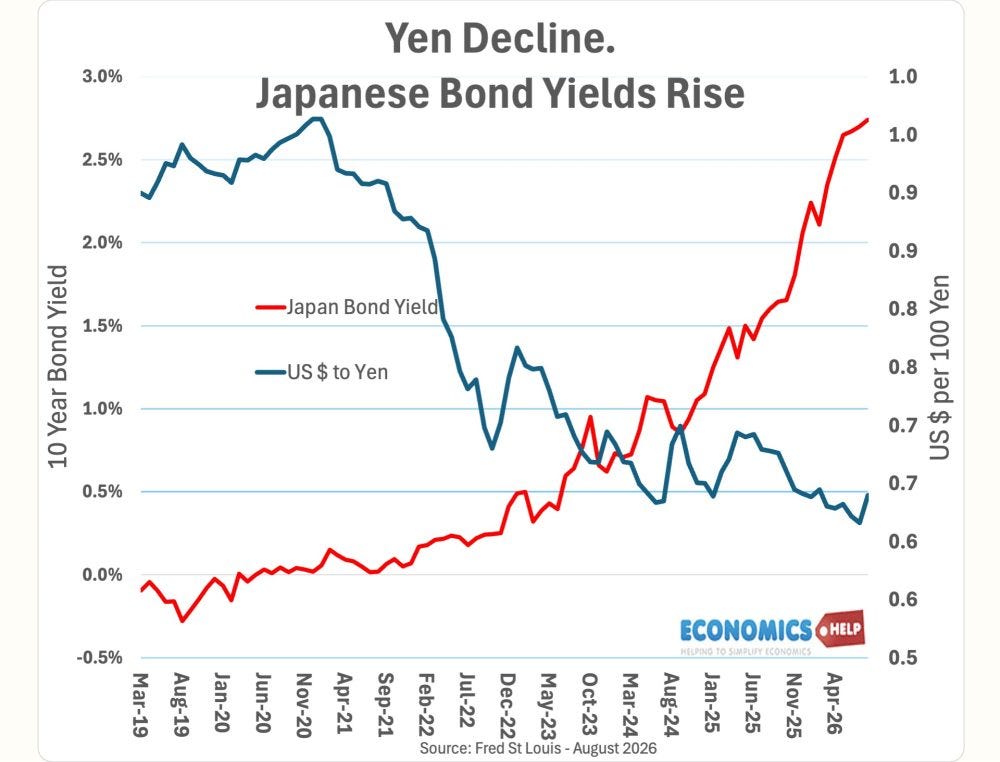
However, the macroeconomic paradigm has shifted decisively. Driven by persistent domestic wage growth and imported inflation, the Bank of Japan (BOJ) has abandoned its legacy of ultra-loose monetary accommodation. As Japanese sovereign yields climb off their historic floors, the gravitational pull of domestic fixed-income assets is transforming. Japanese institutions no longer face the imperative to chase foreign yield. Instead, they are evaluating the risk-adjusted returns of repatriating capital back into domestic Japanese Government Bonds (JGBs), where yields finally compensate for currency hedging costs. This structural realignment threatens to starve the US financial system of its most reliable foreign buyer base precisely as the US federal government grapples with unprecedented fiscal deficits.
The Mechanics of Global Contagion: From Tokyo to Wall Street
Test Our Free AI & Tech Utilities Suite
Calculate LLM API token costs, analyze article dwell-time, or simulate tech DCA returns.
When liquidity recedes from the US Treasury market, the ripple effects are immediate and systemic. Foreign official and private holdings of US government debt are not merely passive investments; they are the bedrock of market liquidity. As Japanese financial institutions scale back their US Treasury auctions participation or actively liquidate existing portfolios to manage duration risk at home, US yields face upward pressure independent of Federal Reserve rate decisions. This dynamic complicates risk mitigation strategies for CFOs and portfolio managers alike.
Consider the transmission channels:
- Corporate Borrowing Costs: As benchmark US Treasury yields drift upward due to reduced foreign absorption, corporate bond issuance pricing adjusts accordingly. Enterprises seeking capital for cloud compute architecture expansion, research and development, or mergers and acquisitions find themselves paying significantly higher coupons.
- Real Estate and Mortgage Pressures: The American housing market remains inextricably linked to long-duration yields. When Japanese capital retreats, 30-year fixed mortgage rates experience upward volatility, dampening real estate turnover and residential construction activity.
- Equity Valuation Compression: Higher risk-free rates compel equity analysts to re-evaluate discounted cash flow models. High-growth sectors, particularly technology enterprises trading on forward earnings multiples, are exceptionally sensitive to these shifts in global discount rates.
Furthermore, currency markets amplify these strains. The USD/JPY exchange rate acts as a high-frequency barometer for cross-border financial stress. A sudden strengthening of the yen—triggered by aggressive BOJ tightening or rapid unwinding of speculative carry trades—forces leveraged investors to liquidate US dollar-denominated assets to meet margin calls in Tokyo. This liquidity crunch can transform a localized bond market adjustment into a broad-based cross-asset selloff on Wall Street.
Verified Macroeconomic Data & Structural Metrics

To evaluate the scale of this interdependency, institutional risk teams must examine the underlying structural metrics governing US-Japan financial flows:
| Metric / Indicator | Japanese Financial System | US Financial System Impact | Systemic Significance |
|---|---|---|---|
| Sovereign Debt Size | ~$8 Trillion (JGB Market) | ~$28 Trillion (US Treasury Market) | Japan is the largest foreign holder of US sovereign debt. |
| Benchmark 10-Year Yield Shift | Rising from near-zero toward 1.0%+ | Direct upward pressure on US term premiums | Reduces foreign demand for US auctions. |
| Institutional Capital Allocation | Massive domestic asset base (Pension funds/Insurers) | Trillions deployed in US credit & equities | Repatriation risk threatens US market liquidity. |
| Policy Divergence Risk | BOJ monetary policy normalization | Federal Reserve rate path adjustments | Increases FX volatility and hedging costs. |
Industry & Market Implications: Winners and Losers
As the normalization of Japan's monetary policy gains structural momentum, corporate sectors across the United States will experience divergent fortunes. Understanding these microeconomic divisions is essential for asset managers optimizing portfolio construction.
The Losers: Highly Leveraged & Interest-Rate Sensitive Sectors
Industries reliant on continuous, low-cost debt refinancing—such as commercial real estate, speculative technology startups, and heavily indebted consumer discretionary firms—face acute margin compression. As Japanese investors pull back, domestic US banks must absorb a larger share of federal debt issuance, crowding out private sector credit creation and driving up debt-servicing costs.
The Winners: Capital-Rich Financial Institutions & Fixed-Income Desks
Conversely, financial institutions with robust balance sheets, sophisticated liquidity management platforms, and strong net interest margins stand to benefit from higher benchmark yields. Asset managers specializing in yield-alternative strategies and global macro hedge funds equipped to trade cross-currency volatility will find abundant alpha opportunities amidst the turbulence.
Frequently Asked Questions (People Also Ask)
Why does Japan’s bond market directly impact US interest rates?
Japan is historically one of the largest foreign creditors to the United States, holding massive quantities of US Treasuries. When Japanese bond yields rise due to BOJ policy tightening, domestic Japanese investors demand higher yields on foreign assets or choose to repatriate their capital back to Japan. This reduction in foreign demand for US debt forces US Treasury yields higher, which subsequently pushes up borrowing costs for American consumers and corporations.
What is the "Great Repatriation" risk in Japanese finance?
The Great Repatriation risk refers to the potential scenario where Japanese institutional investors—such as massive pension funds and life insurers—sell off foreign investments (including US Treasuries and equities) to reinvest in domestic Japanese Government Bonds now that local yields are rising. This shift removes a vital pillar of support from international capital markets.
How does the BOJ's monetary policy shift affect the US dollar?
As the Bank of Japan normalizes interest rates and moves away from negative or ultra-low rate policies, the Japanese yen typically strengthens against the US dollar. A stronger yen increases the cost of hedging for Japanese investors holding US assets and can trigger the unwinding of cross-border carry trades, creating volatility across global equity and debt markets.
What should corporate treasurers do to mitigate these macroeconomic risks?
Corporate treasurers and CFOs should prioritize liquidity preservation, lock in long-term fixed-rate debt before further yield curve steepening occurs, and conduct rigorous stress-testing on capital allocation models. Monitoring cross-border capital flows and foreign exchange hedging costs is critical for maintaining financial stability in an era of synchronized global monetary tightening.
Future Outlook: Critical Milestones to Monitor
Looking ahead, financial market participants must maintain vigilant oversight of several key leading indicators. The trajectory of Japanese core inflation, upcoming policy statements from the Bank of Japan board, and auction bid-to-cover ratios for both JGBs and US Treasuries will provide early warnings of stress.
Ultimately, the notion that domestic monetary policy occurs in a vacuum has been thoroughly discredited. As Lachman and other macroeconomists emphasize, Tokyo's sovereign debt market is not a localized curiosity; it is a load-bearing pillar of global financial architecture. For Wall Street professionals, ignoring the tremors in the Japanese bond market is no longer an option. Effective risk mitigation, strategic capital allocation, and rigorous macroeconomic forecasting require treating Tokyo and New York as two halves of a single, interconnected financial machine.