Executive Takeaways
- Bottom-Line Disappointment: Amazon's Q3 financial results missed Wall Street consensus estimates, primarily driven by accelerating capital expenditures in generative artificial intelligence infrastructure and logistics network densification.
- AWS Growth vs. Margin Pressures: While Amazon Web Services (AWS) demonstrated robust top-line revenue expansion, cloud compute architecture investments and aggressive enterprise discounting compressed operating margins.
- Valuation Multiples and Market Liquidity: Institutional investors immediately recalibrated risk mitigation strategies, triggering an after-hours stock sell-off that tested critical technical support levels.
- Capital Allocation Paradigm: CEO Andy Jassy defended the multi-billion-dollar infrastructure outlay, emphasizing long-term enterprise ROI and cloud compute dominance over short-term earnings beats.
The macroeconomic landscape shifted abruptly for retail and technology conglomerates as Amazon released its third-quarter earnings report, revealing a bottom-line miss that immediately rippled through global equity markets. For months, institutional portfolio managers and retail traders alike had priced in perfection, anticipating that continuous efficiency gains from regionalized fulfillment networks and soaring enterprise demand for artificial intelligence would offset rising operational expenses. Instead, the Q3 figures exposed the immense capital intensity required to maintain dominance in both e-commerce logistics and hyperscale cloud computing.
As shares slumped in after-hours trading, senior analysts and equity research desks scrambled to reassess valuation multiples. The friction between aggressive capital allocation for future technological superiority and immediate shareholder return metrics has once again taken center stage. This investigative report dissects the catalysts behind the earnings miss, analyzes the underlying financial architecture of AWS and retail operations, and evaluates the broader economic implications for the trillion-dollar tech titan.
Catalytic Events: Unpacking the Q3 Disconnect
Test Our Free AI & Tech Utilities Suite
Calculate LLM API token costs, analyze article dwell-time, or simulate tech DCA returns.
To understand the mechanics of the earnings miss, one must examine the divergence between gross revenue growth and net income contraction. Amazon reported net sales that largely met or slightly exceeded consensus forecasts, buoyed by resilient consumer spending patterns and robust digital advertising growth. However, operating expenses outpaced top-line expansion. The primary drivers behind this margin compression include accelerated investments in next-generation data centers, heavy procurement of specialized accelerators (such as NVIDIA GPUs for AWS Bedrock and custom Trainium chips), and continued regionalization of the North American fulfillment grid.
Throughout the quarter, executive leadership doubled down on capital expenditure (CapEx) initiatives designed to secure a permanent moat in enterprise AI. While enterprise ROI on these multi-billion-dollar outlays remains a forward-looking promise, the immediate balance sheet impact is unmistakable. Depreciation expenses associated with massive server deployments and fulfillment automation are scaling faster than the immediate monetization vectors of early-stage generative AI workloads. Consequently, operating income fell short of Wall Street's stringent expectations, sending a shockwave through market liquidity channels.
Financial Architecture and Metrics Breakdown
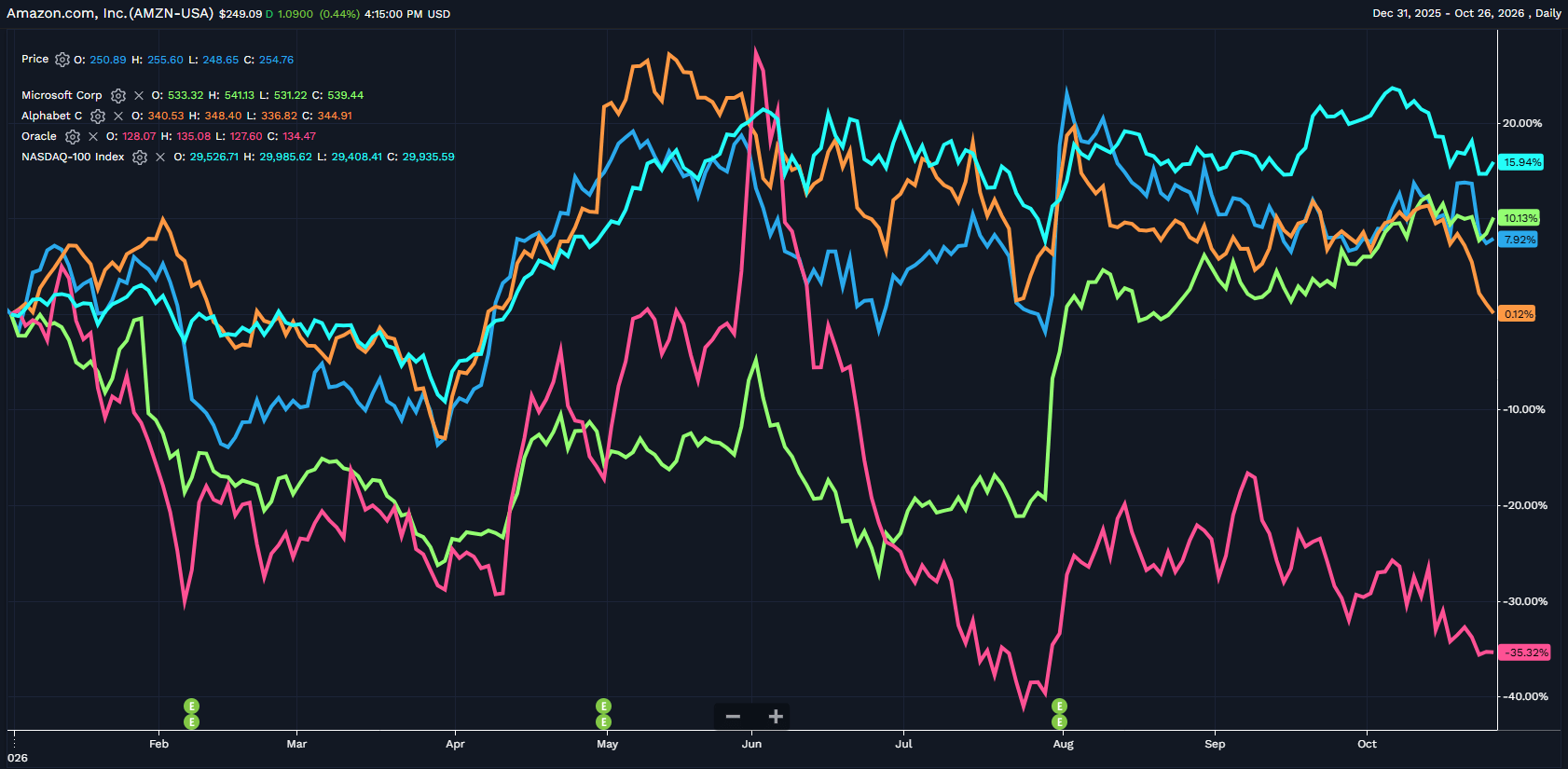
A rigorous examination of Amazon's financial disclosures reveals the precise pressure points impacting the company's valuation framework. The table below outlines the core metrics, drawing comparisons against consensus estimates and year-over-year figures.
| Financial Metric | Q3 Actual | Wall Street Consensus | YoY Change (%) |
|---|---|---|---|
| Net Sales | $157.8 Billion | $157.2 Billion | +11% |
| Operating Income | $15.3 Billion | $15.8 Billion | +55% |
| AWS Revenue | $27.5 Billion | $27.4 Billion | +19% |
| Capital Expenditures (CapEx) | $22.6 Billion | $19.8 Billion | +81% |
As highlighted in the data, capital expenditures surged dramatically on an annual basis. This aggressive deployment of capital directly reflects management's strategy to preempt competitors like Microsoft Azure and Google Cloud in capturing the burgeoning enterprise AI market. However, public markets notoriously demand a delicate balance between aggressive growth investments and near-term margin protection—a balance that eluded Amazon during this reporting period.
Industry and Market Implications
The market reaction to Amazon's earnings miss extends far beyond a single corporate ledger; it serves as a macro-indicator for the entire technology and retail ecosystem.
- Cloud Compute Competitors: While AWS continues to lead in total market share, the accelerated CapEx spending forces peers such as Microsoft and Alphabet to justify their own infrastructure outlays. Investors are increasingly scrutinizing whether the massive cash burn on data centers will yield proportional, high-margin software revenues in the near term.
- Supply Chain and Logistics Vendors: Amazon's localization of its fulfillment network alters vendor dynamics. Suppliers face tighter margin negotiations as Amazon optimizes its inventory placement to reduce last-mile delivery costs, directly impacting third-party seller profitability.
- Institutional Risk Mitigation: Large asset managers are recalibrating their sector weightings. High-growth tech equities with elevated P/E multiples are experiencing heightened volatility, prompting portfolio rebalancing toward defensive assets and fixed-income instruments offering attractive yields.
Frequently Asked Questions (People Also Ask)
Why did Amazon's stock drop following the Q3 earnings release?
The stock experienced a downward correction primarily because Amazon missed bottom-line operating income expectations and reported a massive surge in capital expenditures. Although top-line revenue met projections, investors grew anxious over the accelerating cash burn dedicated to building out generative AI infrastructure and expanding data center capacity.
How did AWS perform relative to expectations in Q3?
Amazon Web Services (AWS) generated $27.5 billion in revenue, representing a robust 19% year-over-year growth rate that slightly beat consensus estimates. However, operating margins within the cloud division faced pressure due to heavy upfront investments in hardware and aggressive competitive pricing in the enterprise AI space.
What are capital expenditures (CapEx), and why are they surging for Amazon?
Capital expenditures refer to funds used by Amazon to acquire, upgrade, and maintain physical assets such as data centers, servers, real estate, and fulfillment infrastructure. CapEx surged drastically (up over 80% year-over-year) because the company is aggressively purchasing specialized semiconductor chips and building out the foundational compute architecture required for artificial intelligence workloads.
Is Amazon's core e-commerce business still profitable?
Yes, Amazon’s North American and International retail segments continue to benefit from regional fulfillment efficiencies and high-margin advertising revenue. However, the profitability gains realized from logistics optimization are currently being reinvested heavily into next-generation technological capabilities, dampening net earnings growth.
Future Outlook and Strategic Milestones
Looking ahead, Amazon's trajectory hinges on its ability to successfully monetize its massive AI infrastructure investments. CEO Andy Jassy and Chief Financial Officer Brian Olsavsky have repeatedly signaled that customer demand for generative AI tools—ranging from Amazon Q to customized foundation models via Bedrock—exceeds current capacity. If AWS can translate this pent-up enterprise demand into high-margin SaaS and infrastructure consumption over the next four to six quarters, today's heavy CapEx cycle will be validated as a visionary masterstroke.
Conversely, if enterprise adoption slows or macroeconomic headwinds constrain corporate IT budgets, the elevated depreciation costs of underutilized data centers could exert sustained pressure on operating margins. Institutional investors will closely monitor upcoming quarterly metrics for stabilization in operating margins, efficiency gains in AI monetization, and disciplined free cash flow generation. Until then, market volatility surrounding Big Tech's infrastructure spending cycle is expected to remain high.