NEW YORK — For the first time in modern financial record-keeping, the sell-side research apparatus across institutional Wall Street has arrived at an extraordinary, monolithic verdict: not a single major equity strategist expects the U.S. stock market to finish 2026 in negative territory. According to the year-end Bloomberg News survey tracking 21 top equity prognosticators at premier global investment banks, precisely zero foresee a decline for the S&P 500 over the coming twelve months.
The milestone represents an absolute capitulation of the institutional bear. Heading into previous market cycles, divergent opinions routinely tempered sell-side sentiment, with cautious macro bears warning of impending recessions, multiple contractions, or liquidity crunches. As 2025 closes, however, that skepticism has entirely evaporated. Driven by resilient corporate balance sheets, accelerating enterprise artificial intelligence adoption, robust cloud compute infrastructure deployment, and expectations of sustained monetary accommodation from the Federal Reserve, the Street’s targets for the benchmark index range from moderate mid-single-digit advances to aggressive surges beyond the 7,000 threshold.
Yet behind the wall-to-wall optimism lies an unsettling reality that veteran market participants, portfolio risk officers, and hedge fund allocators are actively pricing in: absolute consensus has historically served as a dangerous contrarian indicator. When every sell-side desk aligns on the identical direction of travel, unexpected macroeconomic shocks, margin compression, and crowded positioning risk transforming minor systematic disruptions into aggressive market drawdowns.
Executive Takeaways
- Unprecedented 21-of-21 Consensus: Bloomberg’s definitive survey of 21 Wall Street equity strategists yields a 100% bullish outlook for 2026, marking the first time in tracked financial history that no sell-side bank predicts an annual decline for the S&P 500.
- Structural Fundamentals Powering the Bull: Projections rest on an anticipated 11% to 14% aggregate growth in S&P 500 earnings per share (EPS), underpinned by enterprise AI monetization, hyperscaler capital expenditure, and lower corporate borrowing costs.
- The Valuation Tightrope: Equities enter 2026 trading near historically elevated forward price-to-earnings (P/E) multiples of roughly 22x, leaving zero margin for regulatory crackdowns, structural inflation resurgence, or execution delays in high-capex cloud architectures.
- Contrarian Red Flags: Quantitative allocators caution that universal bullishness eliminates cash reserves on the sidelines, warning that when every market participant is already positioned long, incremental buying power deteriorates rapidly.
The Anatomy of Unanimity: Why Wall Street Abandoned the Bear Case
The collective embrace of the 2026 stock rally is not merely speculative exuberance; it is grounded in a synchronized recalibration of corporate cash-flow modeling. Sell-side equity research heads at Goldman Sachs, Morgan Stanley, JPMorgan Chase, Citigroup, and Bank of America have converged around a core macro premise: the transition of artificial intelligence from speculative infrastructure spending into tangible enterprise return on investment (ROI).
Throughout 2024 and 2025, capital allocation was dominated by semiconductor acquisitions, data center expansion, and massive cloud compute buildouts spearheaded by mega-cap hyperscalers. Heading into 2026, analysts forecast that non-tech sectors—including healthcare, industrials, retail banking, and logistics—will begin realizing material productivity dividends from these multi-billion-dollar outlays. Operating margins, which historically contract during mature economic expansions, are broadly projected to expand by 70 to 120 basis points as automated workflows, machine-learning-driven operational efficiencies, and lower wage pressures feed directly into bottom-line EPS figures.
Simultaneously, the monetary backdrop has shifted from a restrictive headwind to an accommodative tailwind. With global central banks continuing their synchronized easing cycle and corporate balance sheets successfully refinancing high-yield debt maturities without triggering a wave of defaults, liquidity conditions remain highly favorable. The cost of corporate debt capital has stabilized, encouraging a broad revival in debt-financed share repurchases and mergers and acquisitions (M&A), both of which mechanically support per-share equity valuations.
| Institution / Desk | 2026 S&P 500 Target | Implied Return | Projected 2026 EPS | Primary Thesis Driver |
|---|---|---|---|---|
| Morgan Stanley | 6,800 | +8.5% | $298 | Margin expansion driven by broad software automation |
| Goldman Sachs | 6,900 | +10.1% | $305 | Hyperscaler AI capex continuity & corporate buyback surge |
| JPMorgan Chase | 6,650 | +6.1% | $290 | Consumer resilience & financial sector net interest recovery |
| Evercore ISI | 7,200 | +14.9% | $315 | Structural labor productivity inflection via generative AI |
| Bank of America | 6,750 | +7.7% | $295 | Cash reallocation from money markets into equities |
The Valuation Dilemma: Priced for Absolute Perfection
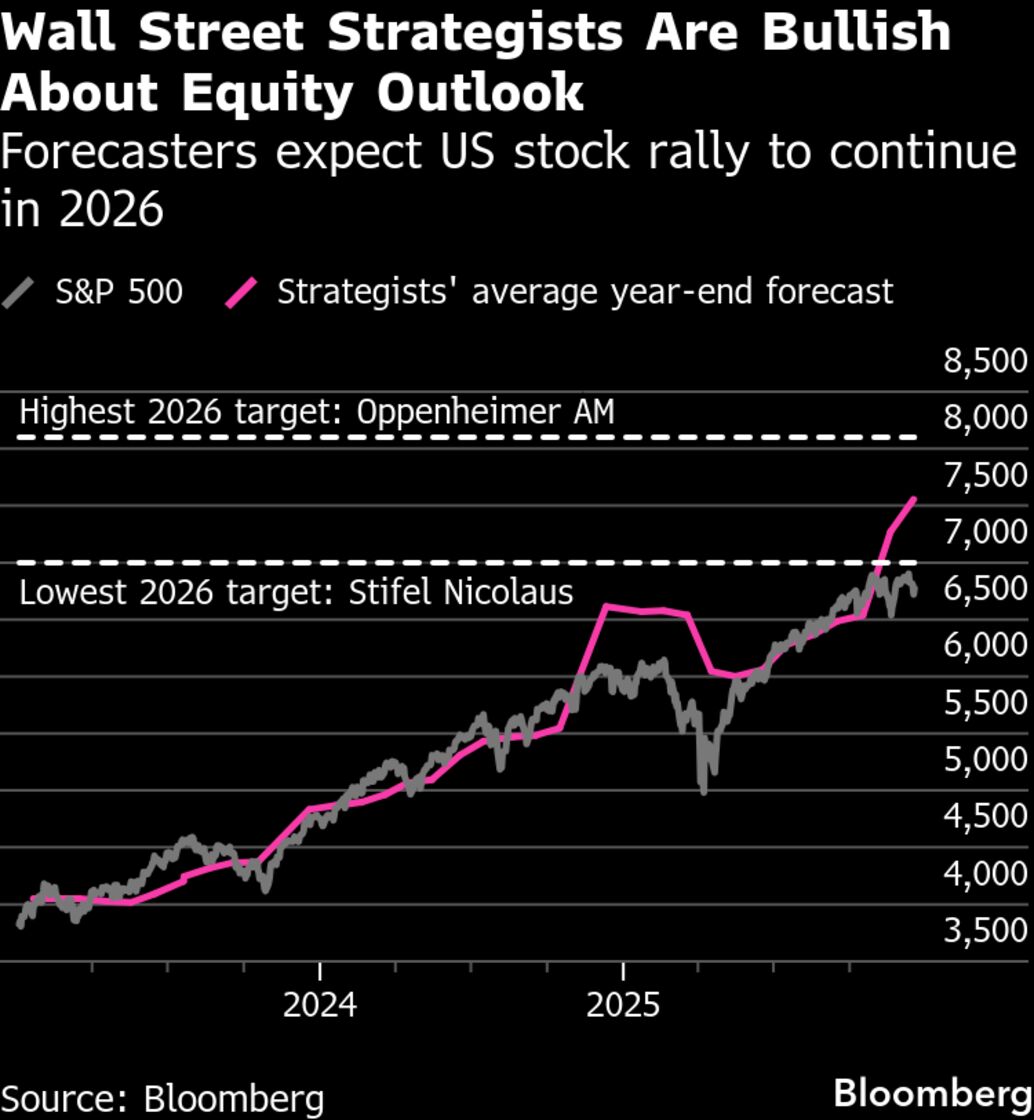
While the institutional consensus paints a serene path higher, quantitative analysts and valuation purists emphasize that equities are trading without any margin of safety. Entering 2026, the S&P 500 sits at an aggregate forward price-to-earnings multiple of roughly 22 times forward twelve-month earnings—a level seen only a handful of times over the last century, most notably during the late-1990s tech boom and the zero-interest-rate rebound of late 2020.
When valuation multiples are stretched to this extent, the equity risk premium (ERP)—the additional return an investor demands for choosing volatile equities over risk-free U.S. Treasuries—sinks to multi-decade lows. If long-term benchmark sovereign yields linger near 4.0% to 4.5%, an S&P 500 trading at 22 times earnings offers minimal risk-adjusted cushion. In this environment, any macro deviation from the consensus script has asymmetrical consequences.
The primary threat to this valuation construct is the persistence of sticky structural inflation. Should supply chain realignments, escalating tariff barriers, or sovereign debt deficits prevent global central banks from executing planned interest rate cuts, terminal discount rates will remain elevated. A compression of the S&P 500 multiple from 22x to historical norms of 18x would require corporate earnings to grow at improbable, near-record rates simply to keep the index flat—a dynamic the current 21-analyst survey completely discounts.
Historical Precedents: The Peril of Total Conformity
History suggests that when Wall Street strategists completely purge skepticism, the market tends to engineer sharp reality checks. The disappearance of dissenting views often coincides with structural peaks in investor sentiment rather than sustainable entry points.
In late 2007, heading into what would become the Global Financial Crisis, sell-side consensus largely anticipated continuous economic expansion driven by emerging market industrialization, almost uniformly dismissing structural fissures in mortgage-backed securitizations and banking solvency. Similarly, heading into 2022, after a massive liquidity-fueled bull run, the vast majority of institutional strategists predicted another positive year for the equity indices, failing to anticipate the most aggressive monetary tightening campaign in four decades that subsequently triggered a 19% plunge in the S&P 500 and a 33% crash in the Nasdaq Composite.
The danger is not necessarily that the analytical modeling behind the forecasts is flawed; rather, it is the behavioral consequence of crowded capital. When every major investment bank, asset manager, and retail wealth advisory model portfolio positions for a sustained rally, discretionary liquidity becomes fully deployed. Who remains to purchase equities at 23x or 24x forward earnings once the entirety of institutional capital is already fully allocated?
Winners, Losers, and Sector Divergence
Despite the monolithic headline targets for the benchmark index, the underlying composition of the 2026 market is expected to feature sharp divergence among individual sectors, capital structures, and asset classes.
The Structural Beneficiaries:
- Hyperscalers and Enterprise Software Providers: Companies delivering verifiable, monetizable AI applications and scalable cloud compute architecture are positioned to command premium multiples as corporate software budgets prioritize infrastructure upgrades.
- Tier-1 Investment Banks and Asset Managers: Increased liquidity, stabilizing credit conditions, and a revitalized equity underwriting and M&A pipeline provide strong, high-margin fee revenue for broad-line financial institutions.
- Advanced Infrastructure and Power Generation: With enterprise data centers consuming unprecedented levels of electricity, utility providers and clean energy infrastructure operators with long-term, utility-grade supply agreements are capturing defensive, inflation-protected revenue streams.
The Vulnerable Segments:
- Highly Leveraged, Unprofitable Tech: Speculative firms that survived on cheap capital but lack clear pathways to positive free cash flow face continued discount-rate pressure if benchmark bond yields refuse to collapse.
- Discretionary Consumer Retailers: Companies with limited pricing power that rely on mid-to-lower-income consumer brackets face margin erosion as cumulative post-pandemic price increases constrain discretionary spend.
- Commercial Real Estate Legacy Portfolios: Heavily indebted office and regional retail operators confronting multi-trillion-dollar debt rollovers at modern rates remain insulated from the broader market rally, facing aggressive debt restructurings and writedowns.
Frequently Asked Questions (People Also Ask)
Why are all Wall Street analysts predicting a stock rally in 2026?
Wall Street strategists are unanimously bullish due to a confluence of macroeconomic and corporate catalysts. Key drivers include accelerating earnings per share (EPS) growth fueled by enterprise artificial intelligence integration, resilient U.S. consumer balance sheets, an accommodative global monetary policy stance featuring anticipated rate reductions, and robust corporate capital allocation strategies dominated by aggressive share buybacks.
Has Wall Street ever achieved 100% bullish consensus before, and what happened?
Complete sell-side unanimity is historically rare. Periods of near-unanimous optimism—such as late 1999, late 2007, and late 2021—were often followed by significant volatility or bear markets. In financial markets, total consensus often indicates that market positioning is maxed out and good news has already been fully priced in, leaving equities vulnerable to unanticipated macroeconomic, regulatory, or geopolitical disruptions.
What are the primary risks that could derail the 2026 market rally?
The major downside catalysts include: structurally higher inflation that forces central banks to halt interest rate cuts; geopolitical instability disrupting critical supply chains; regulatory scrutiny targeting artificial intelligence hardware export controls or big tech anti-trust monopolies; and slower-than-expected corporate productivity gains from capital investments in cloud and compute infrastructure.
What is the average S&P 500 price target among the surveyed analysts for 2026?
Across the 21 analysts surveyed by Bloomberg News, the median S&P 500 target for year-end 2026 sits around 6,850, representing an estimated return of approximately 9% to 11% from late-2025 levels. High-end targets stretch as far as 7,200, while the most conservative institutional desks project modest single-digit appreciation toward 6,650.
Future Outlook: Strategic Milestones to Watch in 2026
As 2026 unfolds, institutional allocators will focus on hard metrics rather than sell-side narrative models. The first major inflection point will arrive during the Q1 2026 corporate earnings cycle, where enterprise clients must prove they are converting cloud compute and hardware outlays into operating revenue gains. If earnings growth fails to hit the double-digit thresholds demanded by 22x P/E multiples, equity valuations will come under immediate pressure.
Additionally, institutional eyes will remain fixed on sovereign bond auctions and central bank dot plots. Any re-acceleration of the Consumer Price Index (CPI) or wage inflation that restricts the Federal Reserve’s capacity to ease policy could destabilize the fundamental pillar supporting this historic, unanimous market thesis. For corporate treasury desks, asset managers, and retail investors, 2026 presents an environment where the path of least resistance appears decidedly upward—yet the risk of standing in an entirely unanimous trade has never carried higher stakes.